











 Secure payments
Standard refund policy
Trade Assurance
Secure payments
Standard refund policy
Trade Assurance
| Model | MT36HVS51272PZ-667H1 |
|---|---|
| Product Type | Memory Module |
| Compliance Standards | RoHS |
| Memory Capacity | 4 GB |
| Memory Technology | DDR2 |
| Product Voltage | 1.8V |
| RAM Speed | 667MHz |
| RAM Standard | DDR2-667/PC2-5300 |
| Error Identifying | ECC |
| Signal Type | Registered |
| Column Access Strobe (CAS) | CL5 |
| Rank | Dual Rank x4 |
| Quantity of Pins | 240-pin |
| RAM Genre | VLP RDIMM |
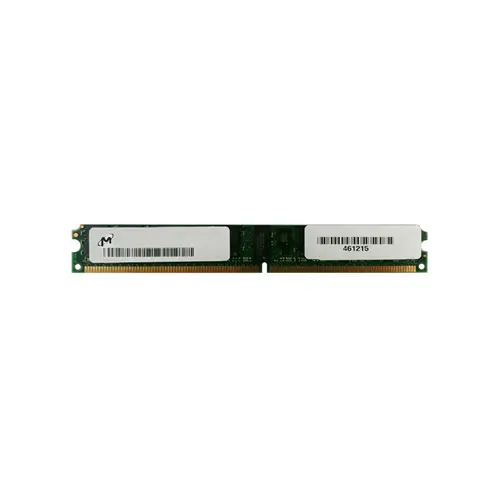
This Micron 4GB DDR2-667 VLP RDIMM is a server-class module featuring ECC and registered signaling, ideally suited for virtualization hosts or memory-intensive database servers where data integrity and signal stability across high-density configurations are critical. Its dual-rank x4 organization enhances command/address pipelining for improved throughput, while the very low-profile form factor allows dense 1U/2U deployments without clearance conflicts.
1. ECC error correction detects and corrects single-bit memory faults, preventing silent data corruption in mission-critical financial or database servers where data integrity is paramount.
2. Registered signal buffering stabilizes high-density memory configurations, enabling reliable operation under heavy workloads across multiple DIMMs in enterprise virtualization hosts.
3. VLP form factor fits seamlessly into space-constrained 1U and 2U rack servers, improving airflow and cooling efficiency in dense data center deployments.
4. Dual Rank x4 organization leverages interleaving to maximize bandwidth utilization, reducing latency during simultaneous access requests from multiple virtual machines.
5. 4 GB capacity per module supplies essential memory resources for legacy server applications, sustaining light database services or domain controller roles without excessive power draw.
When you are running a virtualized cluster or an in-memory database, memory errors are not an inconvenience; they are a threat to business continuity. The MT36HVS51272PZ-667H1 is a 4GB DDR2-667 VLP RDIMM purpose-built for legacy server platforms where stability and data integrity remain non-negotiable. Its ECC engine actively detects and corrects single-bit errors, preventing silent data corruption during marathon transactional processing—exactly what you need when a flipped bit in a Redis node could cascade into inaccurate analytics or even application crashes. Because this module uses registered logic, it buffers the command and address signals, which means you can populate all available DIMM slots across multiple ranks without overloading the memory controller. That signal isolation becomes critical in dense, multi-CPU servers handling dozens of virtual machines, where signal integrity directly dictates uptime. With a dual-rank x4 organization, the module interleaves access across internal banks, raising throughput under heavy loads—your database query caches stay responsive even while background VMs jostle for bandwidth. And its very low profile form factor solves a practical problem in 1U and blade chassis: you get full-function registered ECC memory that clears the obstruction of adjacent riser cards and keeps cooling airflow unimpeded, so your colocation investment doesn't overheat because of a memory stick that was too tall. In a legacy virtualization host or a memory-analytics appliance, these four characteristics work together to turn a simple DIMM refresh into a guarantee of predictable, error-resilient performance.
General Virtualization
For general virtualization using these 4 GB DDR2-667 registered ECC modules, balance capacity and channel symmetry. Deploy modules in matched pairs or quads across available memory channels — for example, four or eight DIMMs to reach 16 GB or 32 GB — ensuring each channel carries identical capacity for optimal interleaving. The registered ECC design and dual-rank x4 organization provide the stability needed for multiple guest VMs without compromising uptime.
In-Memory Database
In-memory databases demand maximum capacity and data integrity over raw speed. Populate all available DIMM slots with these VLP RDIMMs to reach the platform’s ceiling, often 32 GB on legacy dual-socket servers. The ECC and registered signalling protect in-memory datasets from bit errors, while dual-rank chips improve bank-level parallelism, partially offsetting the slower DDR2-667 clock during large table scans and frequent writes.
High Performance Computing
For HPC workloads, configure a uniform memory topology: install two identical 4 GB dual-rank RDIMMs per channel to sustain 667 MHz without throttling, as exceeding rank limits often forces speed downgrades. The very low-profile form factor aids cooling in dense 1U compute nodes. This arrangement balances memory bandwidth across banks and leverages ECC reliability, making it suitable for sustained floating-point and simulation jobs where computation accuracy is critical.
Rigorously tested for Dell PowerEdge 2970, HP DL385 G2, IBM x3655 servers.
Q: Can I mix this MT36HVS51272PZ-667H1 with other memory modules of different brands or speeds?
A: Mixing Registered ECC modules with different brands or speeds is not recommended. It may cause system instability or failure to POST. Use identical modules for guaranteed compatibility and reliability.
Q: Is this memory compatible with my server?
A: This DDR2-667 Registered ECC RDIMM typically suits older Intel 5000/5100 or AMD Socket F platforms. Verify your motherboard's QVL and support for 4GB RDIMMs before purchase.
Q: What is the recommended DIMM population order for optimal performance?
A: For this dual-rank RDIMM, populate per your server manual. Generally, fill the first slot of each memory channel (often white connectors) to enable interleaving and maximize throughput.
Q: Does this module support overclocking or XMP profiles?
A: No. As a server-grade Registered ECC DDR2 module, it adheres strictly to JEDEC standards. It does not support overclocking or XMP profiles, prioritizing stability.
Q: What warranty and typical failure rate can I expect?
A: This module includes a 1-year warranty. Its ECC Registered design ensures high reliability, with a typical annualized failure rate well below 0.5% under normal operating conditions.