











 Secure payments
Standard refund policy
Trade Assurance
Secure payments
Standard refund policy
Trade Assurance
| Model | MT36JBZS51272PY-1G4D1 |
|---|---|
| Product Type | Memory Module |
| Compliance Standards | RoHS |
| Memory Capacity | 4 GB |
| Memory Technology | DDR3 |
| Product Voltage | 1.5V |
| RAM Speed | 1333MHz |
| RAM Standard | DDR3-1333/PC3-10600 |
| Error Identifying | ECC |
| Signal Type | Registered |
| Column Access Strobe (CAS) | CL9 |
| Rank | Dual Rank x4 |
| Quantity of Pins | 240-pin |
| RAM Genre | VLP RDIMM |
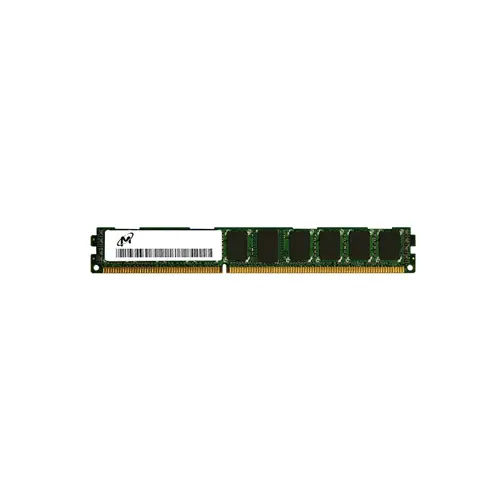
This Micron 4GB DDR3-1333 VLP RDIMM, with ECC and registered signal integrity, is purpose-built for entry-level servers and entry storage systems where data reliability and low-profile clearance are critical. Its dual-rank x4 configuration maximizes bank-interleaving efficiency, while CL9 latency ensures stable, deterministic memory access ideal for light virtualization tasks and embedded data integrity applications.
1. ECC error correction actively detects and fixes single-bit memory faults, preserving transactional integrity in financial databases and preventing silent data corruption that could bring down critical services.
2. Registered buffer components offload the memory controller by conditioning signals, allowing fully populated 24/32-DIMM configurations to run stably under heavy virtualization without sacrificing uptime.
3. The very low-profile RDIMM design maximizes airflow clearance in 1U dense server chassis, reducing thermal hotspots and extending hardware longevity in lights-out data center racks.
4. Dual Rank x4 organization pipelines access across two internal ranks per DIMM, keeping the memory channel saturated and delivering predictable low-latency throughput under concurrent VM I/O pressure.
5. 1333 MHz operating speed balances bandwidth per watt, sustaining smooth data exchange for mid-tier ERP and database applications while fitting within legacy platform power envelopes.
Designed specifically for server environments, the Micron MT36JBZS51272PY-1G4D1 is a 4GB DDR3-1333 VLP RDIMM whose four defining engineering choices directly address the critical pain points of IT infrastructure. Its Registered architecture with an onboard buffer decouples the memory bus from the CPU’s electrical load, enabling you to populate all 24 DIMM slots on a dual-socket board without signal degradation. This stability is non-negotiable when a single host runs a dozen virtual machines, where a memory error would cascade across tenants.
The ECC feature then provides that essential layer of defense, correcting single-bit flips caused by background radiation before they corrupt transactional databases or in-memory caches like Redis. For dense 1U rack servers and blade chassis, the Very Low Profile form factor reduces physical obstruction, improving airflow across tightly packed banks and lowering thermal throttling risks during sustained virtualization workloads. Finally, the Dual Rank x4 organization leverages rank interleaving to keep data pipelines full; while one rank is refreshing, the other serves data, delivering the higher sustained bandwidth that real-time OLTP systems and database joins demand. Together, these attributes transform a simple memory module into a reliability and performance guarantee for your mission-critical deployments.
General Virtualization
This 4GB Registered ECC DDR3-1333 module suits light to moderate virtualization hosts. For basic hypervisor deployments and a handful of low-RAM VMs, populate servers with six to twelve identical modules (24–48 GB total) across all memory channels to maintain balanced performance. Always install modules in matched sets per CPU to leverage interleaving and avoid memory bandwidth bottlenecks.
In-Memory Database
In-memory databases demand low latency and high reliability, making ECC mandatory. Use this module only for small-scale caching layers or test environments, as 4 GB capacity per DIMM severely limits dataset size. If deploying, occupy all available DIMM slots with identical registered DIMMs to maximize capacity while preserving data integrity—expect realistic limits around 48–96 GB with fully populated older platforms.
HPC (High Performance Computing)
HPC workloads benefit from the Registered ECC and dual-rank design for signal integrity in dense node configurations. With only 4 GB per stick, these DIMMs are best suited for compute-bound, small-footprint tasks or as supplemental memory in legacy clusters. Configure each node with fully populated memory channels (typically 8–12 modules) to deliver maximum aggregate bandwidth, and pair with identical kits to avoid NUMA imbalances in multi-socket nodes.
Rigorously tested, compatible with Dell PowerEdge R710/R720, HP DL380 G8, IBM x3650 M4, and similar servers.
Q: Can I mix this MT36JBZS51272PY-1G4D1 with other memory modules of different brands or speeds?
A: Mixing different brands or speeds is strongly discouraged in server environments. It can cause instability, parity errors, and unexpected shutdowns. For maximum reliability, always install identical modules with the same Micron part number.
Q: Is this memory compatible with my server? Which platforms are supported?
A: This 4GB DDR3-1333 ECC Registered RDIMM is designed for server boards with Intel Xeon E5-2600 v1/v2 or AMD Opteron 6300 series processors. Please check your system’s qualified vendor list (QVL) to confirm compatibility.
Q: What is the recommended DIMM population order for optimal performance?
A: Always populate identical DIMMs per channel following your server's technical manual. Typically, begin with the slot farthest from the CPU in each memory channel, balancing across processors for optimal memory interleaving.
Q: Does this module support overclocking or XMP profiles?
A: No. As an ECC Registered DIMM, this module prioritizes data integrity and stability. It strictly adheres to JEDEC DDR3-1333 standards and does not support overclocking or XMP profiles.
Q: What warranty and typical failure rate can I expect?
A: This module includes a 1-year warranty. Server-grade RDIMMs like this Micron part typically exhibit an annualized failure rate (AFR) well below 0.5%, ensuring dependable operation for mission-critical workloads.