











 Secure payments
Standard refund policy
Trade Assurance
Secure payments
Standard refund policy
Trade Assurance
| Model | MT36JDS1G72PDZ-1G1M1 |
|---|---|
| Product Type | Memory Module |
| Compliance Standards | RoHS |
| Memory Capacity | 8 GB |
| Memory Technology | DDR3 |
| Product Voltage | 1.5V |
| RAM Speed | 1066MHz |
| RAM Standard | DDR3-1066/PC3-8500 |
| Error Identifying | ECC |
| Signal Type | Registered |
| Column Access Strobe (CAS) | CL7 |
| Rank | Dual Rank x8 |
| Quantity of Pins | 240-pin |
| RAM Genre | RDIMM |
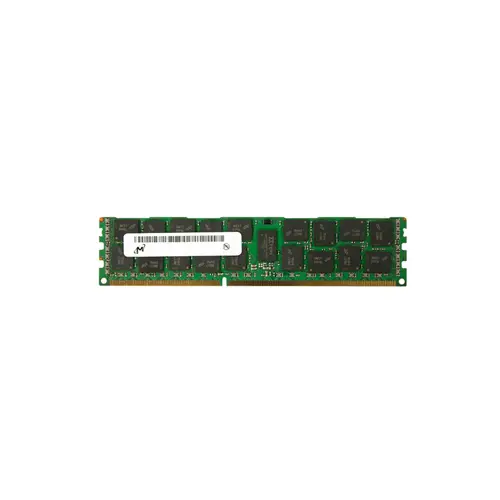
This Micron 8GB DDR3-1066 RDIMM, with its Registered architecture and ECC, is engineered for entry-level servers and small business virtualization platforms where data integrity is non-negotiable. The dual-rank x8 organization combined with CL7 latency provides a balanced mix of capacity interleaving and low response times, making it suitable for memory-resident databases and light multi-tenant workloads.
1. Registered DIMM architecture buffers command and control signals, enabling stable operation across fully populated memory channels in dense virtualization clusters.
2. ECC protection continuously detects and corrects single-bit errors, preserving data integrity during prolonged financial transaction processing or database hosting.
3. Registered signaling minimizes electrical loading on the memory controller, allowing servers to scale to high total memory capacities without compromising signal reliability.
4. Dual Rank x8 organization interleaves accesses across internal ranks, boosting sustained bandwidth and reducing latency under heavy multi-tenant workloads.
5. The module’s capacity provides a balanced memory footprint for entry-to-mid-level application servers, supporting smooth concurrent execution of web services and lightweight containers.
The module with MPN MT36JDS1G72PDZ-1G1M1 is unmistakably a server-class RDIMM, and for the modern data center, its four distinguishing characteristics directly translate to infrastructure resilience and workload performance. In a dense virtualization cluster running dozens of VMs on a single hypervisor, a silent bit-flip in unprotected memory can cascade into data corruption across guest operating systems. The integrated ECC engine detects and corrects single-bit errors in real time, protecting your multi-tenant environment from costly silent failures. That error correction is only sustainable at scale because the registered buffer re-drives address and command signals, stabilizing communication when all 24 DIMM slots are populated—a configuration impossible for unbuffered memory. Moreover, this module’s dual-rank design embeds two independent sets of DRAM banks on each stick. While one rank is busy refreshing, the memory controller can access the other, delivering the sustained bandwidth that an in-memory database like SAP HANA or Redis demands for sub-millisecond transactions. Even the CAS latency of seven cycles ensures deterministic response at 1066MT/s, reducing tail latency for latency-sensitive financial analytics. This isn’t just an 8GB DDR3-1066 component; it’s a building block for data integrity, maximum memory density, and the predictable throughput your enterprise applications rely on under constant load.
General Virtualization
Deploy identical 8 GB ECC Registered RDIMMs across all memory channels symmetrically. For a typical dual‑socket server using triple‑channel architecture, start with six modules (48 GB) and scale to twelve (96 GB) to host a moderate number of virtual machines. Balanced channel population enables memory interleaving, improving throughput and reliability for mixed VM workloads.
In‑Memory Database
Maximize capacity by fully populating every DIMM slot with these 8 GB dual‑rank modules, reaching 128 GB to 256 GB on supported platforms. Distribute modules evenly between CPU sockets to maintain uniform NUMA latency, ensuring the entire dataset resides in RAM without performance‑sapping swap access.
High Performance Computing
Populate one 8 GB RDIMM per memory channel—six modules on a triple‑channel system—to achieve full channel interleaving and peak bandwidth. If greater capacity is necessary, add a second matched module per channel while monitoring for possible frequency adjustments. Balanced socket distribution ensures consistent bandwidth for parallel, compute‑intensive tasks.
Rigorously tested server memory; compatible with Dell PowerEdge R710, HP DL380 G7, IBM x3650 M3.
Q: Can I mix this MT36JDS1G72PDZ-1G1M1 with other memory modules of different brands or speeds?
A: Mixing RDIMMs of different brands, speeds, or ranks is not recommended for server environments. It may cause instability or system hangs. Use identical Micron-certified modules to guarantee reliable ECC operation and performance.
Q: Is this memory compatible with my system? (Please specify Intel or AMD server platform.)
A: This 8GB DDR3-1066 Registered ECC RDIMM requires a server motherboard supporting dual-rank x8 modules and 1.5V. It is validated on Intel Xeon 5500/5600 series and AMD Opteron 6100/6200 platforms. Always check your system's QVL list.
Q: What is the recommended DIMM population order for optimal performance?
A: Populate identical DIMMs per channel starting from slot 1 (farthest from CPU). For dual-socket servers, balance memory across CPUs. Follow the system-specific user guide to maintain memory interleaving and avoid NUMA penalties.
Q: Does this module support overclocking or XMP profiles?
A: No. This is a JEDEC-compliant registered ECC server memory operating at 1066MHz CL7. It does not support overclocking, XMP, or SPD programming profiles. Stability and data integrity are prioritized over performance tuning.
Q: What warranty and typical failure rate can I expect?
A: This Micron module includes a 1-year warranty. Enterprise-grade components ensure an annualized failure rate (AFR) well below 1%, designed for 24/7 operation in registered server environments with rigorous testing and ECC protection.