

 Secure payments
Standard refund policy
Trade Assurance
Secure payments
Standard refund policy
Trade Assurance
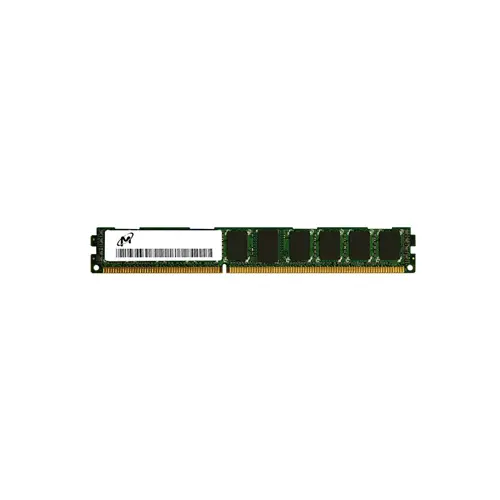
| Model | MT36JSF1G72PDZ-1G1D1 |
|---|---|
| Product Type | Memory Module |
| Compliance Standards | RoHS |
| Memory Capacity | 8 GB |
| Memory Technology | DDR3 |
| Product Voltage | 1.5V |
| RAM Speed | 1066MHz |
| RAM Standard | DDR3-1066/PC3-8500 |
| Error Identifying | ECC |
| Signal Type | Registered |
| Column Access Strobe (CAS) | CL7 |
| Rank | Quad Rank x8 |
| Quantity of Pins | 240-pin |
| RAM Genre | RDIMM |
This 8GB DDR3-1066 registered ECC RDIMM is purpose-built for server platforms running virtualization and memory-intensive database workloads where data integrity is non-negotiable. Its Quad Rank x8 configuration maximizes per-channel capacity, while the combination of ECC error correction, registered signal buffering, and low CL7 latency ensures reliable, high-density operation under sustained heavy loads.
1. ECC actively scrubs single-bit memory faults in real time, preserving result accuracy for financial simulations that run uninterrupted for weeks.
2. Registered logic isolates the memory controller from DRAM loads, allowing fully populated 24-slot servers to operate with rock-solid signal integrity.
3. Quad Rank x8 organization doubles the logical bank count, improving memory page hit rates and sustaining throughput in heavily consolidated SQL instances.
4. An 8 GB RDIMM base capacity simplifies scaling to 192 GB in a typical dual-processor server, comfortably meeting the memory footprint for mid-tier ERP platforms.
5. The 1066 MT/s transfer rate aligns with proven enterprise Xeon platforms, delivering deterministic latency that simplifies capacity planning for latency-sensitive telecom workloads.
The MT36JSF1G72PDZ-1G1D1 is unmistakably a server-grade module—an RDIMM with ECC and Registered buffering designed for enterprise workloads. In this environment, the first critical differentiator is ECC error correction. A single bit flip in a virtualized cluster can silently corrupt guest memory, cause an entire hypervisor to crash, or propagate undetected data errors into a database; ECC actively detects and corrects these single-bit events, preserving the integrity of transactional and analytic workloads around the clock.
The second pillar is the Registered buffer. By electrically isolating the DRAM from the memory controller, it stabilizes high-density configurations and lets a server populate all channels without signal degradation. For a virtualized host running 40 or more VMs, this means reliable 96 GB or 128 GB footprints with Quad Rank modules like this one—the third essential trait. Quad Rank x8 topology packs more 8 GB capacity into a single DIMM, maximizing memory slots so that in-memory databases such as SAP HANA or Redis can hold entire datasets, boosting query throughput without resorting to slow storage.
Finally, the CAS 7 latency delivers a tangible advantage. In a latency-sensitive in-memory database, each nanosecond saved on a cache miss directly lowers response time. Together, ECC, Registered buffering, Quad Rank density, and tight CL7 timing form a foundation that keeps virtualization clusters stable, accelerates memory-hungry applications, and protects your data from silent corruption—transforming raw specifications into real operational resilience.
General Virtualization
For general virtualization, populate all memory channels identically with these 8 GB quad-rank RDIMMs to enable balanced interleaving and maximize throughput. A common starting point is six modules (48 GB) in a dual-socket server with triple-channel architecture, scaling to twelve modules (96 GB) or more as VM density increases. Keep spare DIMM slots open for future expansion, but always install modules in matched sets per CPU to avoid NUMA penalties.
In-Memory Database
In-memory databases like SAP HANA or Redis demand the largest possible capacity. Using multiple 8 GB registered DIMMs, aim for the platform’s maximum—typically 192 GB (24 modules) or 384 GB in quad-socket designs—to hold entire datasets in RAM. Although DDR3-1066 is not the fastest grade, the ECC and registered signaling ensure data integrity under continuous load, making these modules suitable for capacity-optimized database nodes.
High-Performance Computing
HPC workloads benefit from high memory bandwidth, so install these RDIMMs in a configuration that fills every channel with a single module (1DPC) to maintain 1066 MHz speed. For double-precision simulations, a six-module (48 GB) or twelve-module (96 GB) triple-channel setup per node delivers solid bandwidth per core. Always use identical quad-rank modules to prevent timing conflicts, and rely on ECC to detect silent data corruption during long-running parallel jobs.
Rigorously validated server memory, compatible with Dell PowerEdge R710, HP ProLiant DL380 G7, and IBM System x3550 M3.
Q: Can I mix this MT36JSF1G72PDZ-1G1D1 with other memory modules of different brands or speeds?
A: Mixing is not recommended. For stable ECC Registered operation, all modules should match in speed, rank, voltage, and preferably be identical part numbers. Mismatched DIMMs risk system errors.
Q: Is this memory compatible with my system? Which Intel or AMD platforms does it support?
A: It is a DDR3-1066 RDIMM for servers. Compatible with Intel Xeon 5500/5600 series and AMD Opteron 4100/6100 platforms. Verify your motherboard's QVL for this 8GB Quad Rank Registered DIMM.
Q: What is the recommended DIMM population order for optimal performance?
A: Follow your server board’s population guide. Typically, populate identical RDIMMs starting from the first slot of each memory channel. Quad Rank modules may limit maximum DIMMs per channel; consult the manual.
Q: Does this module support overclocking or XMP profiles?
A: No. This is a server-grade Registered ECC DIMM operating strictly at JEDEC standard DDR3-1066. It does not support overclocking or XMP profiles, prioritizing reliability and data integrity.
Q: What warranty and typical failure rate can I expect?
A: This module includes a one-year warranty. As a rigorously tested server component, its annualized failure rate (AFR) is very low under specified conditions, ensuring dependable long-term operation.