











 Secure payments
Standard refund policy
Trade Assurance
Secure payments
Standard refund policy
Trade Assurance
| Product Type | Memory Module |
|---|---|
| Compliance Standards | RoHS |
| Memory Capacity | 8 GB |
| Memory Technology | DDR3 |
| Product Voltage | 1.5V |
| RAM Speed | 1333MHz |
| RAM Standard | DDR3-1333/PC3-10600 |
| Error Identifying | ECC |
| Signal Type | Registered |
| Column Access Strobe (CAS) | CL9 |
| Rank | Dual Rank x4 |
| Quantity of Pins | 240-pin |
| RAM Genre | RDIMM |
This DDR3-1333 Registered ECC DIMM (8GB, dual rank x4) is a server-grade module purpose-built for entry-level virtualization, light in-memory databases, and other data-integrity-critical workloads on legacy platforms requiring registered signal buffering. Its dual-rank configuration improves command/address bus efficiency under multi-DIMM setups, while ECC and registered signaling jointly eliminate single-bit errors and enhance electrical stability in 24/7 operation.
1. ECC correction actively hunts and fixes single-bit errors in real time, preserving transactional accuracy for database and financial workloads where even one corrupted bit is unacceptable.
2. Registered buffering eases the electrical strain on the server’s memory controller, letting fully loaded multi-DIMM platforms maintain rock-solid stability under 24/7 operation.
3. Dual Rank x4 interleaving doubles the internal bank groups accessible to the CPU, maximizing bandwidth efficiency and smoothing out response times when juggling dozens of virtual machines.
4. 8 GB capacity per module provides the density sweet spot for virtualized hosts, packing enough headroom to run numerous light to medium VMs without immediate hardware refreshes.
5. 1333 MHz speed drives a steady 10.6 GB/s per channel, delivering consistent, predictable throughput for concurrent enterprise applications rather than chasing peak burst rates.
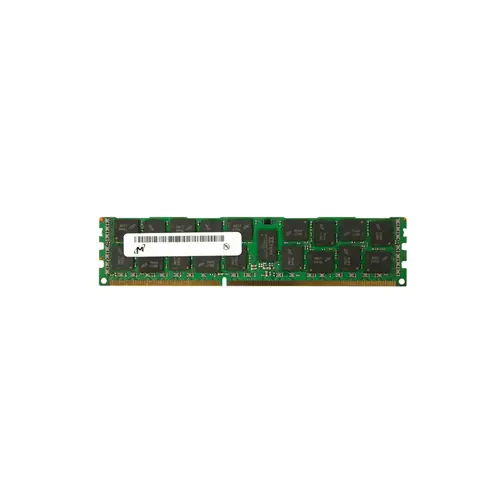
The Micron MT36JSF1G72PZ-1G4M1HF is an 8 GB DDR3-1333 registered DIMM with ECC, purpose-built for server infrastructures where silent data errors and instability are simply unacceptable. In a virtualized cluster running dozens of mixed-workload VMs, ECC protection becomes your first line of defense: it constantly detects and corrects single-bit memory flips caused by background cosmic radiation, preventing a flipped bit from corrupting a database transaction or crashing a live migration. The registered buffer then ensures rock-solid signal integrity when all memory channels are fully populated, so your hypervisor can scale to hundreds of gigabytes without intermittent faults. Meanwhile, the dual-rank x4 organization enables aggressive bank interleaving, which directly translates into higher sustained bandwidth when multiple virtual machines or an in-memory database like Redis hammer the memory controller with parallel requests. Combined with a dependable 1333 MT/s speed at CL9 latency, this memory keeps online transaction processing snappy and consistent without introducing jitter. For a database server holding financial records or a multi-tenant private cloud, these four design elements turn raw capacity into a safeguard for data integrity, stable consolidation, and uninterrupted business operations.
General Virtualization
Populate at least one 8 GB RDIMM per memory channel on each socket to maintain balanced access. A common dual-socket build with 8 DIMMs (64 GB) supports moderate VM densities, while scaling to 16 DIMMs (128 GB) accommodates heavier consolidation without dropping the 1333 MHz speed. Always match channels symmetrically to avoid NUMA penalties.
In-Memory Database
Maximize capacity by filling each channel with two or three 8 GB RDIMMs. On a typical dual-socket platform, three DIMMs per channel (24 modules) deliver 192 GB, keeping entire datasets in RAM. The dual-rank x4 design enhances rank interleaving for lower latency, while ECC Registered integrity safeguards transactional data.
HPC
For bandwidth-sensitive jobs, install one 8 GB RDIMM per channel (32 GB per socket) to sustain peak 1333 MHz frequency. If capacity bottlenecks arise, move to two DIMMs per channel (64 GB per socket) to balance higher memory volume with acceptable latency. Symmetric population across all CPU memory controllers guarantees uniform performance, and ECC prevents silent data corruption.
Strictly tested. Compatible with Dell PowerEdge R720/R620, HP DL380p Gen8, Lenovo System x3650 M4.
Q: Can I mix this MT36JSF1G72PZ-1G4M1HF with other memory modules of different brands or speeds?
A: Mixing RDIMMs of different brands or speeds is not advised. It can cause signal instability and disable ECC, forcing the system to the lowest common speed or preventing boot.
Q: Is this memory compatible with my server?
A: It suits Intel Xeon E5-2400/E5-2600 v1/v2 platforms and AMD Opteron systems requiring 240-pin, 1.5V DDR3-1333 Registered ECC memory. Verify vendor-qualified list for your board.
Q: What is the recommended DIMM population order for optimal performance?
A: Populate identical ranks per channel, balancing across memory controllers. Follow your server manual's slot numbering; typically, fill matching slots in banks for symmetric multi-channel RDIMM access.
Q: Does this module support overclocking or XMP profiles?
A: No. This is a JEDEC-compliant, server-grade RDIMM with ECC. Overclocking or XMP is unsupported and may endanger data integrity and system stability.
Q: What warranty and typical failure rate can I expect?
A: It includes a 1-year warranty. As a rigorously validated Enterprise RDIMM, its estimated annualized failure rate (AFR) is under 0.2% in normal operating conditions.