











 Secure payments
Standard refund policy
Trade Assurance
Secure payments
Standard refund policy
Trade Assurance
| Product Type | Memory Module |
|---|---|
| Compliance Standards | RoHS |
| Memory Capacity | 8 GB |
| Memory Technology | DDR3 |
| Product Voltage | 1.5V |
| RAM Speed | 1866MHz |
| RAM Standard | DDR3-1866/PC3-14900 |
| Error Identifying | ECC |
| Signal Type | Registered |
| Column Access Strobe (CAS) | CL13 |
| Rank | Dual Rank x4 |
| Quantity of Pins | 240-pin |
| RAM Genre | RDIMM |
This registered DDR3-1866 RDIMM with ECC is engineered for server platforms, delivering enhanced data integrity and stability for virtualization and memory-intensive workloads like in-memory databases. Its dual-rank x4 configuration and low CL13 latency ensure high bandwidth efficiency, while the registered signal buffering minimizes electrical load on the memory controller, enabling reliable operation in dense multi-DIMM server deployments.
1. End-to-end error correction safeguards data integrity in mission-critical databases, preventing silent corruption that could compromise transactional accuracy.
2. The register buffer offloads the memory controller, enabling stable multi-DIMM configurations that are essential for high-density server deployments.
3. Elevated clock speed drives superior memory bandwidth, accelerating in-memory analytics and reducing latency for concurrent virtual machine requests.
4. Dual-rank organization with an optimized device width exploits bank-level parallelism, sustaining consistent throughput even under mixed high-contention workloads.
5. A modest capacity fits dedicated lightweight appliance roles and entry-level virtualization nodes, keeping per-socket power profiles lean without sacrificing essential service headroom.
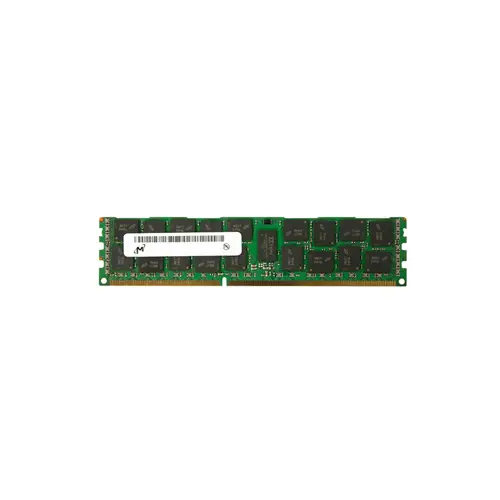
The MT36JSF1G72PZ-1G9K1H is an 8GB DDR3-1866 Registered ECC RDIMM engineered explicitly for servers, where neither error nor downtime is an option. In a virtualized cluster running VMware or Hyper‑V, its ECC technology continuously corrects single‑bit memory errors caused by cosmic radiation or aging silicon. Without this, a flipped bit inside a guest operating system kernel could silently corrupt a financial transaction or bring down multiple virtual machines, making ECC a non‑negotiable insurance policy for business continuity. The registered signal buffer on the module stabilizes the address and command lines, permitting a host to populate all memory channels reliably even at high densities. This lets you run dozens of additional virtual machines per node or grow an in‑memory database layer like Redis without gambling on signal integrity. Moreover, the dual‑rank x4 organization and 1866MT/s throughput raise effective memory bandwidth under concurrent access patterns. When a database engine executes complex join operations across large tables, rank interleaving hides refresh and precharge delays, sustaining lower query latency and a smoother experience for every connected client. These four design choices transform a simple DIMM into a reliable foundation for enterprise workloads where data integrity, dense consolidation, and predictable performance directly protect revenue and reputation.
General Virtualization
For a host running multiple virtual machines, populate at least six to eight of these 8 GB RDIMMs across all memory channels to achieve 48–64 GB total capacity. Balanced DIMM-per-channel configurations preserve memory bandwidth and keep latency low under mixed workloads, while ECC and registered buffering ensure stability for mission-critical hypervisors.
In-Memory Database
In-memory databases demand both capacity and fault tolerance. Deploy twelve or more modules (96 GB minimum) in a fully balanced multi-channel layout so the entire dataset can reside in RAM. The ECC and registered design protects against single-bit errors that could corrupt data, making this 8 GB RDIMM a reliable building block for Redis or SAP HANA testbeds.
High-Performance Computing
HPC clusters benefit from maximum bandwidth, so install one DIMM per channel across all available channels (typically eight modules per socket for 64 GB). The 1866 MT/s speed and dual-rank x4 organization deliver strong throughput for parallel simulations. ECC is essential here—silent data corruption in long-running computational jobs is unacceptable, and registered RDIMMs allow dense memory populations without signal degradation.
Rigorously tested server memory. Compatible with Dell R720, HP DL380p Gen8, Lenovo x3650 M4, Cisco C220 M3.
Q: Can I mix this MT36JSF1G72PZ-1G9K1H with other memory modules of different brands or speeds?
A: Mixing brands or speeds is not recommended for registered ECC memory. It can cause signal integrity issues and system instability. Server environments require uniform modules to ensure reliable 24/7 operation.
Q: Is this memory compatible with my server platform, such as Intel Xeon or AMD Opteron systems?
A: This DDR3-1866 registered ECC module supports select Intel Xeon E5-2600 v2 and AMD Opteron 6300 series platforms. Verify your server board supports 1.5V RDIMMs and 1866MHz with dual-rank x4 organization.
Q: What is the recommended DIMM population order for optimal performance?
A: Populate identical DIMMs per channel, starting from the furthest slot from the CPU. For dual-processor servers, balance memory across both CPUs. Always follow the slot numbering in your server’s user guide.
Q: Does this module support overclocking or XMP profiles?
A: No. This is a server-grade registered DIMM. It strictly follows JEDEC DDR3-1866 specifications and does not support overclocking or XMP profiles, ensuring maximum data integrity.
Q: What warranty and typical failure rate can I expect with this module?
A: It includes a one-year warranty. The typical annualized failure rate (AFR) is under 0.5% for enterprise Micron RDIMMs, far exceeding standard commercial-grade reliability expectations.