











 Secure payments
Standard refund policy
Trade Assurance
Secure payments
Standard refund policy
Trade Assurance
| Product Type | Memory Module |
|---|---|
| Compliance Standards | RoHS |
| Memory Capacity | 16 GB |
| Memory Technology | DDR3 |
| Product Voltage | 1.5V |
| RAM Speed | 1600MHz |
| RAM Standard | DDR3-1600/PC3-12800 |
| Error Identifying | ECC |
| Signal Type | Registered |
| Column Access Strobe (CAS) | CL11 |
| Rank | Dual Rank x4 |
| Quantity of Pins | 240-pin |
| RAM Genre | RDIMM |
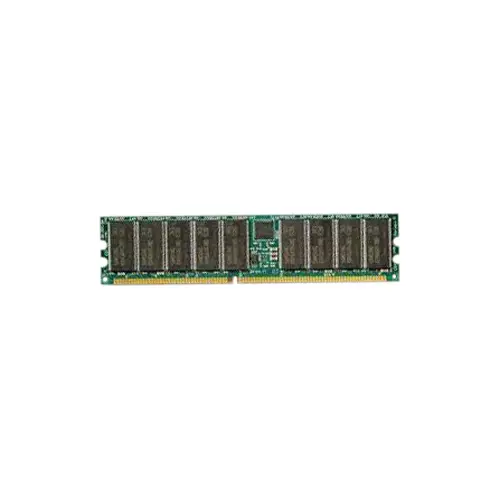
This 16GB DDR3-1600 Registered ECC DIMM is engineered for enterprise-class server platforms, providing reliable single-bit error correction and stable registered signaling crucial for virtualization and memory-intensive workloads like in-memory databases. Its dual-rank x4 organization with CL11 latency delivers a balanced combination of capacity density and predictable performance, ensuring data integrity under sustained high-load conditions.
1. 16 GB capacity per module delivers the memory footprint needed to pack more virtual machines per server, directly boosting consolidation ratios in data center environments.
2. ECC data protection proactively corrects single-bit errors and detects multi-bit faults, essential for preserving long-running transactional workloads from silent data corruption.
3. Registered signal buffering stabilizes command and address lines at higher densities, allowing systems to scale RAM populations without sacrificing signal integrity under full load.
4. Dual Rank x4 organization interleaves data across internal banks, amplifying effective memory bandwidth to keep multiple CPU cores fed during heavy database or analytics operations.
5. 1600 MHz speed provides swift data transfers that reduce latency in memory-intensive server applications, helping sustain high throughput for content delivery and enterprise virtualization platforms.
When a data center hinges on uptime and accuracy, every component matters. The Micron MT36JSF2G72PZ-1G6E1HF is a 16GB DDR3-1600 Registered ECC RDIMM, purpose-built for enterprise servers where reliability isn't optional. Its ECC engine is your frontline defense against single-bit errors caused by cosmic radiation or electrical noise—silently correcting flipped bits that would otherwise corrupt financial transactions or patient records. The registered signal buffer stabilizes high-capacity configurations; as you populate all channels in a virtualization cluster running dozens of VMs, the buffer reduces electrical load on the memory controller, preventing boot failures and random crashes under sustained pressure. In memory-hungry workloads like an in-memory database or real-time analytics cache, the dual-rank x4 organization increases bank availability, allowing the memory controller to interleave requests more efficiently and drive higher IOPS without expanding your physical footprint. The 16GB capacity per module lets you fill fewer DIMM slots to reach your target—vital when consolidation saves cooling and power budgets. Simply put, this RDIMM transforms raw specifications into measurable uptime and consistent response times for your critical services.
Based on the DDR3, ECC, Registered, and 240-pin specifications, this module is a server-class RDIMM designed for reliability and density. The following capacity planning guidance covers three typical server workloads.
General Virtualization
Populate one 16 GB RDIMM per memory channel to balance capacity and bandwidth. For a dual-socket host with four channels per CPU, installing eight modules per processor delivers 128 GB total, comfortably supporting dozens of standard VMs. Maintain symmetric populations across NUMA nodes to avoid performance penalties.
In-Memory Database
Maximize capacity by filling all available DIMM slots with these 16 GB registered ECC modules—24 slots in a dual-socket platform yield 384 GB. The registered ECC design guarantees data integrity and signal stability under sustained in-memory workloads, while the dual-rank x4 organization provides essential bank interleaving for high transaction rates.
HPC
Achieve peak bandwidth by installing exactly one 16 GB RDIMM per memory channel. On an eight-channel system, eight identical modules supply 128 GB while enabling full channel interleaving. The dual-rank construction increases bank-level parallelism, reducing access latency for memory-bound parallel simulations. Ensure all modules run at the rated DDR3-1600 speed to maintain uniform performance.
Rigorously tested server memory; compatible with Dell PowerEdge R720, HP ProLiant DL380p Gen8, IBM System x3650 M4.
Q: Can I mix this MT36JSF2G72PZ-1G6E1HF with other memory modules of different brands or speeds?
A: Mixing different brands or speeds is not recommended for RDIMMs. It may cause signal integrity issues, ECC errors, or reduced stability. All modules should match in speed, rank, and timing.
Q: Is this memory compatible with my system?
A: This DDR3-1600 Registered ECC module is compatible with servers using Intel Xeon E5-series or AMD Opteron platforms. Verify your motherboard's QVL and BIOS support for 16GB dual-rank x4 RDIMMs.
Q: What is the recommended DIMM population order for optimal performance?
A: Populate identical DIMMs per channel, starting with the slot farthest from the CPU. For dual-socket servers, balance memory across both processors to maximize memory bandwidth and interleaving.
Q: Does this module support overclocking or XMP profiles?
A: No. This is a server-grade Registered ECC module built to JEDEC specifications for 24/7 stability. It does not support overclocking or XMP profiles, which are typical for desktop memory.
Q: What warranty and typical failure rate can I expect?
A: This product includes a one-year warranty. Enterprise RDIMMs typically have an annualized failure rate (AFR) below 0.5% under specified conditions, ensuring high reliability for mission-critical workloads.