











 Secure payments
Standard refund policy
Trade Assurance
Secure payments
Standard refund policy
Trade Assurance
| Product Type | Memory Module |
|---|---|
| Compliance Standards | RoHS |
| Memory Capacity | 16 GB |
| Memory Technology | DDR3 |
| Product Voltage | 1.5V |
| RAM Speed | 1866MHz |
| RAM Standard | DDR3-1866/PC3-14900 |
| Error Identifying | ECC |
| Signal Type | Registered |
| Column Access Strobe (CAS) | CL13 |
| Rank | Dual Rank x4 |
| Quantity of Pins | 240-pin |
| RAM Genre | RDIMM |
This RDIMM is specifically engineered for server platforms requiring uncompromising data integrity, making it ideal for virtualization clusters and in-memory databases where registered ECC memory eliminates single-bit errors and the dual-rank x4 configuration maximizes bandwidth via interleaving. The tight CL13 latency at 1866MHz delivers a reliable balance of speed and stability for mission-critical enterprise workloads.
1. ECC protection detects and corrects single-bit errors in real time, safeguarding transactional data integrity in always-on database servers.
2. Registered signal buffering reduces electrical load on the memory controller, enabling fully populated server boards with maximum DIMM counts for large-scale virtualization.
3. Dual Rank x4 organization leverages rank interleaving to boost sustained throughput, minimizing latency during concurrent virtual machine memory accesses.
4. DDR3 technology at 1866 MHz delivers the bandwidth headroom needed to accelerate in-memory analytics and high-frequency trading applications.
5. A 16 GB module capacity increases memory density per channel, allowing enterprise hypervisors to host more VMs without sacrificing per-VM RAM allocation.
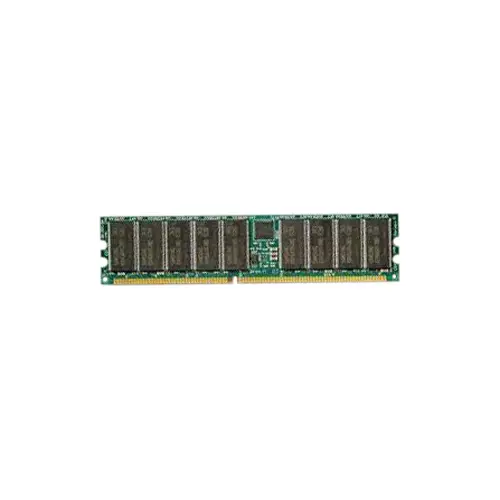
The MT36JSF2G72PZ-1G9 is a server-grade RDIMM engineered for mission-critical enterprise workloads. Its three defining characteristics—ECC error correction, registered signal buffering, and dual-rank x4 organization at 1866MHz—directly translate into tangible reliability and performance in your data center. ECC corrects single-bit memory errors caused by cosmic radiation, preventing silent data corruption that could crash a virtual machine or poison a financial database. In a virtualization cluster running dozens of VMs, bit flips are not a possibility but a statistical certainty; ECC ensures that a memory fault does not cascade into application failure. The registered architecture re-drives address and command signals, allowing this 16GB module to maintain rock-solid signal integrity even when fully populating a server’s 24 DIMM slots. This means you can confidently scale to 384GB or beyond for memory-hungry applications like SAP HANA or large Redis caches, without risking intermittent instability. Meanwhile, the dual-rank design leverages interleaving to deliver higher sustained bandwidth, a critical advantage when multiple virtual machines compete for memory access or when an in-memory database processes millions of queries per second. In such scenarios, this module does more than store data—it directly accelerates transaction throughput and reduces response latency, making it a strategic asset for your infrastructure.
Capacity Planning Guide for 16GB DDR3-1866 ECC RDIMMs
This module is a server-class Registered ECC DDR3 DIMM, essential for platforms prioritizing data integrity and stability. The following recommendations outline optimal configurations for common server workloads.
General Virtualization
Deploy these modules in uniform banks to maximize memory channels. Start with four modules (64 GB) per host to comfortably run 15–20 light VMs, and scale by adding identical quad-kit sets to maintain balanced interleaving and bandwidth.
In-Memory Database
Low-latency ECC is critical here. Populate all channels with single-rank or dual-rank DIMMs uniformly—six or eight modules provide the 96–128 GB footprint needed for moderate Redis or Memcached instances, while preserving registered memory stability under sustained writes.
High-Performance Computing
Fill every memory channel with identical DIMMs to saturate the memory controller. For dual-socket nodes, 16 modules (256 GB) deliver high throughput for MPI workloads, and dual-rank x4 construction ensures reliable error correction during multi-day computational runs.
Rigorously tested, compatible with Dell R720, HP DL380p Gen8, Lenovo x3650 M4.
Q: Can I mix this MT36JSF2G72PZ-1G9 with other memory modules of different brands or speeds?
A: Mixing with unbuffered or non-ECC modules is not supported. For server stability, all installed RDIMMs should match speed, rank, and timing. Different brands may work if specifications are identical, but uniformity is strongly recommended.
Q: Is this memory compatible with my Intel Xeon E5-2600 v2 series server?
A: Yes, this DDR3-1866 Registered ECC RDIMM is compatible with platforms supporting the Intel C600 chipset and Xeon E5-2600 v2 processors using a standard 240-pin socket. Verify system board qualification for dual-rank x4 modules.
Q: What is the recommended DIMM population order for optimal performance?
A: Install identical modules in matched sets across memory channels, typically one DIMM per channel first, then populate the second bank. Follow your server motherboard manual for specific slot numbering to utilize interleaving and maximize bandwidth.
Q: Does this module support overclocking or XMP profiles?
A: No. As a server-grade Registered ECC DIMM, it adheres to JEDEC DDR3-1866 specifications at CL13. Overclocking and XMP are not supported; reliability and data integrity are prioritized over frequency adjustments.
Q: What does 'Registered' mean, and can I use this in a standard desktop?
A: 'Registered' means the module has a register chip for command/address signals, essential in servers with high-capacity memory arrays. It cannot be used in desktops or notebooks that require unbuffered, non-ECC memory and will not physically fit or function.