











 Secure payments
Standard refund policy
Trade Assurance
Secure payments
Standard refund policy
Trade Assurance
| Model | MT36JSF51272PZ-1G4 |
|---|---|
| Product Type | Memory Module |
| Compliance Standards | RoHS |
| Memory Capacity | 4 GB |
| Memory Technology | DDR3 |
| Product Voltage | 1.5V |
| RAM Speed | 1333MHz |
| RAM Standard | DDR3-1333/PC3-10600 |
| Error Identifying | ECC |
| Signal Type | Registered |
| Column Access Strobe (CAS) | CL9 |
| Rank | Dual Rank x4 |
| Quantity of Pins | 240-pin |
| RAM Genre | RDIMM |
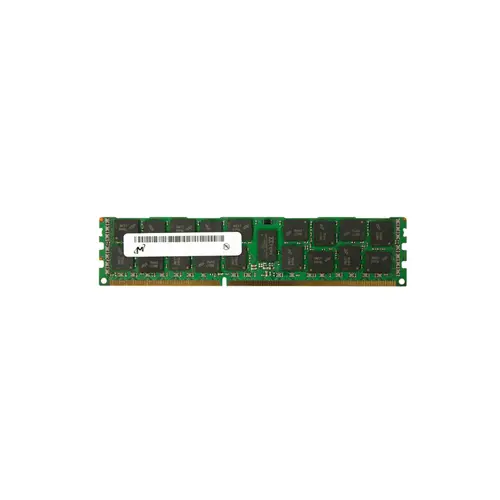
This Micron 4GB DDR3-1333 Registered ECC RDIMM is purpose-built for entry-level servers and workstations handling virtualization, lightweight databases, and memory-sensitive applications where data integrity is paramount. The Registered signal type enhances electrical stability when populating multiple DIMMs per channel, while the ECC and dual-rank x4 organization work in tandem to correct single-bit errors and improve data access parallelism under sustained load.
1. ECC protection actively corrects single-bit errors during data transactions, preserving financial record integrity in always-on database servers.
2. Registered signal buffering stabilizes command and address loads across fully populated memory channels, essential for maintaining uptime in dense virtualization clusters.
3. Dual Rank x4 organization maximizes interleaving efficiency, delivering the sustained bandwidth needed to keep multiple virtual machines responsive under heavy consolidation.
4. A 4 GB module capacity targets dedicated lightweight workloads such as web caching or DNS services, where cost-effective memory granularity matters more than massive density.
5. The DDR3-1333 clock rate with CL9 latency provides a balanced mix of throughput and access time, ensuring smooth operation of line-of-business applications in legacy server fleets.
The MT36JSF51272PZ-1G4 is a 4GB DDR3-1333 Registered DIMM engineered specifically for server environments where uptime and accuracy are non-negotiable. Four design characteristics directly resolve the biggest pain points in data centers: ECC error correction, registered signal buffering, a dual-rank x4 organization, and CL9 low-latency timing. In a dense virtualization cluster, ECC acts as a silent validator, automatically correcting single-bit memory flips that cosmic radiation or electrical noise can trigger; without it, a single corrupt bit could crash hypervisors or silently poison a financial database, leading to costly downtime. The registered buffer stabilizes command and address signals, drastically reducing electrical load on the memory controller. This means you can fully populate server memory banks to support hundreds of virtual machines without risking signal integrity or random boot failures. For in-memory databases such as Redis or SAP HANA, the dual-rank x4 layout leverages rank interleaving to overlap read and precharge operations, offering tangible throughput gains when millions of queries hit the dataset per second. Combined with the predictable CL9 latency at 1333MHz, the module delivers consistent, low-jitter performance during real-time analytics spikes, turning commodity hardware into a trustworthy platform where data integrity and responsive multi-tenancy are built in, not bolted on.
This module (MT36JSF51272PZ-1G4) is a 4 GB DDR3-1333 Registered ECC RDIMM, designed for servers where data integrity and stable high-density configurations are critical. Effective capacity planning must balance channel population, rank count, and ECC overhead for each workload.
General Virtualization
Populate all memory channels symmetrically with four or six identical modules (16–24 GB) per host. ECC protection safeguards against single-bit errors that can crash multiple virtual machines, while registered buffers allow fully loaded channels without signal degradation. For moderate VM density, 16 GB total using 4 x 4 GB dual-rank DIMMs provides a cost-effective, stable base.
In-Memory Database
Prioritize absolute capacity to keep hot datasets in RAM. Max out DIMM slots per processor—for example, 8 x 4 GB (32 GB) in a dual-socket server gives 64 GB total. Although 1333 MHz is modest, the ECC and registered feature set ensure reliable data persistence. Dual-rank modules slightly improve bandwidth but keep total ranks per channel within platform limits to avoid downclocking.
High Performance Computing
Install one DIMM per memory channel across all available channels (e.g., 8 x 4 GB for 32 GB in a typical 2‑socket node) to achieve peak aggregated bandwidth. Registered ECC DIMMs sustain signal integrity under heavy, sustained parallel loads, and symmetric population eliminates NUMA imbalances that can bottleneck tightly coupled MPI jobs.
Server-grade, rigorously tested. Compatible with Dell PowerEdge R710, R720, HP ProLiant DL380p Gen8, and more.
Q: Can I mix this MT36JSF51272PZ-1G4 with other memory modules of different brands or speeds?
A: Mixing is not recommended for servers. Use identical modules (same part number, rank, and speed) to ensure signal integrity, system stability, and to avoid unexpected ECC errors.
Q: Is this memory compatible with my system?
A: It is designed for servers supporting DDR3 ECC Registered DIMMs, such as Intel Xeon 5600/5500 series or AMD Opteron 6100 platforms. Verify your board supports 4GB DDR3-1333 RDIMMs.
Q: What is the recommended DIMM population order for optimal performance?
A: Populate identical modules per channel, typically starting with the slots farthest from the CPU. Follow your server's manual for balanced channel interleaving; usually fill all channels for best throughput.
Q: Does this module support overclocking or XMP profiles?
A: No. This server-grade Registered DIMM adheres strictly to JEDEC DDR3-1333 specifications and does not support overclocking or XMP. It is engineered for maximum reliability at standard speeds.
Q: What warranty and typical failure rate can I expect?
A: This module carries a 1-year warranty. It exhibits a very low annualized failure rate typical of enterprise RDIMMs, built with rigorous testing to meet stringent server reliability standards.