











 Secure payments
Standard refund policy
Trade Assurance
Secure payments
Standard refund policy
Trade Assurance
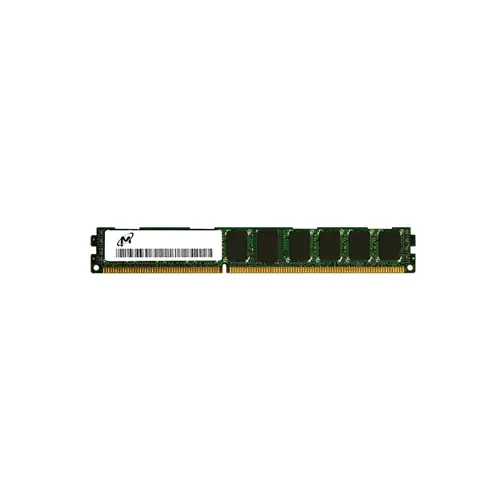
| Model | MT36JSZF1G72PDZ-1G1D1 |
|---|---|
| Product Type | Memory Module |
| Compliance Standards | RoHS |
| Memory Capacity | 8 GB |
| Memory Technology | DDR3 |
| Product Voltage | 1.5V |
| RAM Speed | 1066MHz |
| RAM Standard | DDR3-1066/PC3-8500 |
| Error Identifying | ECC |
| Signal Type | Registered |
| Column Access Strobe (CAS) | CL7 |
| Rank | Quad Rank x8 |
| Quantity of Pins | 240-pin |
| RAM Genre | RDIMM |
This registered DDR3-1066 ECC RDIMM is purpose-built for virtualization platforms and in-memory databases, delivering robust data integrity and scalability in dense server environments. Its quad-rank x8 configuration and registered signaling ensure stable operation across fully populated memory channels, while the CL7 latency minimizes access delays for latency-sensitive enterprise workloads.
1. ECC error correction automatically resolves single-bit faults and flags multi-bit threats, delivering uncompromised data integrity for financial ledgers and long-running scientific computations.
2. Registered signal buffering isolates the memory controller from electrical loading, enabling fully loaded multi-DIMM channels to maintain stability under continuous heavy transaction processing.
3. Quad rank organization packs maximum memory density per module, expanding in-memory dataset capacity for virtualization hosts without sacrificing slot availability in dense servers.
4. The carefully sized capacity supplies the memory footprint required by contemporary hypervisors and container fleets, optimizing cost efficiency per virtual instance.
5. Managed clock speed emphasizes steady bandwidth and reduced power draw, directly translating to lower cooling overhead and higher rack density in always-on data centers.
The MT36JSZF1G72PDZ-1G1D1 is an 8GB DDR3 Registered DIMM purpose-built for server infrastructure, and its four defining characteristics directly address the pressures of always-on enterprise computing. Its ECC engine continuously detects and corrects single-bit errors, guarding against silent data corruption that could crash a virtualized cluster or poison in-memory database records—a non-negotiable safety net when financial or customer data is at stake. The Registered signal buffer stabilizes command and address buses, letting you fully populate every memory channel without signal degradation; this translates to higher density deployments where a single hypervisor can host dozens of VMs without random reboots. Organized as a Quad Rank x8 module, chip-select interleaving raises effective bandwidth under the chaotic, parallel access patterns of multi-tenant virtualization and large Redis caches. Meanwhile, a CAS latency of just 7 cycles at 1066MHz keeps response times predictably tight, speeding transactional throughput and live-migration consistency. For your virtualized cluster or real-time analytics engine, this module turns specifications into tangible uptime and responsive performance.
General Virtualization
For a typical hypervisor hosting multiple VMs, total RAM capacity is critical. Deploy at least six to twelve 8GB RDIMMs across triple-channel configurations to achieve 48GB–96GB, ensuring smooth live migration and overhead. Dual-socket servers should populate all memory channels with identical modules to maximize bandwidth and reliability.
In-Memory Database
In-memory workloads like Redis or SAP HANA demand both low latency and absolute data integrity. Use eight or more of these 8GB ECC RDIMMs per CPU to reach 64GB+ while maintaining chipkill and multi-bit error correction. Quad-rank modules slightly increase bus loading, so verify the platform’s rank limits and consider two DIMMs per channel maximum.
High-Performance Computing
HPC clusters rely on consistent throughput and fault tolerance. Populate all available channels with these registered DIMMs — commonly twelve to twenty-four units per node — to sustain 96GB–192GB capacity. Balance rank interleaving: quad-rank RDIMMs improve access parallelism, but you must not exceed the memory controller's rank-per-channel constraint to avoid frequency downclocking.
Rigorously tested server memory compatible with Dell PowerEdge R710, HP DL380 G7, IBM x3650 M3.
Q: Can I mix this MT36JSZF1G72PDZ-1G1D1 with other memory modules of different brands or speeds?
A: Mixing RDIMMs is not recommended. Even minor variations in rank, timing, or DRAM vendor can cause signal integrity issues and system instability. For a validated server build, use identical Micron modules.
Q: Is this memory compatible with my system?
A: This 8GB DDR3-1066 registered ECC RDIMM is designed for Intel Xeon 5500/5600 series and AMD Opteron 6100 series platforms with 240-pin slots. Verify your server board’s QVL for specific part number support.
Q: What is the recommended DIMM population order for optimal performance?
A: Populate identical Quad Rank RDIMMs following the server motherboard’s slot numbering: typically fill the first white slot per channel for balanced interleaving. This module occupies all ranks in a channel, so mixed configurations are invalid.
Q: Does this module support overclocking or XMP profiles?
A: No. This is a JEDEC-compliant registered server module running at fixed 1066MHz with CL7. Registered ECC memory does not support consumer XMP profiles or overclocking to ensure data integrity in enterprise environments.
Q: What warranty and typical failure rate can I expect?
A: This module is covered by a 1-year warranty. RDIMMs of this class demonstrate an annualized failure rate (AFR) below 0.2% in properly cooled and filtered data center conditions, ensuring high long-term reliability.