











 Secure payments
Standard refund policy
Trade Assurance
Secure payments
Standard refund policy
Trade Assurance
| Model | MT36JSZF1G72PDZ-1G4D1 |
|---|---|
| Product Type | Memory Module |
| Compliance Standards | RoHS |
| Memory Capacity | 8 GB |
| Memory Technology | DDR3 |
| Product Voltage | 1.5V |
| RAM Speed | 1333MHz |
| RAM Standard | DDR3-1333/PC3-10600 |
| Error Identifying | ECC |
| Signal Type | Registered |
| Column Access Strobe (CAS) | CL9 |
| Rank | Quad Rank x8 |
| Quantity of Pins | 240-pin |
| RAM Genre | RDIMM |
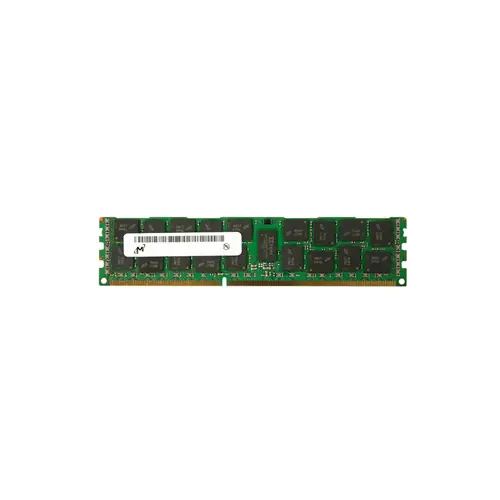
Based on its RDIMM form factor, ECC, and registered signal type, this is a server-class DDR3-1333 memory module designed for reliability-centric workloads. Its Quad Rank x8 organization enables high capacity density per channel and, combined with ECC and registered buffering, makes it ideal for virtualization platforms and in-memory databases where data integrity and stable operation under heavy load are critical.
1. ECC protection silently corrects single-bit errors in real time, preserving data integrity for transactional databases and eliminating silent data corruption risks that cause unplanned server downtime.
2. Registered signal buffering stabilizes command and address lines under fully populated memory channels, essential for maintaining reliability in dense rack servers running always-on enterprise workloads.
3. Quad Rank x8 organization maximizes capacity per DIMM slot, allowing hypervisor hosts to allocate significantly more memory to virtual machines without expanding hardware footprint.
4. An eight-gigabyte capacity per module offers the density needed to consolidate multiple VMs and memory-hungry middleware instances, directly improving data center consolidation ratios.
5. The 1333 MHz clock rate delivers a balanced bandwidth envelope that sustains concurrent multi-threaded processing, keeping response times predictable for mid-tier database and web serving clusters.
When you are managing a virtualized cluster hosting dozens of mission-critical VMs, a single undetected bit-flip can cascade into data corruption and costly downtime. The MT36JSZF1G72PDZ-1G4D1 RDIMM is engineered to eliminate that risk. Its ECC technology actively detects and corrects single-bit errors, preserving data integrity for in-memory databases and transactional workloads where accuracy is non-negotiable. In dense server environments, the registered signal buffer stabilizes command and address lines across multiple DIMMs, letting you populate all channels with confidence without signal degradation—critical for maintaining uptime in high-capacity virtualization nodes. The quad-rank x8 organization delivers dense 8 GB capacity per module while optimizing bank-level parallelism under heavy concurrent access, which directly boosts throughput in memory-hungry database instances and caching layers. Add a true CAS latency of 9 at 1333 MHz, and you get predictable, low-latency performance that keeps real-time analytics responsive. For IT architects building resilient infrastructure, this means fewer memory-related failures, smoother scaling, and assured data consistency in every clock cycle.
General Virtualization
For a virtualized host running multiple VMs, memory capacity and reliability are paramount. The ECC and registered features of this 8GB RDIMM ensure data integrity under constant uptime. Deploy six to twelve modules per server (48–96 GB) in balanced channels to accommodate typical mixed workloads without overcommitting RAM, leaving headroom for hypervisor overhead.
In-Memory Database
In-memory databases like Redis or SAP HANA demand high capacity and error-free operation. Populate all available DIMM slots with these 8GB quad-rank RDIMMs to maximize density – a common 2-socket server can reach 128 GB or more. Prioritize identical modules in each memory channel to maintain consistent latency and avoid performance penalties under heavy cache pressure.
High-Performance Computing
HPC clusters benefit from the stability of registered ECC memory during long-running parallel jobs. While clock speeds are moderate, the large capacity per module supports memory-bound simulations. Install eight to sixteen modules per node (64–128 GB) in a balanced multi-channel configuration, ensuring each CPU gets symmetrical access. This setup sustains throughput in computational fluid dynamics or genomic sequencing tasks.
Rigorously tested server memory, compatible with Dell PowerEdge R710/R720, HP ProLiant DL380 G7/G8, and similar systems.
Q: Can I mix this MT36JSZF1G72PDZ-1G4D1 with other memory modules of different brands or speeds?
A: Mixing is strongly discouraged. This is an 8GB DDR3-1333 Registered ECC RDIMM. Combining with dissimilar modules (speed, rank, vendor) risks instability and memory errors on server platforms requiring uniformity.
Q: Is this memory compatible with my system?
A: It is designed for server boards using Intel Xeon 5500/5600 series or AMD Opteron 6100/6200 series with DDR3 Registered ECC slots. Verify your board supports 240-pin DDR3-1333 RDIMMs and quad-rank 8GB modules.
Q: What is the recommended DIMM population order for optimal performance?
A: Populate identical DIMMs per memory channel, starting with the slot farthest from the CPU (often blue/black sequence). Consult your server board manual to balance Quad Rank x8 modules across channels for maximum throughput.
Q: Does this module support overclocking or XMP profiles?
A: No. This is a JEDEC-compliant DDR3-1333 Registered ECC server DIMM with timings fixed at CL9. It does not support XMP or overclocking, as server environments prioritize data integrity over speed.
Q: What warranty and typical failure rate can I expect?
A: It includes a 1-year warranty. As an enterprise-grade Micron RDIMM built with rigorous testing, the typical annualized failure rate (AFR) is below 0.5% under specified operating conditions.