











 Secure payments
Standard refund policy
Trade Assurance
Secure payments
Standard refund policy
Trade Assurance
| Model | MT36JSZF1G72PZ-1G4 |
|---|---|
| Product Type | Memory Module |
| Compliance Standards | RoHS |
| Memory Capacity | 8 GB |
| Memory Technology | DDR3 |
| Product Voltage | 1.5V |
| RAM Speed | 1333MHz |
| RAM Standard | DDR3-1333/PC3-10600 |
| Error Identifying | ECC |
| Signal Type | Registered |
| Column Access Strobe (CAS) | CL9 |
| Rank | Dual Rank x4 |
| Quantity of Pins | 240-pin |
| RAM Genre | RDIMM |
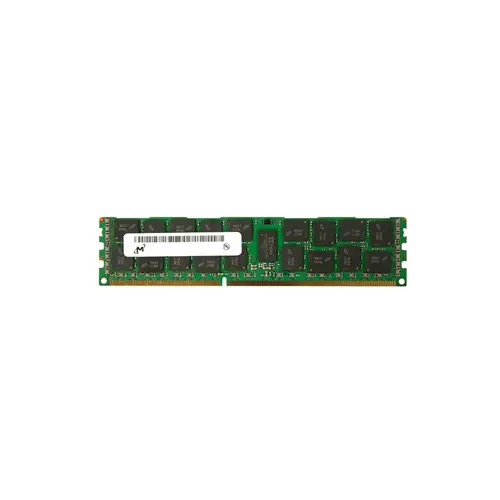
This 8 GB DDR3-1333 Registered ECC RDIMM is a server-grade memory module ideally suited for virtualization hosts, in-memory databases, and mission-critical workloads that demand strong data integrity. Its registered signal architecture and integrated ECC provide enhanced signal stability on high-density memory channels, while the dual-rank x4 organization improves bank-level parallelism for lower effective latency under sustained load.
1. A single-module density that comfortably hosts multiple virtualized tenants without inducing hypervisor-level swapping, directly supporting higher consolidation ratios in enterprise data centers.
2. End-to-end error correction eliminates silent bit flips, safeguarding transactional integrity in databases and financial systems where even single-bit faults are unacceptable.
3. Registered buffering restores clean command and address signals across fully loaded memory channels, preserving stability and uptime in large-scale, multi-DIMM server deployments.
4. Dual rank x4 device organization enables rank-level interleaving, keeping channel bandwidth saturated and response times low during simultaneous heavy queries across many cores.
5. Operating at a speed grade tuned for balanced performance, it delivers steady bandwidth envelope that matches typical throughput demands of mid-tier application servers without unnecessary power overhead.
When you are running a virtualized cluster hosting a dozen mission-critical VMs, a single undetected bit-flip in memory can cascade into data corruption across your entire workload. The Micron MT36JSZF1G72PZ-1G4 is an 8GB DDR3-1333 Registered DIMM engineered precisely to eliminate that risk. Its integrated ECC continuously scans and corrects single-bit errors, ensuring computational integrity for in-memory databases where every transaction must be absolutely trusted. The registered architecture buffers command and address signals, which means even in a fully populated server with multiple dual-rank modules, you maintain clean signaling and stable operation under heavy load—no unexplained lockups during overnight batch processing. In a dense virtualization host, the dual-rank x4 organization maximizes bank-level parallelism, allowing your hypervisor to service concurrent memory requests from dozens of VMs without bandwidth choking. For your Redis or SAP HANA instance, this translates directly into lower tail latency and predictable response times, because the memory system never becomes the silent bottleneck. When uptime and data accuracy are non-negotiable, this module delivers the reliability your infrastructure demands.
General Virtualization
Populate at least six to eight modules (48–64 GB) per host for moderate VM density. Distribute these Registered DIMMs evenly across all memory channels to preserve balanced interleaving and reliable ECC operation. Scale up to twelve modules (96 GB) if you plan to run memory-overcommitted hypervisors.
In-Memory Database
Maximize capacity by fully populating every available slot with these 8 GB dual-rank RDIMMs; a 16-slot server yields 128 GB. Keep memory speed at the rated 1333 MHz and avoid mixing ranks, as the consistent CL9 timing and registered signaling sustain low-latency access critical for real-time data sets held entirely in RAM.
High-Performance Computing
Install identical modules in matched sets per CPU socket to maintain uniform quad-channel or triple-channel bandwidth. For memory-bandwidth-bound workloads, fill all channels with at least one 8 GB RDIMM each, then add a second set if capacity demands exceed base throughput, preserving the CL9 x4 rank arrangement to minimize access conflicts under sustained parallel loads.
Rigorously validated for servers: fits Dell PowerEdge R720, HP ProLiant DL380p G8, IBM System x3650 M4.
Q: Can I mix this MT36JSZF1G72PZ-1G4 with other memory modules of different brands or speeds?
A: Mixing is not recommended. For optimal stability, use identical modules with the same speed, rank, and ECC registered type. Mismatched memory may cause system instability or failure to boot on server platforms.
Q: Is this memory compatible with my server platform (Intel or AMD)?
A: This 8GB DDR3-1333 ECC Registered DIMM is compatible with servers supporting 240-pin DDR3 RDIMM, such as Intel Xeon E5-2400/E5-2600 v1/v2 or AMD Opteron 4300/6300 series. Verify your platform supports registered ECC memory.
Q: What is the recommended DIMM population order for optimal performance?
A: For dual-socket servers, populate identical DIMMs per channel starting from farthest slot from CPU. Follow your system's manual for balanced memory population to maximize interleaving and bandwidth. Typically, fill slots 1, 2 per channel.
Q: Does this module support overclocking or XMP profiles?
A: No. As a server-class registered ECC DIMM, it strictly adheres to JEDEC DDR3-1333 standards and does not support overclocking or XMP profiles. Priority is reliability over speed.
Q: What warranty and typical failure rate can I expect?
A: This module comes with a 1-year warranty. Enterprise-grade ECC RDIMMs have very low failure rates, typically <0.2% annually, ensuring high reliability for mission-critical server workloads.