











 Secure payments
Standard refund policy
Trade Assurance
Secure payments
Standard refund policy
Trade Assurance
| Model | MT36JSZF51272PDZ-1G1 |
|---|---|
| Product Type | Memory Module |
| Compliance Standards | RoHS |
| Memory Capacity | 4 GB |
| Memory Technology | DDR3 |
| Product Voltage | 1.5V |
| RAM Speed | 1066MHz |
| RAM Standard | DDR3-1066/PC3-8500 |
| Error Identifying | ECC |
| Signal Type | Registered |
| Column Access Strobe (CAS) | CL7 |
| Rank | Dual Rank x4 |
| Quantity of Pins | 240-pin |
| RAM Genre | RDIMM |
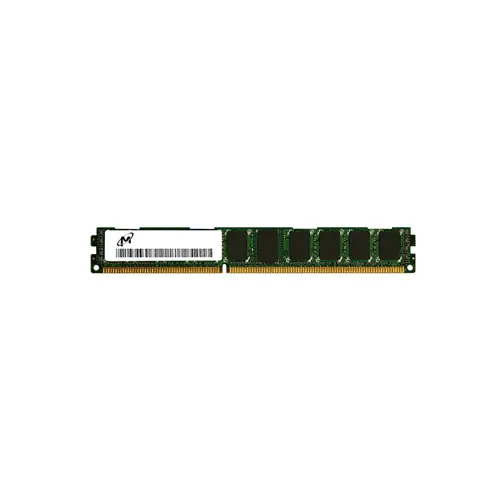
This 4GB DDR3-1066 Registered ECC DIMM is purpose‑built for legacy server environments, delivering the data integrity and registered signal stability essential for memory‑intensive database applications and virtualization hosts. Its dual‑rank x4 organization combined with a low CL7 latency enhances per‑channel bandwidth efficiency in multi‑module configurations, while ECC protects against single‑bit errors in continuous operation.
1. Modest capacity per module streamlines cost-sensitive server deployments, providing an efficient building block for light web hosting, DNS appliances, and edge nodes where extreme density is not required.
2. Integrated ECC actively catches and corrects single-bit errors, safeguarding critical business data against silent corruption during long-running financial or virtualization workloads.
3. Registered signal buffering stabilizes command and address paths, allowing fully populated memory channels in large-scale virtualization hosts without risking electrical loading issues.
4. Dual Rank x4 organization leverages simultaneous bank interleaving to keep memory pipelines saturated, lifting transaction throughput for in-memory databases under heavy concurrent access.
5. Snappy CAS latency shrinks the delay between a read request and data delivery, directly cutting query completion time in latency-bound caching clusters and real-time recommendation engines.
In round-the-clock server operations, the MT36JSZF51272PDZ-1G1 RDIMM converts four design attributes into tangible resilience and throughput. ECC error correction acts as a silent guardian, intercepting single-bit faults induced by ambient radiation before they corrupt financial databases or destabilize hypervisor-managed virtual machines—where one flipped bit could crash dozens of production workloads. The registered buffer redrives address and command signals, enabling you to fully populate a server’s 18 or 24 slots without signal collapse, a prerequisite for dense virtualization clusters that demand hundreds of gigabytes of reliable memory. Dual-rank ×4 organization exploits internal bank interleaving to maximize bandwidth under mixed I/O, accelerating in-memory analytics platforms like SAP HANA or Redis by reducing data-fetch bubbles. Complementing these, the 1066MHz frequency with a tight CL7 latency ensures deterministic data delivery, smoothing real-time transaction processing. For your data center, this means uncompromising data integrity, larger VM footprints, and consistently low query latencies, safeguarding uptime and user experience.
General Virtualization
For basic virtualization hosts running multiple light VMs, populate at least six identical MT36JSZF51272PDZ-1G1 modules across three memory channels per CPU to reach 24 GB, ensuring balanced interleaving and maximum throughput. ECC and registered buffering stabilize the hypervisor under overcommitment, while dual‑rank x4 organization provides the reliability needed for live migration and failover clusters. Avoid mixing capacities or ranks in the same channel to prevent NUMA latency penalties.
In‑Memory Database
In‑memory databases demand both capacity and fault tolerance, so install a fully populated bank of nine 4 GB RDIMMs per socket (36 GB total) to hold substantial working sets. ECC scrubbing corrects single‑bit errors that could corrupt real‑time transactional data, and registered signaling permits dense population without command‑bus degradation. Plan for identical spare modules and enable memory mirroring or sparing in the BIOS if absolute uptime is required.
High‑Performance Computing
HPC clusters thrive on memory bandwidth, making a balanced per‑socket configuration of six or twelve dual‑rank RDIMMs the baseline. Running half the channels empty forfeits interleaving, so fill each memory channel identically to sustain 1066‑MT/s streaming into the processor’s prefetchers. ECC protects long‑running simulations, while the CL7 latency and registered buffer keep data‑movement jitter low enough for parallel MPI job scalability.
This rigorously tested DDR3 ECC RDIMM is compatible with Dell R710, R610, HP DL380 G7, IBM x3650 M3, and similar servers.
Q: Can I mix this MT36JSZF51272PDZ-1G1 with other memory modules of different brands or speeds?
A: Mixing is not recommended for registered ECC memory. Differing brands, speeds, or ranks can cause POST failures, stability issues, and parity errors, compromising server reliability in production environments.
Q: Is this memory compatible with my system?
A: This RDIMM is designed for servers using Intel Xeon 5500/5600 series or AMD Opteron 6100 platforms. Please verify your motherboard's Qualified Vendor List and support for DDR3-1066 registered ECC modules.
Q: What is the recommended DIMM population order for optimal performance?
A: Always follow your server board manual. Typically, populate the farthest slot from the CPU per channel first, balancing identically across all memory channels to ensure proper interleaving and ECC functionality.
Q: Does this module support overclocking or XMP profiles?
A: No. This is an enterprise-grade registered DIMM engineered for absolute data integrity. It strictly adheres to JEDEC DDR3-1066 standards and does not support XMP or manual overclocking.
Q: What warranty and typical failure rate can I expect?
A: This module includes a one-year warranty. It delivers extremely low annualized failure rates, typically below 0.5%, and is built for sustained 24x7 mission-critical workloads.