











 Secure payments
Standard refund policy
Trade Assurance
Secure payments
Standard refund policy
Trade Assurance
| Product Type | Memory Module |
|---|---|
| Memory Capacity | 4 GB |
| Memory Technology | DDR3 |
| Product Voltage | 1.5V |
| RAM Speed | 1333MHz |
| RAM Standard | DDR3-1333/PC3-10600 |
| Error Identifying | ECC |
| Signal Type | Registered |
| Column Access Strobe (CAS) | CL9 |
| Rank | Dual Rank x4 |
| Quantity of Pins | 240-pin |
| RAM Genre | RDIMM |
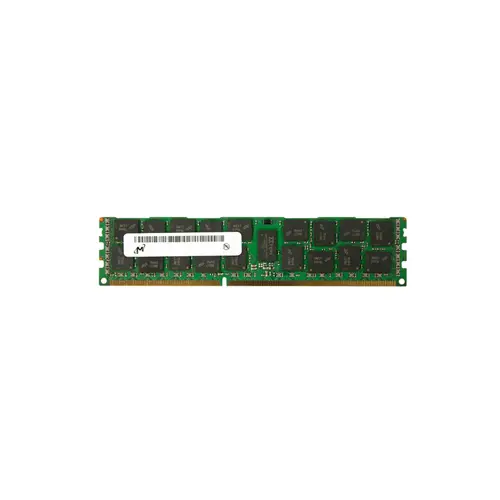
This DDR3-1333 Registered ECC RDIMM is engineered for server-class platforms, where its dual-rank x4 organization enhances memory interleaving and sustained bandwidth for virtualization and in-memory database workloads. The combination of ECC error correction and registered signal buffering ensures robust data integrity and signal stability in multi-DIMM configurations, making it ideal for mission-critical enterprise environments.
1. Error-correcting code protection detects and corrects single-bit memory faults silently, preserving transactional integrity in financial databases and preventing undetected data corruption in long-running server workloads.
2. Registered signal buffering isolates the memory bus from the CPU’s memory controller, enabling dense memory populations that keep large virtualized fleets running stably without signal degradation.
3. Dual-rank organization interleaves memory accesses across internal banks, saturating the channel bandwidth to sustain consistent throughput for multiple virtual machines under heavy consolidation.
4. The moderate transfer rate balances cost-efficient bandwidth delivery, providing sufficient headroom for concurrent web-serving and lightweight containerized applications in entry-level enterprise servers.
5. Low-latency column access strobe timing accelerates cache miss resolution, sharpening response times for latency-sensitive workloads such as real-time analytics and in-memory caching.
The MT36JSZF51272PZ-1G4G1HG module is an RDIMM purpose-built for servers, where four architectural characteristics directly combat real-world infrastructure risks. Its ECC protection continuously detects and corrects single-bit memory errors caused by background radiation or cosmic particles, which is non-negotiable when a flipped bit in a financial database or a virtualized customer record can silently corrupt transactions or crash an entire hypervisor host. The registered signal buffer decouples the memory controller from the ranks of DRAM chips, allowing your VMware cluster or bare-metal database server to populate all 24 DIMM slots without timing failures, preserving signal integrity as you scale from 64 GB to 384 GB to meet growing VM density. The dual-rank x4 organization enables rank interleaving, so while one rank processes a read burst, the controller can already initiate a precharge or activate on the other, drastically reducing idle latency for memory-intensive analytics like SAP HANA or Redis. Finally, the DDR3-1333 speed at CL9 latency hits a reliability sweet spot, delivering 10.6 GB/s bandwidth with deterministic access times that keep synchronous replication and hundreds of simultaneous virtual desktops responsive under load. Together, these features translate directly into sustained uptime, consistent query performance, and a server platform that won’t become the bottleneck.
General Virtualization
This 4GB 1333MHz DDR3 RDIMM is best suited for small-scale virtualization hosts. For a basic hypervisor running three to five light VMs, populate four to six identical modules to reach 16GB–24GB of balanced, ECC-protected capacity. Always install in matched pairs and fill identical channels to maintain memory interleaving and stable Registered DIMM performance.
In-Memory Database
In-memory databases demand high capacity and low latency, making a single 4GB DIMM a starting point rather than the solution. Aim for the motherboard’s maximum supported slots using identical 4GB RDIMMs—often 12 or 24 DIMMs in a dual-socket server—to build 48GB–96GB pools. Opt for the highest channel count supported and keep ranks balanced across channels to maximize throughput on read-heavy workloads.
HPC
HPC clusters often scale horizontally, so cost-effective 4GB RDIMMs can equip many nodes. Per node, populate all three or four channels per processor with one or two DIMMs each, yielding 12GB–32GB per socket while preserving memory bandwidth. Use dual-rank x4 modules like this one to benefit from rank interleaving; match configurations across every node to guarantee predictable MPI job performance.
Confirmed compatible with servers like Dell PowerEdge R710, HP DL380 G7, IBM x3650 M3. Rigorously tested.
Q: Can I mix this MT36JSZF51272PZ-1G4G1HG with other memory modules of different brands or speeds?
A: Mixing RDIMMs of different brands or speeds is not recommended. The memory controller will downclock all modules to the lowest common speed, potentially causing signal integrity issues and sacrificing the reliability ECC and registered architecture are designed to provide.
Q: Is this memory compatible with my server system?
A: This is a DDR3-1333 Registered ECC DIMM for servers. It requires a platform supporting dual-socket or single-socket Intel Xeon 5500/5600 series, AMD Opteron 6100/6200 series, or similar server chipsets with 240-pin DDR3 RDIMM slots. Verify your motherboard's qualified vendor list.
Q: What is the recommended DIMM population order for optimal performance?
A: For dual-rank x4 RDIMMs, populate identical modules per memory channel starting with the furthest slot from the CPU. Follow your server vendor's population guide to maintain balanced interleaving and avoid performance degradation; typically, populate white or blue slots first.
Q: Does this module support overclocking or XMP profiles?
A: No, this is a server-grade Registered ECC memory. It operates strictly at JEDEC standard DDR3-1333 with CL9 timings. Overclocking and XMP are not supported, as stability and data integrity take precedence in server environments.
Q: What warranty and typical failure rate can I expect?
A: This module includes a one-year warranty. Enterprise RDIMMs like this Micron module have an annualized failure rate typically below 0.5% under normal server operating conditions, provided proper cooling and voltage within 1.5V specifications are maintained.