











 Secure payments
Standard refund policy
Trade Assurance
Secure payments
Standard refund policy
Trade Assurance
| Product Type | Memory Module |
|---|---|
| Compliance Standards | RoHS |
| Memory Capacity | 8 GB |
| Memory Technology | DDR3 |
| Product Voltage | 1.5V |
| RAM Speed | 1066MHz |
| RAM Standard | DDR3-1066/PC3-8500 |
| Error Identifying | ECC |
| Signal Type | Registered |
| Column Access Strobe (CAS) | CL7 |
| Rank | Dual Rank x4 |
| Quantity of Pins | 240-pin |
| RAM Genre | RDIMM |
This RDIMM with ECC and registered signal integrity is purpose-built for server platforms handling virtualization, in-memory databases, and mission-critical workloads where data integrity is non-negotiable. Its Dual Rank x4 configuration and low CAS latency of CL7 optimize memory access parallelism and response time, ensuring stable performance under heavy load.
1. ECC error correction silently detects and fixes single-bit memory faults, preserving data integrity for financial ledgers and database commitments that cannot tolerate silent corruption.
2. Registered signal buffering decouples the memory bus from the chip loads, enabling stable high-capacity configurations that keep virtualized infrastructures running without crash-inducing electrical noise.
3. Dual Rank x4 organization exploits rank interleaving to keep the command pipeline full, smoothing out access latency spikes when multiple VMs contend for shared memory bandwidth.
4. The 1066MHz clock drives a dependable 8.5 GB/s transfer rate, well-aligned with entry-level private cloud controllers and cache-heavy web-serving tiers that value consistency over peak throughput.
5. CL7 column access latency shortens the data ready cycle window, which sharpens response times in in-memory databases and real-time analytics under parallel query pressure.
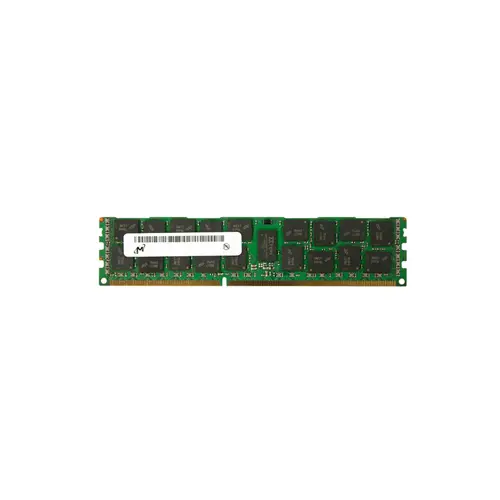
The Micron MT36JSZS1G72PY-1G1A1AB is an 8 GB DDR3-1066 registered DIMM built for server environments, where uptime and data integrity are non-negotiable. Its ECC technology actively detects and corrects single-bit memory errors caused by background radiation, which, in a round-the-clock virtualized cluster running multiple VMs, prevents silent data corruption that could crash a hypervisor or corrupt a customer database. The registered architecture buffers address and command signals, stabilizing the electrical load so that a fully populated server with 12 or 18 DIMMs can maintain reliable 1066 MT/s bandwidth without signal degradation—essential when an in-memory database like Redis or a large-scale SAP HANA instance demands consistent, low-latency access to many gigabytes of working data. A dual-rank x4 organization interleaves internal bank groups to deliver higher sustained throughput under heavy concurrent loads, meaning your OLTP queries return faster even when the server is hammered by thousands of transactions per second. Finally, the CL7 latency squeezes extra responsiveness out of every cycle, reducing the gap between a CPU request and critical data delivery. For the infrastructure team managing a virtualization farm or deploying a database server that cannot tolerate performance jitter, this RDIMM translates directly into reduced downtime risk, predictable response times, and a hardened platform for mission-critical workloads.
General Virtualization
For light to moderate VM densities, populate servers with at least four of these 8 GB RDIMMs across dual channels to reach 32 GB total. Balanced memory and core ratios prevent swapping, so aim for six to eight modules (48–64 GB) when hosting mixed workloads, keeping identical ranks to maintain stable registered timing.
In-Memory Database
In-memory datasets demand capacity over speed, so fill all channels with these dual-rank 8 GB RDIMMs. A six-channel configuration yielding 48 GB suits small Redis or Memcached instances, while twelve modules (96 GB) support larger analytical stores. ECC and registered signaling are non-negotiable for data integrity under sustained load.
High-Performance Computing
HPC favors bandwidth; install one DIMM per channel and leverage dual-rank x4 organization for efficient bank interleaving. Start with six modules (48 GB) across three channels to feed compute-bound simulations. Scale to twelve modules for memory-intensive fluid dynamics or weather models, ensuring all sticks match CAS 7 latency to avoid straggler effects.
Validated rigorously, compatible with Dell PowerEdge R720, HP ProLiant DL380p Gen8, Lenovo ThinkServer RD430.
Q: Can I mix this MT36JSZS1G72PY-1G1A1AB with other memory modules of different brands or speeds?
A: Mixing RDIMMs of different brands or speeds is not recommended. It may cause system instability or POST failures. Always use identical modules to ensure reliable ECC and registered operation.
Q: Is this memory compatible with my system?
A: This DDR3-1066 registered ECC module is designed for servers. Verify your board supports DDR3 RDIMMs, 1.5V, and the specific Intel Xeon 5500/5600 or AMD Opteron 4100/6100 platform. Check the server vendor’s QVL.
Q: What is the recommended DIMM population order for optimal performance?
A: For dual-socket servers, populate identical DIMMs symmetrically per channel, starting with the furthest slot from the CPU. Follow the platform manual to balance memory channels and maximize interleaving with dual-rank x4 modules.
Q: Does this module support overclocking or XMP profiles?
A: No. This is a server-grade registered ECC DIMM optimized for data integrity and 24/7 stability. It adheres strictly to JEDEC DDR3-1066/PC3-8500 standards and does not support XMP or overclocking.
Q: What warranty and typical failure rate can I expect?
A: It includes a 1-year warranty. As an enterprise-class RDIMM, the design MTBF exceeds 2 million hours under normal operating conditions, resulting in an extremely low annualized failure rate in qualified server environments.