











 Secure payments
Standard refund policy
Trade Assurance
Secure payments
Standard refund policy
Trade Assurance
| Model | MT36JSZS1G72PY-1G4A1 |
|---|---|
| Product Type | Memory Module |
| Compliance Standards | RoHS |
| Memory Capacity | 8 GB |
| Memory Technology | DDR3 |
| Product Voltage | 1.5V |
| RAM Speed | 1333MHz |
| RAM Standard | DDR3-1333/PC3-10600 |
| Error Identifying | ECC |
| Signal Type | Registered |
| Column Access Strobe (CAS) | CL9 |
| Rank | Dual Rank x4 |
| Quantity of Pins | 240-pin |
| RAM Genre | RDIMM |
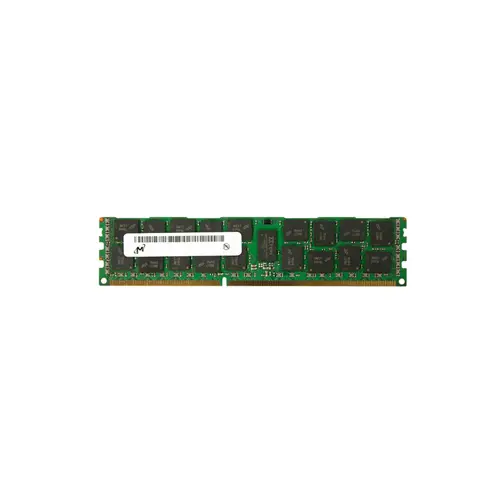
Designed for server platforms, this Micron DDR3-1333 8GB RDIMM with registered ECC ensures fault-tolerant data integrity, making it ideal for virtualization and memory-centric database workloads. Its dual-rank x4 organization and CL9 latency provide balanced electrical loading and stable command response under sustained multi-DIMM configurations, reinforcing 24/7 enterprise reliability.
1. ECC – Single-bit error correction safeguards transactional data integrity, eliminating silent data corruption risks in mission-critical databases.
2. Registered – Buffered signaling reduces electrical load on the memory controller, enabling large-memory configurations essential for dense virtualization hosts.
3. Dual Rank x4 – Parallel access across dual ranks maximizes channel utilization, sustaining high throughput for multiple concurrent virtual machines.
4. Ample module density allows cost-effective scaling to total memory footprints that accommodate hefty in-memory workloads like real-time analytics.
5. The module’s DDR3 frequency delivers consistent bandwidth that accelerates parallel query execution in heavy OLAP environments.
As the foundation of a reliable virtualization cluster or in-memory database, the Micron 8GB DDR3-1333 RDIMM (MT36JSZS1G72PY-1G4A1) solves four critical pain points. ECC error correction catches and fixes single-bit flips caused by cosmic radiation, preventing silent data corruption that could crash your hypervisor or distort transaction records. The registered buffer strengthens command/address signals, letting you install up to 96GB or more across all channels without signal droop—essential for dense VM hosting. Dual-rank x4 design uses rank interleaving to overlap memory accesses, boosting effective bandwidth and smoothing latency spikes when Redis or real-time analytics engines hammer datasets. Standard 1.5V operation keeps power and heat low in 24/7 rack deployments, while the 1333MHz clock and CAS 9 latency deliver steady throughput. This module doubles capacity over 4GB sticks, extending legacy server life affordably.
General Virtualization
For a typical virtualization host running multiple VMs, populate the server with at least six to eight of these 8GB RDIMMs to reach 48–64GB per socket. This ECC registered DDR3-1333 memory ensures data integrity under sustained load and allows smooth overcommitment of memory to guest machines.
In-Memory Database
In-memory databases like Redis or SAP HANA demand maximum capacity and fault tolerance. Deploy a fully balanced configuration of 12 or more identical modules per CPU—aiming for 96GB and above—to exploit all memory channels. The ECC and registered signaling are critical here, preventing silent data corruption during high-speed, all-in-memory operations.
High-Performance Computing (HPC)
HPC clusters benefit from dense, reliable memory per node. Install at least 12 to 16 of these dual-rank x4 RDIMMs per dual-socket server, targeting 128–256GB, to feed data-hungry simulations and parallel workloads. The DIMM’s registered architecture maintains signal quality across large module counts, and ECC guards against cosmic-ray-induced errors during long-running compute jobs.
Rigorously tested DDR3 RDIMM, compatible with Dell R720/R620, HP DL380p Gen8, IBM x3650 M4, and more.
Q: Can I mix this MT36JSZS1G72PY-1G4A1 with other memory modules of different brands or speeds?
A: Mixing is not recommended for registered server memory. For guaranteed stability, install identical modules with the same Micron part number, speed, and dual-rank configuration.
Q: Is this memory compatible with my server?
A: This RDIMM is designed for Intel Xeon 5500/5600 series or AMD Opteron 6100 platforms. Confirm your server explicitly supports 8GB DDR3-1333 PC3-10600 ECC Registered memory.
Q: What is the recommended DIMM population order for optimal performance?
A: Populate identical DIMMs per channel starting from the slots farthest from the CPU. Always consult your server’s service manual for balanced memory channel configuration to maximize throughput.
Q: Does this module support overclocking or XMP profiles?
A: No, enterprise-grade registered memory does not support overclocking or XMP. It runs strictly at JEDEC-standard DDR3-1333 CL9 for unwavering reliability in mission-critical environments.
Q: What warranty and typical failure rate can I expect?
A: This module carries a one-year warranty. Server-grade RDIMMs exhibit extremely low failure rates under normal operating conditions, delivering dependable long-term performance.