











 Secure payments
Standard refund policy
Trade Assurance
Secure payments
Standard refund policy
Trade Assurance
| Product Type | Memory Module |
|---|---|
| Memory Capacity | 8 GB |
| Memory Technology | DDR3 |
| Product Voltage | 1.35V |
| RAM Speed | 1333MHz |
| RAM Standard | DDR3-1333/PC3-10600 |
| Error Identifying | ECC |
| Signal Type | Registered |
| Column Access Strobe (CAS) | CL9 |
| Rank | Dual Rank x4 |
| Quantity of Pins | 240-pin |
| RAM Genre | VLP RDIMM |
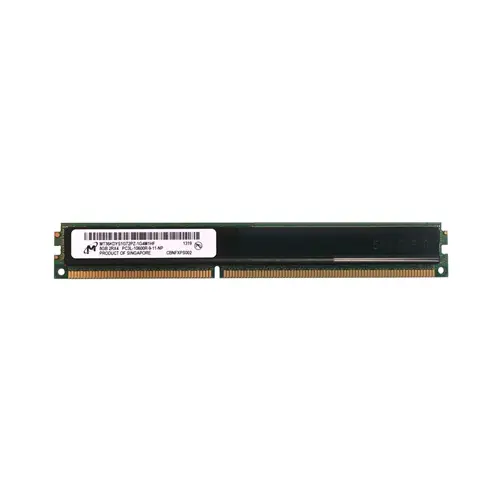
This low-profile 8GB DDR3-1333 VLP RDIMM, with its dual-rank x4 organization and registered ECC architecture operating at a power-efficient 1.35V, is purpose-built for dense server deployments and memory-intensive workloads such as virtualization and in-memory databases where data integrity and signal stability are paramount. The registered signal path and CL9 latency ensure reliable operation in multi-DIMM configurations, while the very low profile design enables seamless integration into compact rack servers and blade enclosures with stringent height constraints.
1. ECC protection silently corrects single-bit memory errors, preserving transactional integrity in mission-critical databases and preventing silent data corruption across long-running virtualization hosts.
2. The registered buffer isolates the memory controller from excessive electrical loading, allowing densely packed servers to maintain stable signal integrity even with fully populated DIMM slots.
3. Very low-profile form factor maximizes clearance inside 1U and blade chassis, effectively improving airflow and reducing thermal hotspots around CPU sockets in high-density racks.
4. Dual-rank x4 organization enables rank interleaving that keeps memory channels fully saturated, delivering consistent bandwidth to hypervisors under heavy multi-VM consolidation.
5. Low-voltage operation cuts overall power draw per DIMM, translating into measurable thermal savings and lower energy costs for data centers scaling to hundreds of nodes.
The Micron MT36KDYS1G72PZ-1G4M1HF is an 8GB DDR3-1333 VLP RDIMM purpose-built for servers where uptime and data fidelity are non-negotiable. Its four defining characteristics directly address critical pain points in today's data centers. First, Error Correcting Code technology continuously detects and corrects single-bit memory errors, which is vital when a cosmic ray-induced bit flip in a virtualization cluster could silently corrupt a guest operating system or bring down multiple workloads. Second, the Registered signal type buffers command and address signals, enabling the use of high-density memory configurations across numerous DIMM slots without signal degradation—a must for scaling in-memory databases like SAP HANA or Redis. Third, the dual-rank x4 organization leverages bank interleaving to boost effective bandwidth; for a heavily loaded hypervisor hosting dozens of VMs, this translates to lower latency and smoother context switching. Finally, the 1.35V low-voltage operation and Very Low Profile design shrink power consumption and thermal footprint, slashing cooling costs in dense 24/7 rack deployments.
Server Memory Identified
This is a DDR3-1333 Registered ECC VLP RDIMM (8GB, 1.35V, dual-rank x4), designed for server-class platforms requiring data integrity and large memory populations. The low voltage and very low profile form factor suit dense rack and blade deployments. Below are capacity planning guidelines for typical server workloads.
General Virtualization
Equip dual-socket servers with at least 12–16 modules (96–128 GB) to host a moderate number of virtual machines. Registered ECC ensures memory isolation and stability across multiple tenants. For light to medium workloads, start with one module per memory channel and scale by adding identical 8 GB RDIMMs as VM density grows.
In-Memory Database
Maximize total capacity by fully populating all memory channels with these 8 GB RDIMMs—typically 16–24 modules across two sockets to reach 128–192 GB. The 1.35V low-voltage design helps manage the thermal load of heavily utilized DIMM slots. Prioritize balanced channel population to sustain high bandwidth under real-time query and caching workloads.
High-Performance Computing
Configure nodes with a module-per-channel strategy (e.g., 8 modules for an 8-channel system) to optimize memory bandwidth for parallel compute jobs. The 1333 MHz clock and CL9 latency provide predictable performance for throughput-sensitive simulations. When larger per-node memory is needed, scale out across more nodes rather than mixing different DIMM densities in a single system.
Server-grade DDR3 Registered ECC memory, rigorously tested, compatible with Dell R710, R720, HP DL380p Gen8, and more.
Q: Can I mix this MT36KDYS1G72PZ-1G4M1HF with other memory modules of different brands or speeds?
A: Mixing different brands or speeds is not recommended for Registered ECC memory. It may cause instability or fail POST. For reliable server operation, use identical modules validated for dual or quad-channel configurations.
Q: Is this memory compatible with my system?
A: This VLP RDIMM requires a server platform supporting DDR3 ECC Registered DIMMs, typically Intel Xeon E5-2400/2600 series or AMD Opteron 6300 series. Verify the motherboard QVL for this PC3-10600 module to ensure compatibility.
Q: What is the recommended DIMM population order for optimal performance?
A: Populate identical modules per channel, starting with the farthest slot from the CPU. For dual-socket servers, balance memory across both processors. Refer to the server’s technical manual for specific slot numbering and balanced configurations.
Q: Does this module support overclocking or XMP profiles?
A: No. This is an enterprise-grade Registered ECC DIMM without XMP support. It operates strictly at JEDEC standard DDR3-1333 CL9 timings to ensure data integrity in 24/7 server environments.
Q: What warranty and typical failure rate can I expect?
A: This module includes a 1-year warranty. Enterprise DDR3 RDIMMs are designed for high reliability with very low annualized failure rates, typically well below 1% under normal operating conditions.