











 Secure payments
Standard refund policy
Trade Assurance
Secure payments
Standard refund policy
Trade Assurance
| Product Type | Memory Module |
|---|---|
| Compliance Standards | RoHS |
| Memory Capacity | 8 GB |
| Memory Technology | DDR3 |
| Product Voltage | 1.35V |
| RAM Speed | 1333MHz |
| RAM Standard | DDR3-1333/PC3-10600 |
| Error Identifying | ECC |
| Signal Type | Registered |
| Column Access Strobe (CAS) | CL9 |
| Rank | Dual Rank x4 |
| Quantity of Pins | 240-pin |
| RAM Genre | RDIMM |
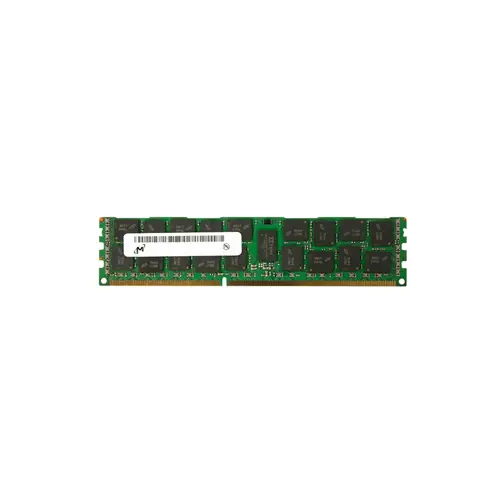
Designed as a server-grade Registered DIMM with ECC, this 8GB DDR3-1333 module ensures data integrity in virtualized environments and memory-intensive database workloads. Its dual-rank x4 configuration combined with a low-latency CL9 and 1.35V operation delivers stable, energy-efficient performance ideal for sustained mission-critical operations.
1. ECC error correction silently detects and fixes single-bit memory faults in the background, preserving data integrity throughout months-long server uptime cycles that transactional databases demand.
2. Registered signal buffering strengthens command and address bus integrity, enabling fully populated memory channels without risking signal degradation in large-scale virtualization hosts.
3. Dual Rank x4 organization leverages rank interleaving to overlap memory accesses, keeping the data pipeline saturated and reducing I/O wait time for latency-sensitive enterprise applications.
4. Ample module-level capacity increases virtual machine density per physical node, directly improving consolidation ratios and lowering per-VM hardware cost in software-defined data centers.
5. Low-voltage operation curtails energy consumption and waste heat at the rack level, which reduces cooling overhead and extends component lifespan in perpetually-on server clusters.
When deploying virtualization clusters or in-memory databases, the Micron MT36KSF1G72PZ-1G4M1F1 RDIMM isn’t merely compatible—it’s a strategic safeguard. Its ECC technology continuously corrects single-bit memory errors that naturally occur due to cosmic radiation or electrical noise. In a dense VMware or Hyper‑V cluster, an uncorrected bit flip can silently corrupt transactional data inside a Redis or SAP HANA instance, leading to costly downtime. Here, ECC transforms unpredictable soft errors into non‑events you never notice. Meanwhile, the Registered interface buffers command and address signals, allowing multiple high‑capacity DIMMs to operate stably on a single server board. This directly supports scaling up virtual machines without signal degradation, keeping memory latencies predictable even when every slot is populated. The dual‑rank x4 organization interleaves internal banks to boost bandwidth during simultaneous read‑write workloads, which is critical when dozens of VMs compete for memory access. Operating at 1.35V reduces thermal load inside dense rack servers, lowering cooling costs and improving long‑term reliability without sacrificing the 1333MHz throughput. In short, this module doesn’t just store data—it preserves application integrity, maximizes uptime, and sustains consistent performance where traditional desktop memory would become a silent liability.
Capacity Planning Guide for Server Memory (8GB DDR3-1333 RDIMM ECC)
This registered ECC DDR3-1333 module is designed for server-class platforms requiring data integrity and stable operation under sustained loads. It uses 1.35V low-voltage signaling for improved energy efficiency in dense deployments.
General Virtualization
For mixed-workload virtualization hosts, populate at least six identical modules across memory channels to support balanced CPU access and adequate capacity for multiple VMs. A six-module (48 GB) configuration allows overcommitment while avoiding excessive swapping, and registered ECC corrects memory errors that could corrupt guest states.
In-Memory Database
In-memory databases demand low latency and absolute data accuracy. Deploy eight modules per socket (64 GB total) to hold large datasets entirely in RAM, leveraging the registered ECC to prevent silent data corruption. Configure modules symmetrically across all memory channels to maximize bandwidth and ensure response times remain consistent under heavy query loads.
High-Performance Computing
For HPC clusters running memory-bandwidth-sensitive simulations, populate all available memory slots with identical 8 GB RDIMMs to achieve peak interleaving. A fully populated dual-socket node (e.g., 128 GB) provides ample workspace for large models while ECC safeguards long-running parallel jobs against single-bit errors, reducing recomputation overhead and improving cluster up-time.
This server memory is rigorously tested and compatible with Dell PowerEdge R720, R620, HP DL380p Gen8, and IBM x3650 M4.
Q: Can I mix this MT36KSF1G72PZ-1G4M1F1 with other memory modules of different brands or speeds?
A: Mixing registered ECC modules from different brands or speeds is not recommended. It may cause system instability or fail to POST. For server reliability, always use identical, validated modules with matching rank and timing.
Q: Is this memory compatible with my server? Which Intel or AMD platforms are supported?
A: This RDIMM is designed for DDR3-1333 systems with ECC support. It typically works with Intel Xeon E5-2400/2600 v1/v2 series or AMD Opteron 4300/6300 platforms using C600/C202 chipsets. Verify motherboard qualified vendor list.
Q: What is the recommended DIMM population order for optimal performance in a server?
A: Populate identical DIMMs per channel following motherboard guidelines. Typically, fill blue slots first for channel 0, then black for channel 1. Balance capacity across memory controllers to maximize bandwidth. Consult your system manual for exact order.
Q: Does this module support overclocking or XMP profiles?
A: No. This is a JEDEC-compliant DDR3-1333 registered ECC module. It does not support overclocking or XMP profiles, as server memory prioritizes stability and data integrity over speed adjustments.
Q: What warranty and typical failure rate can I expect?
A: This module includes a 1-year warranty. Enterprise-grade registered ECC memory typically exhibits an annualized failure rate (AFR) below 0.5% under specified operating conditions, ensuring high reliability in 24/7 server environments.