











 Secure payments
Standard refund policy
Trade Assurance
Secure payments
Standard refund policy
Trade Assurance
| Product Type | Memory Module |
|---|---|
| Compliance Standards | RoHS |
| Memory Capacity | 8 GB |
| Memory Technology | DDR3 |
| Product Voltage | 1.35V |
| RAM Speed | 1333MHz |
| RAM Standard | DDR3-1333/PC3-10600 |
| Error Identifying | ECC |
| Signal Type | Registered |
| Column Access Strobe (CAS) | CL9 |
| Rank | Dual Rank x4 |
| Quantity of Pins | 240-pin |
| RAM Genre | RDIMM |
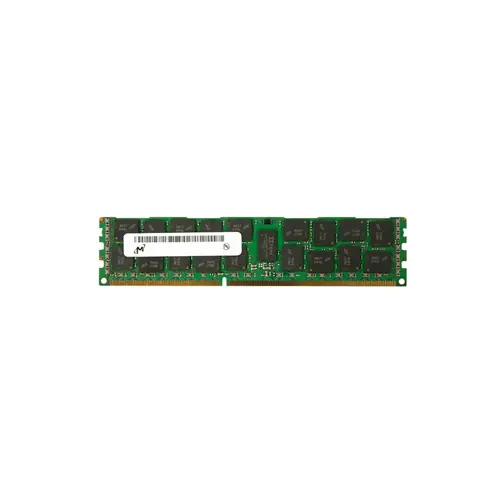
This 8GB DDR3-1333 RDIMM, with ECC and registered signal integrity, is purpose-built for entry-level servers and virtualization platforms where data integrity and stable multi-DIMM operation are critical. Its dual-rank x4 organization and CL9 latency provide a favorable balance of capacity and memory bandwidth for virtualized workloads or light in-memory database applications, while the 1.35V operating voltage improves power efficiency in dense deployments.
1. ECC protection silently corrects single-bit errors, preventing silent data corruption in long-running database and analytics applications.
2. Registered clocking decouples the memory bus loading, allowing fully populated server boards to maintain signal integrity under heavy load.
3. Dual Rank x4 architecture leverages rank interleaving to boost command throughput, reducing latency spikes during concurrent VM operations.
4. A modest per-module capacity suits tiered storage caching or lightweight container hosts, balancing memory footprint with power efficiency.
5. 1333 MHz operation delivers ample throughput for legacy enterprise workloads, extending the usable life of existing server infrastructure.
When you are managing a virtualization cluster or running an in-memory database, the choice of server memory directly determines whether your workloads stay up or quietly corrupt data. The Micron MT36KSF1G72PZ-1G4M1FE is an 8GB DDR3-1333 RDIMM engineered precisely for these high-stakes environments, and four of its characteristics turn technical specifications into operational guarantees. Its ECC technology continuously detects and corrects single-bit errors, preventing silent bit flips that could crash a hypervisor hosting dozens of virtual machines or inject invalid entries into a mission-critical database. The registered signal buffer stabilizes the command and address buses, so you can populate all DIMM slots without signal degradation—essential when scaling memory capacity for large VM fleets. The dual-rank x4 organization increases bank interleaving, boosting bandwidth efficiency during simultaneous read/write bursts that are typical in database caching and live migration. Operating at a low 1.35V, it reduces thermal load and power draw across densely packed server nodes, lowering cooling costs while preserving the reliability your users demand. In a virtualized data center or a real-time analytics engine, this memory keeps transactions accurate, uptime high, and TCO predictable.
General Virtualization
For a hypervisor hosting multiple moderate VMs, populate all memory channels symmetrically to maximize bandwidth. Deploy kits of six or twelve identical 8GB RDIMMs, yielding 48GB or 96GB per host, enough for 10–20 light VMs. Avoid mixing single- and dual-rank DIMMs in the same channel to maintain stable registered signaling.
In-Memory Database
Aim for the largest supported capacity using 8GB dual-rank RDIMMs across all slots, often 128GB or more. Populate three DIMMs per channel to leverage triple-channel interleaving while keeping CAS latency low at CL9. Keep spare DIMMs on hand, as ECC corrects single-bit errors but a permanent chip failure will drop the rank, reducing headroom.
High-Performance Computing
Balance memory per core at roughly 2–4GB and fill all memory channels equally for peak bandwidth. Cluster typical nodes with 64–96GB (eight or twelve 8GB modules) to feed dual-socket processors. The 1.35V low-voltage design reduces thermal load, allowing tighter rack packing and sustained boost clocks during long simulation runs.
Rigorously tested server memory for Dell PowerEdge R720, HPE ProLiant DL380p Gen8, and compatible systems.
Q: Can I mix this MT36KSF1G72PZ-1G4M1FE with other memory modules of different brands or speeds?
A: We strongly advise against mixing different brands or speeds. For optimal stability in registered server environments, use identical modules with the same Micron part number to prevent signal integrity issues and potential system crashes.
Q: Is this memory compatible with my Intel or AMD server platform?
A: This 8GB DDR3L-1333 RDIMM with ECC is designed for Intel Xeon E5 series and AMD Opteron platforms using 240-pin DDR3 sockets. Verify your motherboard supports 1.35V registered ECC memory for assured compatibility.
Q: What is the recommended DIMM population order for optimal performance?
A: To maximize interleaving, populate identical DIMMs per channel starting from the farthest slot from the CPU. Follow your server board's slot coloring and population guide, typically filling blue slots first across all memory channels.
Q: Does this module support overclocking or XMP profiles?
A: No. This is a mission-critical JEDEC-compliant RDIMM for enterprise servers. It operates solely at its rated DDR3-1333 CL9 specification without XMP or overclocking support to ensure reliability and data integrity.
Q: What warranty and typical failure rate can I expect?
A: This module includes a 1-year warranty. As an enterprise-grade Micron RDIMM built with ECC, its annualized failure rate is exceptionally low, typically under 0.2%, ensuring years of stable operation in 24/7 server environments.