











 Secure payments
Standard refund policy
Trade Assurance
Secure payments
Standard refund policy
Trade Assurance
| Product Type | Memory Module |
|---|---|
| Compliance Standards | RoHS |
| Memory Capacity | 16 GB |
| Memory Technology | DDR3 |
| Product Voltage | 1.35V |
| RAM Speed | 1333MHz |
| RAM Standard | DDR3-1333/PC3-10600 |
| Error Identifying | ECC |
| Signal Type | Registered |
| Column Access Strobe (CAS) | CL9 |
| Rank | Dual Rank x4 |
| Quantity of Pins | 240-pin |
| RAM Genre | RDIMM |
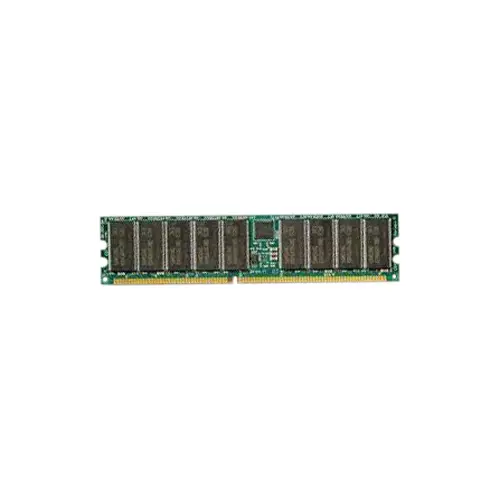
This 16GB DDR3-1333 RDIMM with ECC and registered signal type is designed for server platforms requiring high data integrity, making it ideal for virtualization hosts and in-memory databases. Its dual-rank x4 organization and low 1.35V operating voltage enhance memory bandwidth through bank interleaving while reducing power consumption in dense rack deployments.
1. ECC error correction ensures uncompromised data integrity, preventing single-bit memory flips from evolving into silent data corruption in transactional databases and real-time analytics.
2. Registered signal buffering decouples electrical loading, enabling fully populated memory channels with 16GB RDIMMs to sustain maximum capacity and bandwidth under massive virtualization workloads.
3. Dual Rank x4 organization enables robust chipkill-level fault tolerance, allowing entire DRAM devices to fail without crashing the host during mission-critical operations.
4. A single 16GB DIMM doubles the memory headroom per slot, letting hypervisors safely consolidate more enterprise VMs on each server without triggering ballooning or swapping.
5. Low 1.35V operation trims power consumption at the DIMM level, collectively lowering data center cooling costs and enabling denser blade deployments in energy-constrained facilities.
The Micron MT36KSF2G72PZ-1G4D1F is engineered specifically for server environments where downtime is not an option. As a registered DDR3-1333 RDIMM with ECC operating at 1.35V, it directly addresses the pain points of IT infrastructure managers running virtualized clusters and memory-intensive databases.
In a virtualized cluster hosting dozens of VMs, a single bit flip in unprotected memory can corrupt an entire hypervisor, cascading into multi-tenant outages. The built-in ECC detects and corrects single-bit errors in real time, silently shielding your consolidation ratios from cosmic-ray-induced crashes. Meanwhile, the registered signal buffer decouples the electrical load from the memory controller, allowing you to populate all 24 DIMM slots on a typical two-socket server without sacrificing signal integrity. This means your VMware or KVM hosts can scale to hundreds of gigabytes with absolute stability.
For an in-memory database like Redis or SAP HANA, the dual-rank x4 organization maximizes bandwidth by enabling interleaved access across internal banks. Combined with the low-latency CL9 timing, large analytical queries hit data simultaneously across ranks, slashing response times when microseconds matter. And at 1.35V, the module cuts power draw by nearly 20 percent versus standard 1.5V DIMMs, which translates directly to lower cooling costs in a packed 42U rack. This is not just memory—it is guard-railed performance for workloads that pay your bills.
General Virtualization
For dense virtual machine consolidation, deploy these 16 GB ECC Registered DDR3 modules symmetrically across each CPU’s memory channels. A dual‑socket server typically benefits from six to eight modules per socket (192–256 GB total), preserving balanced NUMA performance and providing ample headroom for memory overcommitment without excessive swapping.
In‑Memory Database
In‑memory databases demand maximum capacity and uncompromising reliability. Populate all available DIMM slots with these dual‑rank RDIMMs to reach the platform’s limit, as capacity directly governs dataset size. Operate at the rated 1333 MHz with CL9, and enable advanced ECC modes—such as sparing or lockstep—if the server supports them, to safeguard in‑flight data.
High Performance Computing (HPC)
Consistent bandwidth is critical for HPC. Install at least one 16 GB module per channel to maintain full memory speed; when higher capacity is needed, use two modules per channel but verify whether the platform down‑clocks to 1066 MHz. A typical compute node employs eight modules (128 GB) for balanced MPI or OpenMP workloads, with ECC protecting against silent data corruption during long‑running calculations.
Rigorously tested, compatible with Dell PowerEdge R720, R620, HP ProLiant DL380p Gen8, and other DDR3 ECC RDIMM servers.
Q: Can I mix this MT36KSF2G72PZ-1G4D1F with other memory modules of different brands or speeds?
A: Mixing is not advised for server environments. To ensure signal integrity and reliability, all installed RDIMMs should share identical part numbers, ranks, and timings. Mixed configurations may cause instability or POST failures.
Q: Is this memory compatible with my system?
A: This is a DDR3-1333 Registered ECC module for servers. It requires a dual-socket Intel Xeon E5-2400/E5-2600 v1/v2 or AMD Opteron 6300/4300 series platform with a C602/C204 or equivalent chipset supporting 1.35V RDIMMs.
Q: What is the recommended DIMM population order for optimal performance?
A: Populate identical DIMMs per channel, starting with the blue slots (primary channels). Follow the motherboard manual: typically slot 1A, 1B, then 2A, 2B. Balance across memory controllers to maximize interleaving and bandwidth on dual-socket servers.
Q: Does this module support overclocking or XMP profiles?
A: No. This is a server-grade Registered ECC DIMM operating at JEDEC standard DDR3-1333 with locked timings (CL9). Overclocking and XMP are not supported, as stability and data integrity are prioritized over non-standard frequencies.
Q: What warranty and typical failure rate can I expect?
A: This product includes a one-year warranty. Enterprise-class memory like this Micron RDIMM typically demonstrates an annualized failure rate (AFR) well below 0.5%, ensuring high reliability in data center workloads.