











 Secure payments
Standard refund policy
Trade Assurance
Secure payments
Standard refund policy
Trade Assurance
| Model | MT36VDDF25672Y-335D2 |
|---|---|
| Product Type | Memory Module |
| Compliance Standards | RoHS |
| Memory Capacity | 2 GB |
| Memory Technology | DDR |
| Product Voltage | 2.5V |
| RAM Speed | 333MHz |
| RAM Standard | DDR-333/PC-2700 |
| Error Identifying | ECC |
| Signal Type | Registered |
| Column Access Strobe (CAS) | CL2.5 |
| Rank | Dual Rank x4 |
| Quantity of Pins | 184-pin |
| RAM Genre | RDIMM |
This legacy 2GB DDR-333 Registered ECC DIMM is purpose-built for server platforms demanding uncompromised data integrity, best deployed in memory-intensive roles such as virtualization hosts and in-memory databases. Its dual-rank x4 organization, combined with registered signal buffering, enhances multi-module stability and addresses higher capacity needs, while the low CL2.5 latency and integrated ECC deliver responsive performance with robust error correction.
1. ECC memory detects and corrects single-bit errors, safeguarding transactional data integrity in always-on enterprise databases.
2. Registered signaling buffers the command and address lines, enabling higher DIMM counts per channel to support large-scale virtualization deployments.
3. Dual Rank x4 organization interleaves access across two sets of memory chips, sustaining channel bandwidth under heavy concurrent workloads like web servers.
4. The 2 GB capacity is purpose-fit for lightweight edge nodes or legacy infrastructure, reducing cost-per-instance for single-function services.
5. CL2.5 low column address strobe latency accelerates read-to-data delivery, improving responsiveness for latency-critical applications such as real-time analytics.
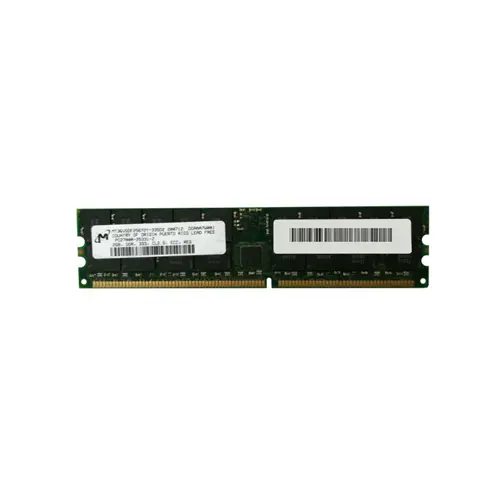
The Micron MT36VDDF25672Y-335D2 is a server-class registered DIMM engineered for environments where uptime and accuracy are non-negotiable. In a virtualized cluster running multiple database VMs, its ECC capability silently corrects single-bit memory errors caused by background radiation. For you, that means transactions are not corrupted mid-flight and hypervisor stability remains intact, directly preventing costly data loss and unplanned failover events. The registered signal type buffers command and address lines, enabling the deployment of multiple modules per channel without electrical loading degrading signal integrity. When your in-memory database like Redis scales to hundreds of gigabytes across DIMM slots, this ensures reliable, glitch-free operation even under heavy simultaneous access. The dual-rank x4 organization interleaves internal banks to boost bandwidth utilization—critical when virtualized workloads hammer memory with random reads and writes, cutting latency and improving effective throughput. Paired with a tight CL2.5 column access strobe, the module serves up critical data with minimal delay, accelerating response times in financial analysis caches or real-time analytics platforms where every microsecond counts.
General Virtualization
For general virtualization on legacy servers using these 2 GB DDR-333 RDIMMs, populate at least four modules (8 GB total) per host to run a handful of light VMs. Pair modules in identical dual-channel configurations to maximize bandwidth. Given the 2.5 V ECC registered design, stick to validated server platforms and balance modules across all memory channels to avoid bottlenecks.
In-Memory Database
In-memory databases demand low latency and ample capacity. Maximize capacity by filling all available DIMM slots—typically six or eight modules (12–16 GB) in a single-socket system. The ECC and registered signaling reduce data errors, critical for transactional workloads. Because 2 GB modules are modest, deploy multiple servers in a cluster to collectively hold larger datasets in memory.
High-Performance Computing (HPC)
For HPC, populate every memory channel with at least one 2 GB RDIMM to balance bandwidth and node count. A typical node might use four modules (8 GB) installed in a symmetric dual-channel arrangement. The DDR-333 speed and CL2.5 latency are sufficient for burst buffer nodes or lighter compute tasks, but avoid using these modules in latency-sensitive parallel jobs without ample memory bandwidth per core.
Verified compatibility: rigorously tested for Dell PowerEdge 2850, HP ProLiant DL380 G4, IBM xSeries 346.
Q: Can I mix this MT36VDDF25672Y-335D2 with other memory modules of different brands or speeds?
A: Mixing registered ECC modules of different speeds or brands is strongly discouraged. Doing so can cause signal integrity issues, forcing the memory to run at the lowest common speed, and may compromise system stability on server platforms.
Q: Is this memory compatible with my system?
A: Compatibility requires a server board supporting 184-pin DDR Registered ECC DIMMs. Verify your Intel or AMD server chipset supports PC-2700 at 2.5V, as this module is not compatible with unbuffered or standard desktop memory slots.
Q: What is the recommended DIMM population order for optimal performance?
A: Always consult your server motherboard manual. Typically, populate identical dual-rank RDIMMs in matched pairs per memory channel, starting with the slots farthest from the CPU, to maintain balanced interleaving and maximize throughput.
Q: Does this module support overclocking or XMP profiles?
A: No. This is a server-grade registered ECC DIMM designed for strict JEDEC compliance at DDR-333. It does not support overclocking or XMP profiles, as data integrity and stability take priority over performance tuning in enterprise environments.
Q: What warranty and typical failure rate can I expect?
A: This module comes with a 1-year warranty. As an enterprise-class RDIMM built to stringent quality standards, the typical annualized failure rate is extremely low under proper thermal and voltage conditions in compliant servers.