











 Secure payments
Standard refund policy
Trade Assurance
Secure payments
Standard refund policy
Trade Assurance
| Product Type | Memory Module |
|---|---|
| Compliance Standards | RoHS |
| Memory Capacity | 8 GB |
| Memory Technology | DDR3 |
| Product Voltage | 1.5V |
| RAM Speed | 1066MHz |
| RAM Standard | DDR3-1066/PC3-8500 |
| Error Identifying | ECC |
| Signal Type | Registered |
| Column Access Strobe (CAS) | CL7 |
| Rank | Quad Rank x4 |
| Quantity of Pins | 240-pin |
| RAM Genre | RDIMM |
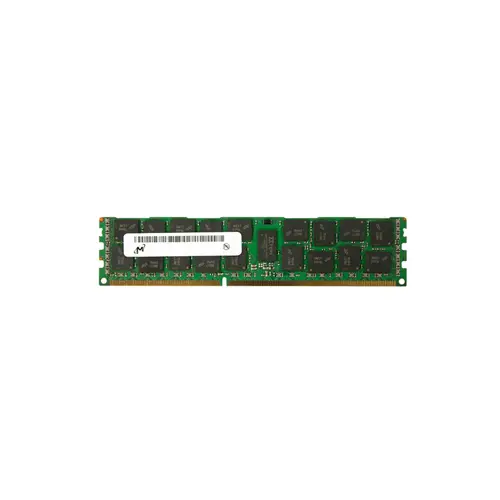
This is a server-class DDR3-1066 RDIMM with ECC and a Quad Rank x4 configuration, ideally suited for legacy virtualization hosts and in-memory database servers where data integrity and high module density are critical. Its registered signal type ensures stable command-address loading in multi-DIMM channels, and the CL7 latency combined with Quad Rank interleaving can provide a measurable throughput advantage in sustained write-intensive workloads.
1. ECC memory ensures end-to-end data integrity, eliminating silent bit-flips that could corrupt financial transactions or virtualization metadata in always-on enterprise servers.
2. Registered signal buffering stabilizes command and address lines across fully populated memory channels, enabling reliable operation in high-density rack deployments without signal degradation.
3. Quad Rank x4 organization packs more DRAM banks per channel, boosting memory-level parallelism for consistent throughput in heavy virtual machine consolidation scenarios.
4. An 8 GB capacity per module hits the cost-density sweet spot for mid-range cloud nodes, allowing a single socket to host dozens of lightweight containers without overprovisioning resources.
5. CL7 low latency reduces the memory access penalty for cache-miss-bound workloads, directly lowering response times in latency-critical database and analytics engines.
When you power a virtualized cluster or an in-memory database, the memory module inside every server is either a foundation for uptime or a single point of failure. The Micron MT72JSZS1G72PZ-1G1D1 is an 8 GB DDR3-1066 Registered RDIMM built precisely for that reality. Its ECC technology actively detects and corrects single-bit errors caused by background radiation or cosmic particles—if you are running a hypervisor with dozens of virtual machines, one uncorrected bit flip can crash entire workloads or silently corrupt financial transactions in a database. That is data integrity you cannot negotiate.
The registered architecture places a buffer on the address and command bus, decoupling the memory controller from the electrical load of DRAM chips. This means you can fully populate all 18 or 24 DIMM slots in a typical dual-socket server without signal degradation, directly supporting dense virtualization or large-memory analytics where every gigabyte counts. With a quad-rank x4 organization, this module packs four independent ranks of memory on a single stick, delivering improved bandwidth via interleaving and allowing the memory controller to hide access latency under heavy concurrency. For an in-memory cache like Redis or a real-time trading engine, that translates into consistent low latency under load. Combined with a tight CL7 access time, this DIMM eliminates the hesitation that hurts transactions-per-second metrics. When your business lives on virtual machines or relies on a fast, error-free memory footprint, this is the reliability you build on.
This is a server-grade memory module, identified by its Registered ECC (RDIMM) technology, DDR3-1066 speed, and quad-rank x4 construction. The following capacity planning recommendations use this 8 GB module across three typical server workloads.
General Virtualization
Populate all memory channels identically to ensure consistent, balanced performance across NUMA nodes. For a dual-socket server with three channels per CPU, install six 8 GB RDIMMs (48 GB total) as a baseline, scaling to twelve modules for 96 GB to comfortably host a larger number of mixed-OS virtual machines without oversubscription.
In-Memory Database
Maximize capacity by fully populating every DIMM slot with these 8 GB quad-rank modules, even if speed may drop to 800 MHz under heavy loading. A configuration of 18 or 24 identical RDIMMs delivers 144–192 GB, enabling large datasets to reside in low-latency main memory and drastically reducing disk I/O bottlenecks.
High Performance Computing
Prioritize peak memory bandwidth by installing one 8 GB RDIMM per channel, maintaining the full 1066 MHz data rate and low CL7 latency. In a dual-socket system, six or eight modules provide 48–64 GB, which is typically sufficient for per-node HPC tasks when paired with efficient interleaving and minimal memory rank contention.
Rigorously tested server memory; compatible with Dell PowerEdge R710, HP DL380 G7, and more.
Q: Can I mix this MT72JSZS1G72PZ-1G1D1 with other memory modules of different brands or speeds?
A: Mixing different brands or speeds is not recommended for registered DDR3 server memory. Unmatched modules may cause signal integrity issues, leading to instability or POST failures in mission-critical environments.
Q: Is this memory compatible with my server?
A: This RDIMM is compatible with servers using Intel Xeon 5500/5600 series or AMD Opteron 6100 platforms that require DDR3-1066 registered ECC memory. Always verify your motherboard’s qualified vendor list.
Q: What is the recommended DIMM population order for optimal performance?
A: Populate identical quad-rank DIMMs per channel, starting with slots farthest from the CPU. Follow the platform-specific memory configuration guide to balance interleaving and avoid performance penalties.
Q: Does this module support overclocking or XMP profiles?
A: No. This is a JEDEC-standard DDR3 registered ECC module for servers. It does not support XMP or overclocking features and operates strictly at fixed 1066 MHz with CL7 timings.
Q: What warranty and typical failure rate can I expect?
A: This module includes a one-year warranty. Typical annualized failure rate (AFR) for these enterprise-grade DRAM modules is well below 0.5%, ensuring high reliability in 24/7 server deployments.