











 Secure payments
Standard refund policy
Trade Assurance
Secure payments
Standard refund policy
Trade Assurance
| Product Type | Memory Module |
|---|---|
| Memory Capacity | 32 GB |
| Memory Technology | DDR3 |
| Product Voltage | 1.5V |
| RAM Standard | DDR3-1866/PC3-14900 |
| Error Identifying | ECC |
| Signal Type | Registered |
| Column Access Strobe (CAS) | CL13 |
| Rank | Quad Rank x4 |
| Quantity of Pins | 240-pin |
| RAM Genre | RDIMM |
This 32 GB DDR3-1866 Registered ECC RDIMM, configured as Quad Rank x4, is engineered for legacy enterprise servers and workstations demanding high memory capacity per channel with uncompromised data integrity. Its CL13 latency and registered signal buffering ensure stable operation under heavy virtualized or in-memory database workloads where reliable error correction is critical.
1. 32 GB capacity per module enables dense memory footprints, supporting significantly more virtual machines per physical server while keeping critical applications fully cached.
2. ECC protection silently corrects single-bit errors in real time, preserving data integrity for financial ledgers and mission-critical databases that cannot tolerate corruption.
3. Registered signal buffering decouples address and command loads from the memory bus, allowing fully populated 24‑DIMM configurations to run stably without signal decay.
4. DDR3-1866 speed sustains up to 14.9 GB/s bandwidth per channel, keeping latency‑sensitive SaaS workloads responsive under concurrent user spikes.
5. Quad Rank x4 organization maximizes DRAM density on a single RDIMM, satisfying the extreme memory demands of in‑memory analytics without exceeding platform rank limits.
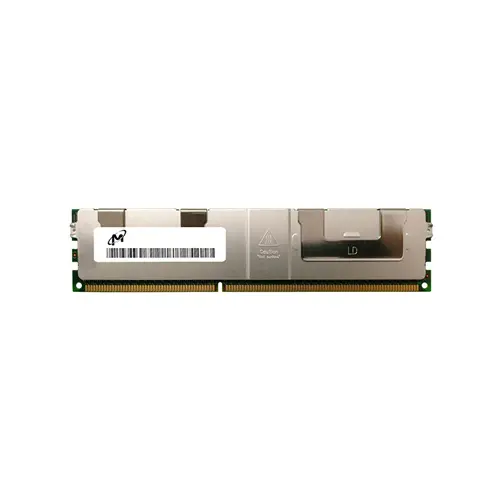
This Micron 32GB DDR3-1866 module, marked by the part number MT72JSZS4G72LZ-1G9E2A7CF, is a Registered DIMM (RDIMM) engineered explicitly for server-class workloads where reliability and density are paramount. Its core attributes—ECC, registered signaling, quad-rank organization, and 1866MT/s bandwidth—directly address the operational pain points of modern data centers. In a dense virtualization cluster hosting dozens of virtual machines on a single physical host, undetected memory errors can silently corrupt application states or crash the entire hypervisor, jeopardizing service-level agreements. ECC scrubbing corrects single-bit flips in real time, preventing such invisible data corruption and preserving system uptime. The registered clock driver buffers the command and address lines, stabilizing signal integrity when multiple high-capacity modules populate all memory channels; this allows you to confidently scale to terabyte-scale memory pools without the startup failures or stability issues that plague unbuffered designs. For in-memory databases like Redis or SAP HANA, where entire datasets reside in DRAM for sub-millisecond access, the quad-rank x4 configuration maximizes capacity within a single slot, enabling denser hosting. Paired with the PC3-14900 throughput and CL13 latency, it ensures that complex real-time analytics and transactional queries stream to the CPU with minimal latency, directly translating into faster insights and higher transaction rates for your business.
General Virtualization
For dense virtualization hosts, this 32 GB Registered ECC DDR3-1866 module is a strong building block. We recommend deploying six to twelve identical modules per dual-socket server to achieve 192–384 GB, ensuring balanced memory channels and ample headroom for 30–50 typical virtual machines while maintaining ECC protection against soft errors.
In-Memory Database
Latency-sensitive in-memory databases benefit from the module’s CL13 timing and high frequency, but quad-rank DIMMs can reduce maximum achievable speed when multiple DIMMs per channel are installed. Populate one DIMM per channel for full 1866 MT/s throughput—e.g., eight modules across a dual-processor platform for 256 GB—or limit to two DIMMs per channel if scaling to 512 GB, accepting slight speed derating while preserving data integrity.
High-Performance Computing
For HPC cluster nodes, memory bandwidth is critical; populate all available channels with a single module per channel to maximize frequency and avoid rank contention. A typical dual-socket configuration with eight channels total would use eight of these 32 GB RDIMMs to supply 256 GB at full DDR3-1866, providing sufficient capacity for large-scale simulations and parallel I/O without ECC-related compute overhead.
This server memory has been rigorously tested and is compatible with Dell PowerEdge R720, HP DL380p Gen8, Lenovo x3650 M4.
Q: Can I mix this MT72JSZS4G72LZ-1G9E2A7CF with other memory modules of different brands or speeds?
A: Mixing RDIMMs of different brands or speeds is not recommended. Different timings, ranks, or voltages may cause signal integrity issues and system instability. Use identical part numbers for reliable server operation.
Q: Is this memory compatible with my system?
A: This DDR3-1866 ECC Registered DIMM is designed for Intel Xeon E5-2600 v2/v3 or AMD Opteron 6300 series servers. Verify your board supports quad-rank x4 32GB modules and check the official memory QVL.
Q: What is the recommended DIMM population order for optimal performance?
A: Follow your server board manual. Typically, populate the furthest slot per channel first. For quad-channel platforms and quad-rank DIMMs, use one DIMM per channel initially, adding a second pair later to balance loads.
Q: Does this module support overclocking or XMP profiles?
A: No. This JEDEC-compliant DDR3-1866 RDIMM has no XMP profiles. Overclocking is not supported on enterprise registered memory, as it compromises the error correction and long-term stability essential for server workloads.
Q: What warranty and typical failure rate can I expect?
A: This module is covered by a 1-year warranty. Built to stringent enterprise standards, ECC RDIMMs exhibit an annualized failure rate (AFR) below 0.5%, ensuring mission-critical reliability with proper system cooling and voltage.