











 Secure payments
Standard refund policy
Trade Assurance
Secure payments
Standard refund policy
Trade Assurance
| Model | MT72KGF4G72LZ-1G4 |
|---|---|
| Product Type | Memory Module |
| Compliance Standards | RoHS |
| Memory Capacity | 32 GB |
| Memory Technology | DDR3 |
| Product Voltage | 1.35V |
| RAM Speed | 1333MHz |
| RAM Standard | DDR3-1333/PC3-10600 |
| Error Identifying | ECC |
| Signal Type | Registered |
| Column Access Strobe (CAS) | CL9 |
| Rank | Quad Rank x4 |
| Quantity of Pins | 240-pin |
| RAM Genre | RDIMM |
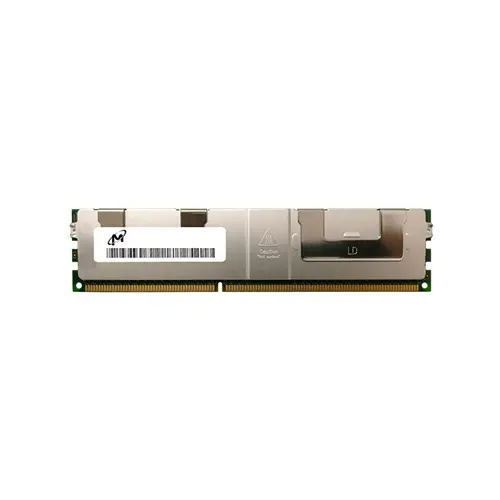
Based on its RDIMM form factor, ECC, and registered signal type, this 32GB DDR3-1333 module is firmly a server-grade memory solution, ideally suited for virtualization hosts and memory-intensive database applications where data integrity and system stability are non-negotiable. The quad-rank x4 organization maximizes capacity per channel while the 1.35V low-voltage operation and CL9 latency efficiently balance power consumption with responsive access for 24/7 enterprise workloads.
1. Dense memory capacity enables high virtual machine density and large in-memory database footprints, reducing the server sprawl required for demanding enterprise consolidation workloads.
2. Integrated error correction shields transactional and analytical operations from silent data corruption, delivering the uncompromising data integrity that financial and scientific computing depend on.
3. Registered buffering preserves clean command and address signaling across fully loaded chassis, allowing operators to scale memory channels without risking intermittent stability faults.
4. Multi-rank chip organization amplifies bank-level parallelism, keeping data pipelines fully saturated and maintaining consistent throughput under heavy, mixed-tenant virtualization pressure.
5. Low-voltage operation directly shrinks power draw and waste heat at the rack level, lowering both electricity consumption and cooling overhead in dense, always-on server environments.
The Micron MT72KGF4G72LZ-1G4 is a 32GB DDR3-1333 RDIMM engineered for enterprise servers where uptime and data integrity directly impact revenue. Its ECC technology actively corrects single-bit memory errors caused by cosmic radiation or electrical noise, a critical safeguard when running a virtualized cluster. A flipped bit in a hypervisor can crash dozens of virtual machines; ECC turns that silent corruption into a non-event, preserving business continuity.
Coupled with ECC, the registered buffer isolates the memory controller from the electrical load of 32GB quad-rank x4 DRAM packages. In memory-intensive databases like SAP HANA or Redis, populating all channels with high-capacity RDIMMs would otherwise overstress the processor and cause signal degradation. The register ensures clean, reliable signaling, letting you scale to terabytes of RAM with consistent 1333MHz latency—essential for real-time analytics.
The quad-rank architecture and CAS 9 latency further sustain bandwidth under concurrent access. When multiple database queries hit memory simultaneously, interleaved ranks reduce contention and keep throughput stable. Finally, the 1.35V operating voltage cuts per-DIMM power draw, which compounds across a full rack. Lower thermal stress extends component lifespan and reduces cooling costs, a tangible advantage in dense data center environments. For IT architects, this RDIMM means safer workloads, predictable performance at scale, and a cooler, more economical server footprint.
General Virtualization
To host numerous virtual machines, populate memory channels evenly to maintain balanced performance. Deploy six or eight of these 32GB Registered ECC RDIMMs in a dual-socket server for a total of 192GB or 256GB, comfortably supporting 20–30 moderate VMs. Always install identical modules across all populated channels to eliminate NUMA imbalances and preserve reliable 1333MHz operation.
In-Memory Database
Databases like Redis or SAP HANA require whole datasets resident in RAM; maximize capacity by filling every available DIMM slot on your supported server board. A fully loaded 24-slot configuration with these Quad Rank modules yields 768GB, ensuring massive in-memory caching and sub-millisecond response times. The registered ECC corrects errors automatically, critical for preserving data integrity under sustained heavy writes.
High-Performance Computing
In HPC clusters, balance bandwidth and capacity by using one DIMM per memory channel—typically four or eight modules per CPU for 128GB or 256GB per node. Running at a clean 1 DPC (DIMM per channel) sustains the full 1333MHz speed while avoiding the down-clocking triggered by multiple Quad Rank loads. This delivers consistent, high-throughput memory access for simulation, modeling, and large-scale parallel computations.
Rigorously tested server memory, compatible with Dell PowerEdge R710, HP ProLiant DL380 G7, and similar DDR3 ECC RDIMM platforms.
Q: Can I mix this MT72KGF4G72LZ-1G4 with other memory modules of different brands or speeds?
A: Mixing RDIMMs of different brands or speeds is not recommended in server environments. It often leads to stability issues and forces all modules to run at the lowest common speed, typically at 1333MHz.
Q: Is this memory compatible with my Intel Xeon E5 or AMD Opteron server platform?
A: This DDR3-1333 RDIMM with ECC is compatible with dual-socket servers using Intel Xeon E5-2400/2600 v1/v2 series and select AMD Opteron 6300 series platforms. Verify quad-rank support on your motherboard.
Q: What is the recommended DIMM population order for optimal performance using this quad-rank module?
A: For quad-rank RDIMMs, populate the first slot of each memory channel (usually blue slots) first. Balance channels across processors and adhere to your server’s specific population guide to avoid performance degradation.
Q: Does this module support overclocking or XMP profiles?
A: No. As a server-grade Registered ECC DIMM, this module adheres to JEDEC DDR3-1333 CL9 specifications. Overclocking and XMP profiles are not supported, prioritizing data integrity and stability over frequency adjustments.
Q: What warranty and typical failure rate can I expect for this memory?
A: This module includes a 1-year warranty. Enterprise DDR3 RDIMMs have an annualized failure rate (AFR) typically below 0.5% under proper cooling and workload conditions, ensuring long-term reliability.