











 Secure payments
Standard refund policy
Trade Assurance
Secure payments
Standard refund policy
Trade Assurance
| Product Type | Memory Module |
|---|---|
| Memory Capacity | 2 GB |
| Memory Technology | DDR3 |
| RAM Speed | 1600MHz |
| RAM Standard | DDR3-1600/PC3-12800 |
| Error Identifying | Non-ECC |
| Signal Type | Unbuffered |
| Column Access Strobe (CAS) | CL11 |
| Rank | Single Rank x8 |
| Quantity of Pins | 240-pin |
| RAM Genre | UDIMM |
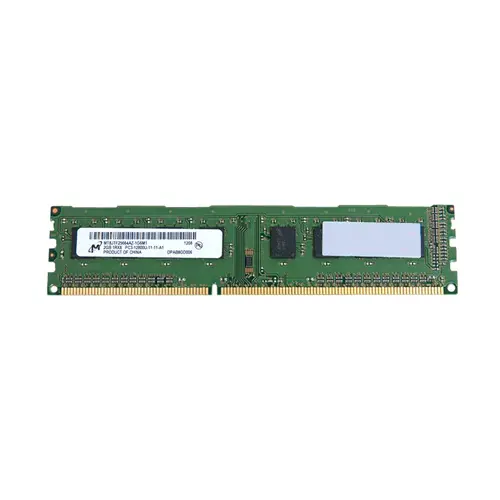
This 2GB DDR3-1600 UDIMM is a desktop-class, non-ECC memory module best suited for breathing new life into older home/office PCs handling daily productivity, light content creation, or legacy gaming. Its unbuffered, single-rank x8 construction reduces electrical loading on the memory bus, delivering enhanced signal integrity and broad backwards compatibility with aging chipsets.
1. 1600MHz frequency delivers consistent frame pacing in mainstream gaming rigs, preventing stutter when the CPU demands rapid texture streaming.
2. CL11 latency tightens the gap between data request and delivery, making multi-window workflows and alt-tabbing between applications feel instantaneous.
3. Single Rank x8 organization reduces electrical load on the memory controller, helping enthusiasts push higher base clocks with improved stability.
4. Unbuffered signaling strips away register delays, giving competitive gamers the lower command-to-response time needed for high-refresh monitors.
5. Non-ECC operation avoids the cycle penalty of parity checks, ensuring full bandwidth is devoted to shader compilation and real-time content creation tasks.
As a 240-pin unbuffered non-ECC UDIMM, this desktop DDR3 module directly addresses the core needs of gamers and content creators. Its unbuffered architecture eliminates the register clock cycle penalty found in server memory, achieving true CL11 latency. In fast-paced AAA titles, this reduced delay means every frame arrives sooner, keeping your reaction sharp. The non-ECC configuration avoids error-correction overhead, ensuring 1600MHz bandwidth is fully dedicated to asset streaming; when you are scrubbing through a 4K video timeline, textures and effects load without micro-stutters. The single-rank x8 design presents a lighter electrical load to the CPU’s memory controller, which improves stability and leaves headroom for tighter timings or a modest overclock on compatible boards. For the desktop user upgrading an aging workstation or gaming rig, these characteristics collectively deliver a fluid, responsive experience where multitasking during heavy renders and high-refresh gameplay feel seamless and immediate.
Based on the specifications—Non-ECC, Unbuffered, 240-pin UDIMM—this is a standard desktop DDR3 2GB memory module. The following capacity planning guidance addresses typical desktop workloads.
Gaming Build
To assemble a 16 GB dual-channel kit using these 2 GB DIMMs, you would need eight modules—four per channel—demanding a motherboard with eight memory slots (e.g., an HEDT X79/X99 platform). A 32 GB dual-channel goal would require sixteen modules, which is unrealistic for mainstream boards; for modern gaming builds, migrate to 8 GB or 16 GB DIMMs in matched pairs instead.
Content Creation
A 64 GB configuration for video editing or 3D rendering would consume 32 of these 2 GB modules, far exceeding any standard desktop’s slot count. Content creators should abandon per-module capacities this small and adopt high-density kits—for instance, four 16 GB DIMMs in a quad-channel platform or two 32 GB DIMMs in a dual-channel workstation, ensuring ample headroom for asset-heavy projects.
General Productivity
For everyday office work, web browsing, and light multitasking, a cost-effective dual-channel setup consists of just two 2 GB modules (4 GB total), keeping budgets low while enabling interleaved memory access. Users who run heavier multitasking or numerous browser tabs can expand to four modules (8 GB) installed across both channels, which noticeably improves responsiveness without overspending.
Rigorously tested desktop DDR3 UDIMM; compatible with Dell OptiPlex 790, HP Compaq 8200 Elite, etc.
Q: Can I mix this MT8JTF25664AZ-1G6M1 with other memory modules of different brands or speeds?
A: Mixing modules is not recommended, as mismatched speed, latency, or IC density may cause instability. For reliable dual-channel operation, install identical Micron-certified UDIMMs with the same part number and rank.
Q: Is this MT8JTF25664AZ-1G6M1 memory compatible with my system?
A: This DDR3-1600 UDIMM is designed for desktop boards with Intel 6/7/8-series or AMD 900-series chipsets. Verify your motherboard supports 240-pin 1.5V unbuffered non-ECC memory and a 2GB single-rank module.
Q: What is the recommended DIMM population order for optimal performance?
A: Install this single-rank module in the primary slot (often DIMM_A2 on 4-slot boards) for single-channel operation. For dual-channel, populate matched pairs into the same-colored slots as indicated in your motherboard manual.
Q: Does this MT8JTF25664AZ-1G6M1 module support overclocking or XMP profiles?
A: No. This module uses JEDEC-compliant DDR3-1600 CL11 timings at 1.5V and does not include XMP profiles. Overclocking is not officially supported and may void the warranty.
Q: What warranty and typical failure rate can I expect for this module?
A: It is backed by a 1-year warranty. Micron 2GB DDR3 UDIMMs exhibit an industry-leading, ultra-low annualized failure rate under normal operating conditions when installed per specification.