











 Secure payments
Standard refund policy
Trade Assurance
Secure payments
Standard refund policy
Trade Assurance
| Product Type | Memory Module |
|---|---|
| Compliance Standards | RoHS |
| Memory Capacity | 4 GB |
| Memory Technology | DDR3 |
| RAM Speed | 1600 |
| RAM Standard | DDR3-1600/PC3-12800 |
| Error Identifying | Non-ECC |
| Signal Type | Unbuffered |
| Column Access Strobe (CAS) | CL11 |
| Rank | Single Rank x8 |
| Quantity of Pins | 204-pin |
| RAM Genre | SoDIMM |
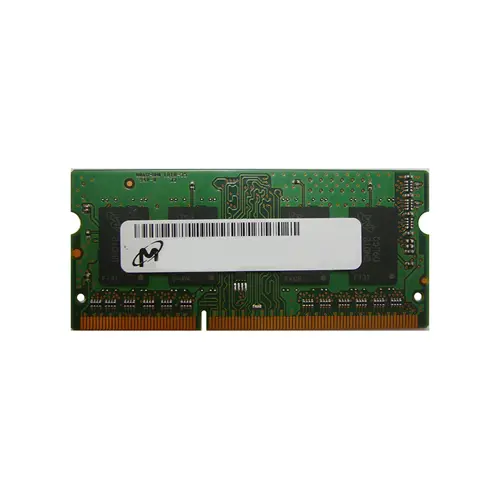
This DDR3-1600 SoDIMM is a standard notebook memory module designed for upgrading older laptops and mobile workstations, offering plug-and-play compatibility with a wide range of Intel and AMD platforms. Its single-rank x8 configuration reduces electrical loading on the memory controller, ensuring reliable unbuffered signaling and improved power efficiency for extended battery life in portable systems.
1. SoDIMM form factor guarantees a straightforward, tool-free installation into ultrabooks and small-form-factor laptops, making hardware upgrades accessible to any user.
2. 4 GB capacity revitalizes aging portable systems, comfortably handling modern operating systems and everyday productivity without excessive swapping.
3. DDR3 technology ensures seamless compatibility across a wide ecosystem of legacy notebooks, allowing a low-risk, drop-in performance refresh.
4. 1600 MT/s data rate strikes an optimal balance between snappy application launch times and minimal battery drain during mobile multitasking.
5. Single Rank x8 organization reduces the electrical load on the notebook’s memory controller, resulting in cooler operation and extended battery runtime in fanless designs.
The MT8JTF51264HZ-1G6 is unmistakably a notebook memory module, and its design directly addresses the real-world frustrations of laptop users. As a 204-pin DDR3 SODIMM, it slots effortlessly into compact ultrabooks and mobile workstations, making a field upgrade simple enough for any IT technician or even a confident end-user, eliminating the need for proprietary tools or service center delays.
Its unbuffered, non-ECC architecture is a deliberate choice for mobile computing. Without the overhead of error correction and signal buffering, the module draws less power and generates minimal heat. For a traveling consultant running virtual machines on a workstation, this translates directly to extended battery life during client meetings and quieter, cooler operation. The low electrical load also places less stress on aging laptop voltage regulators, improving platform longevity.
The DDR3-1600 speed and CL11 timing strike a critical balance. In a thin-and-light notebook upgraded from 2 GB to this 4 GB module, users experience tangibly smoother multitasking—you can keep a dozen browser tabs, a document editor, and a video call active without the system grinding to a halt. For a field service engineer running lightweight diagnostic databases locally, the single-rank x8 organization ensures stable signal integrity and swift data access on older chipsets that struggle with high-density configurations. It is not just a specification; it is the difference between a laptop that stalls under pressure and one that remains a reliable daily workhorse.
This is a standard laptop DDR3 SO-DIMM: 4 GB, DDR3-1600, Non-ECC, unbuffered, single-rank x8. Capacity planning revolves around dual-channel upgrades, maximum density, and power efficiency.
Laptop Upgrade
Add a second identical 4 GB SO-DIMM (DDR3-1600 CL11, 1.5 V) to create an 8 GB dual-channel configuration; this doubles capacity and bandwidth, noticeably improving Windows multitasking and browser responsiveness. If the chipset permits, replace the single 4 GB module with a matched pair of 8 GB DDR3-1600 SO-DIMMs for a 16 GB upgrade, keeping the original as a spare.
Mobile Workstation
For CAD, 3D rendering, or large spreadsheets, maximize capacity by populating both slots with the highest supported density—typically two 8 GB DDR3-1600 modules for a total of 16 GB. The original 4 GB single-rank module can be retired to avoid mixing ranks and capacities, ensuring stable signal integrity under sustained professional workloads.
Ultrabook Power Saving
To extend battery runtime, replace the standard 1.5 V module with a low-voltage DDR3L‑1600 4 GB SO-DIMM operating at 1.35 V. Pair it with a matching DDR3L‑1600 stick to enable 8 GB in dual‑channel low‑power mode; this reduces energy draw while maintaining smooth ultrabook performance during content consumption and office tasks.
Strictly tested for reliable compatibility with laptops: Dell Latitude E6430, Lenovo ThinkPad T430, HP EliteBook 8470p.
Q: Can I mix this MT8JTF51264HZ-1G6 with other memory modules of different brands or speeds?
A: Mixing is possible but not guaranteed. The module operates at JEDEC standard DDR3-1600 CL11. For best stability, install identical modules with matching capacity, rank, and timings.
Q: Is this memory compatible with my laptop?
A: It fits notebooks with a DDR3 SoDIMM slot supporting 204-pin, 1.5V unbuffered non-ECC memory. Compatible with many Intel 2nd/3rd Gen Core and AMD A-series platforms. Verify your model’s specification.
Q: What is the recommended DIMM population order for optimal performance?
A: In laptops with dual slots, install this module in the primary slot. For dual‑channel operation, pair it with an identical module of the same speed, capacity, and single‑rank x8 organization.
Q: Does this module support overclocking or XMP profiles?
A: No. This is a standard JEDEC‑compliant SoDIMM with fixed DDR3-1600 CL11 timings. It does not include XMP profiles and is not designed for overclocking.
Q: What warranty and typical failure rate can I expect?
A: The module comes with a 1-year warranty. Typical annualized failure rate (AFR) is well below 0.5% under normal operating conditions, consistent with industry standards.