











 Secure payments
Standard refund policy
Trade Assurance
Secure payments
Standard refund policy
Trade Assurance
| Product Type | Memory Module |
|---|---|
| Compliance Standards | RoHS |
| Memory Capacity | 512 MB |
| Memory Technology | DDR |
| RAM Speed | 333 |
| RAM Standard | DDR-333/PC-2700 |
| Error Identifying | Non-ECC |
| Signal Type | Unbuffered |
| Column Access Strobe (CAS) | CL2.5 |
| Rank | Single Rank x8 |
| Quantity of Pins | 200-pin |
| RAM Genre | SoDIMM |
This SoDIMM is a legacy DDR-333 module designed for notebook upgrades, delivering reliable Non-ECC, Unbuffered performance for older mobile workstations and compact embedded systems where low power draw and plug-and-play compatibility are critical. Its Single Rank x8 configuration minimizes electrical loading on the memory controller, and the CL2.5 CAS latency ensures snappy responsiveness at the rated 333 MHz speed.
1. SoDIMM form factor enables straightforward, tool-free installation in compact notebook chassis, letting mobile workers upgrade memory on the spot without technical assistance.
2. 512 MB capacity revitalizes older laptops for light multitasking, keeping essential office suites and a lean operating system responsive instead of bogging down in swap file thrash.
3. DDR memory technology operates at lower voltage than legacy SDRAM, trimming heat generation inside tight notebook enclosures and preserving battery life during travel.
4. 333 MHz clock speed delivers adequate data throughput for typical business applications while respecting the modest thermal headroom of ultraportable cooling designs.
5. CL2.5 column access latency reduces data-fetch stalls, giving the system a perceptibly quicker feel when launching programs or switching between browser tabs in a mobile workflow.
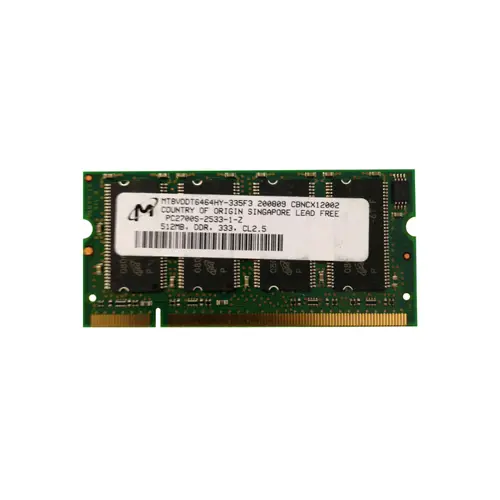
Designed specifically for the notebook platform, the Micron MT8VDDT6464HY-335F3 is a 512MB DDR-333 (PC-2700) 200-pin SODIMM. Its four defining characteristics translate directly into practical advantages for mobile users.
The DDR-333 speed grade with a CL2.5 CAS latency delivers responsive burst performance that keeps older laptops snappy during everyday multitasking—switching between a browser with multiple tabs, a document editor, and a video call feels fluid rather than sluggish. This low latency particularly benefits thin-and-light notebooks running from a mechanical hard drive, where every millisecond saved in memory access reduces frustrating load-time stutter. For the mobile workstation user repairing or upgrading aging field equipment, the single-rank x8 organization ensures maximum compatibility across a wide range of legacy chipsets while drawing minimal power, which helps preserve precious battery runtime during off-grid diagnostics. The standard unbuffered, non-ECC 200-pin SODIMM form factor makes installation straightforward: it slips securely into your notebook’s memory slot with no complex configuration, giving IT technicians and home upgraders alike a foolproof path to extend the usable life of travel-friendly corporate laptops and student portables.
Laptop Upgrade
This 512 MB DDR-333 SoDIMM is suited for rejuvenating aging laptops originally equipped with minimal memory. For basic upgrades, install two identical modules to enable dual‑channel operation and reach 1 GB total, which noticeably improves responsiveness under Windows XP or lightweight Linux distributions. As an alternative, replace a single 256 MB module with this 512 MB stick to achieve 768 MB—enough for smoother web browsing and office tasks without investing in a full kit.
Mobile Workstation
A single 512 MB module is insufficient for modern mobile workstation demands; however, in vintage professional laptops that support up to 2 GB via two slots, this DIMM can be part of a maximum‑capacity configuration. Pair two of these modules to hit the 1 GB ceiling when the chipset permits, providing the minimum headroom for legacy CAD or data analysis tools. For contemporary workloads, migrate to a platform that accepts 4 GB or larger DDR3/DDR4 SoDIMMs, as this DDR‑333 part cannot meet current professional application requirements.
Ultrabook Power Saving
While early‑generation ultra‑portables often used DDR‑333 SoDIMMs, this specific module is not a low‑voltage variant, so its power‑saving benefit is limited compared to modern LPDDR standards. If upgrading a vintage ultrabook, installing a single 512 MB module reduces the number of active DRAM chips versus populating both slots, which marginally lowers power draw. For genuine battery‑life gains, seek out LV‑DDR SoDIMMs or migrate to a newer ultrabook platform where DDR4‑L or LPDDR delivers far superior energy efficiency.
Rigorously tested laptop memory, compatible with Dell Latitude D600, IBM ThinkPad T40, HP Compaq nc6000.
Q: Can I mix this MT8VDDT6464HY-335F3 with other memory modules of different brands or speeds?
A: Mixing different brands or speeds is not recommended. The system will match the slowest module, likely causing instability. For reliable operation, install identical DDR-333 PC-2700 SoDIMMs with matching CAS latency and single‑rank organization.
Q: Is this memory compatible with my system? (Please provide your laptop model or chipset.)
A: This 200‑pin DDR‑333 (PC‑2700) SoDIMM fits older notebooks with Intel 855/915 chipsets or similar. Verify your laptop supports 512 MB modules and a 333 MHz bus. Provide the exact model to confirm compatibility.
Q: What is the recommended DIMM population order for optimal performance?
A: In single‑channel notebooks, slot order does not affect performance. If your system has two slots, you may install one module in either slot. For dual‑channel capability, a matched pair is required; this single module alone cannot enable dual‑channel.
Q: Does this module support overclocking or XMP profiles?
A: No. This module adheres to JEDEC DDR‑333 standards at default CL2.5. It does not support XMP, overclocking, or user‑adjustable timing profiles. Laptop BIOS typically locks these settings.
Q: What warranty and typical failure rate can I expect?
A: This memory carries a one‑year warranty and undergoes rigorous testing. The typical annualized failure rate is well below 0.5% under normal operating conditions, provided the module is installed in compatible, RoHS‑compliant systems.