

 Secure payments
Standard refund policy
Trade Assurance
Secure payments
Standard refund policy
Trade Assurance
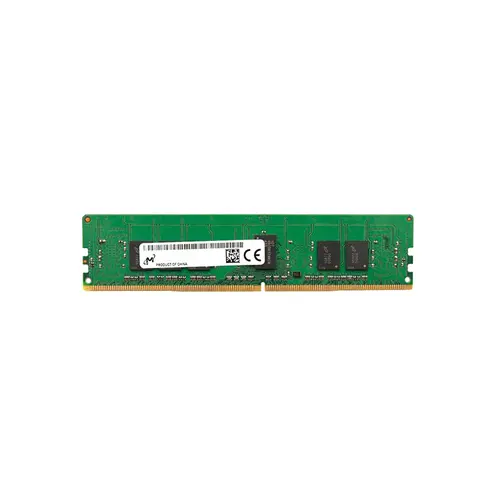
| Model | MT9ASF51272PZ-2G3B1 |
|---|---|
| Product Type | Memory Module |
| Compliance Standards | RoHS |
| Memory Capacity | 4 GB |
| Memory Technology | DDR4 |
| Product Voltage | 1.2V |
| RAM Speed | 2133MHz |
| RAM Standard | DDR4-2133/PC4-17000 |
| Error Identifying | ECC |
| Signal Type | Registered |
| Column Access Strobe (CAS) | CL15 |
| Rank | Single Rank x8 |
| Quantity of Pins | 288-pin |
| RAM Genre | RDIMM |
This DDR4-2133 Registered DIMM with ECC is purpose-built for server platforms running virtualization or in-memory databases, where data integrity and 24/7 stability are critical. Its single-rank x8 configuration and registered signal type reduce bus loading and enhance command/address signal integrity, while CL15 latency keeps access times low to sustain throughput under heavy memory workloads.
1. Registered signal type ensures stable operation across fully populated server memory channels, safeguarding data integrity in virtualized environments where multiple VMs demand concurrent access.
2. ECC protection actively corrects single-bit errors and detects multi-bit faults, preserving transactional accuracy for databases and financial applications that cannot tolerate silent data corruption.
3. Single Rank x8 organization reduces electrical loading on the memory bus, allowing higher memory density per server node and consistent low-latency access under heavy consolidation workloads.
4. DDR4 technology running at a low 1.2V delivers improved energy efficiency per DIMM, directly lowering power and cooling costs in rack-scale deployments that operate around the clock.
5. CL15 latency at the rated speed provides predictable sub-microsecond response times, a meaningful advantage for latency-sensitive enterprise workloads like in-memory caching and real-time analytics.
Built for the data center, the Micron MT9ASF51272PZ-2G3B1 is a 4GB DDR4-2133 Registered DIMM engineered to solve the most critical pain points in enterprise servers. In a dense virtualization cluster, ECC error correction is non-negotiable—a single bit flip in a hypervisor’s memory can silently corrupt a dozen virtual machines, leading to unpredictable crashes. This module’s integrated ECC scrubs those errors in real time, preserving multi-tenant stability across your VMware or KVM footprint. Its Registered signal buffer, meanwhile, decouples the memory bus from the CPU, ensuring clean command signals even when all 24 DIMM slots are populated. For memory-hungry in-memory databases like Redis or SAP HANA, that means you can scale capacity without sacrificing signal integrity, sustaining low-latency transactional performance. The single-rank x8 organization further balances bandwidth and load, reducing electrical noise and improving throughput per channel. All of this is delivered at a frugal 1.2V, cutting thermal waste in high-density racks so you can push workload consolidation further while keeping cooling costs in check. From maximizing uptime in virtualized environments to safeguarding real-time analytics, this RDIMM directly translates enterprise-grade reliability into business continuity.
General Virtualization
For light to moderate virtualization hosts, this 4 GB RDIMM is insufficient as a standalone module. A typical configuration requires at least 64–128 GB total, meaning you would need 16–32 identical units to populate multiple channels. Deploy them in balanced configurations across memory channels (e.g., one or two DIMMs per channel) to maximize bandwidth and maintain NUMA node symmetry, which is essential for consistent VM performance and live migration stability.
In-Memory Database
In-memory databases like Redis or SAP HANA demand large capacities and low latency. A single 4 GB DIMM is not viable for productive datasets; you must deploy numerous modules to reach hundreds of gigabytes. Since these DIMMs are single-rank x8 with modest 2133 MT/s speed, prioritize populating all memory channels evenly with identical modules to reduce access latency and avoid interleaving bottlenecks, ensuring predictable high-throughput data processing under heavy read/write workloads.
High-Performance Computing (HPC)
HPC clusters often value aggregated memory bandwidth over sheer single-core latency. These 4 GB RDIMMs, though low capacity per stick, can be economically deployed in many low- to mid-range compute nodes when total memory per node is scaled to 64–128 GB. Fully populate all memory channels (e.g., eight DIMMs per socket) to achieve maximum bandwidth, but verify that the 2133 MHz speed aligns with your CPU’s memory specifications — slower RAM can cap floating-point throughput in memory-bound simulations.
Rigorously tested RDIMM, compatible with servers like Dell PowerEdge R760, HPE ProLiant DL380 Gen10, Lenovo ThinkSystem SR650.
Q: Can I mix this MT9ASF51272PZ-2G3B1 with other memory modules of different brands or speeds?
A: Mixing RDIMMs of different brands or speeds is not recommended. The system will downclock to the slowest module’s speed, and registered DIMMs may exhibit compatibility conflicts, risking instability in server environments.
Q: Is this memory compatible with my system?
A: This DDR4-2133 registered ECC RDIMM is designed for server platforms using Intel Xeon E5-2600 v3/v4 or similar AMD EPYC architectures. Verify that your server board supports 288-pin registered ECC DDR4 memory before purchasing.
Q: What is the recommended DIMM population order for optimal performance?
A: Populate identical DIMMs per memory channel, starting with the first slot of each channel as indicated in your server manual. Balance capacity across channels to maximize memory bandwidth and maintain ECC effectiveness.
Q: Does this module support overclocking or XMP profiles?
A: No, this registered ECC server memory adheres strictly to JEDEC DDR4-2133 standards. It does not support XMP profiles or overclocking, as stability and data integrity are prioritized over speed in server environments.
Q: What warranty and typical failure rate can I expect?
A: This module comes with a one-year warranty. RDIMMs using high-quality ICs typically exhibit an annualized failure rate (AFR) below 0.5% under standard server operating conditions, ensuring reliable long-term performance.