











 Secure payments
Standard refund policy
Trade Assurance
Secure payments
Standard refund policy
Trade Assurance
| Model | MT9JSF12872PY-1G4D1 |
|---|---|
| Product Type | Memory Module |
| Compliance Standards | RoHS |
| Memory Capacity | 1 GB |
| Memory Technology | DDR3 |
| Product Voltage | 1.5V |
| RAM Speed | 1333MHz |
| RAM Standard | DDR3-1333/PC3-10600 |
| Error Identifying | ECC |
| Signal Type | Registered |
| Column Access Strobe (CAS) | CL9 |
| Rank | Single Rank x8 |
| Quantity of Pins | 240-pin |
| RAM Genre | RDIMM |
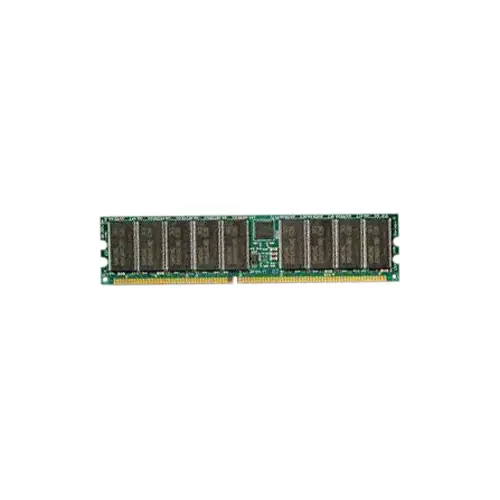
Designed for entry-level server platforms, this 1GB DDR3-1333 RDIMM with ECC and registered signal buffering ensures data integrity and system stability in small-scale virtualization hosts or lightweight in-memory databases. Its single-rank x8 configuration minimizes electrical loading on the memory channel, enabling reliable operation at CL9 latency even in fully populated server nodes.
1. ECC error correction catches and silently repairs single-bit memory faults, preserving the integrity of long-running database services and in-memory caches.
2. Registered signal buffering decouples the command and address bus load, enabling servers to scale up to maximum DIMM slots without compromising stability under heavy consolidation.
3. A low column access strobe latency minimizes the delay between a read command and data delivery, boosting per-core performance in latency-sensitive transactional workloads.
4. The interface’s peak transfer rate comfortably feeds the memory bandwidth demands of multiple hypervisor guests, preventing I/O stalls during simultaneous live migrations.
5. Single-rank design reduces the per-DIMM capacitive load, allowing fully loaded memory channels to operate reliably at rated speed in dense rack deployments.
The MT9JSF12872PY-1G4D1 is a server-class DDR3 Registered DIMM, purpose-built for enterprise environments where data integrity and uptime are non-negotiable. Its ECC technology actively detects and corrects single-bit memory errors, shielding your virtualized infrastructure from silent data corruption that could cascade across multiple virtual machines. In a dense virtualization cluster, this means hypervisor stability even during peak consolidation loads, while in-memory databases like Redis or SAP HANA benefit from deterministic data accuracy where a single flipped bit could otherwise trigger application faults or financial miscalculation. The registered signal buffer isolates the memory controller from the electrical load of each DRAM chip, enabling stable operation across fully populated server memory channels—a critical advantage when scaling to handle larger datasets without sacrificing speed. With a single-rank x8 organization at 1333MHz and CL9 latency, this module balances low latency access and efficient bandwidth utilization, reducing memory access bottlenecks during concurrent query execution. That translates directly into faster transaction processing and smoother workload migration under heavy multi-tenant demands, making this RDIMM a reliable foundation for business-critical operations where downtime carries measurable cost.
General Virtualization
This 1GB DDR3-1333 ECC Registered RDIMM is suited for entry-level servers. For light virtualization, populate all memory channels with identical modules—typically six or eight DIMMs—to reach 6–8 GB total and maintain balanced interleaving. Avoid mixing different ranks or speeds to prevent performance penalties and ensure memory RAS features operate correctly.
In-Memory Database
In-memory databases demand large capacity and low latency; a single 1GB DIMM is insufficient. Combine at least 12–16 identical modules across all memory channels to build a 12–16 GB pool, minimizing swapping. However, for production workloads, upgrading to higher-density RDIMMs (8GB or 16GB) is strongly recommended to meet capacity and bandwidth requirements.
High-Performance Computing (HPC)
HPC applications rely on memory bandwidth as much as capacity. Install an equal number of these 1GB RDIMMs in each memory channel—typically 2 DIMMs per channel for dual-socket systems—to maximize interleaving and throughput. Given the small module size, total capacity will be limited; modern HPC clusters should replace these with 16GB or 32GB registered ECC DDR3/DDR4 modules to avoid bottlenecks.
Rigorously validated for Dell R720, HP DL380p Gen8, Lenovo RD630.
Q: Can I mix this MT9JSF12872PY-1G4D1 with other memory modules of different brands or speeds?
A: Mixing RDIMMs of different brands or speeds is strongly discouraged in server environments. Mismatched registers, timings, or ranks can compromise signal integrity and cause system instability, even if modules share identical base specifications.
Q: Is this memory compatible with my system?
A: This module is compatible with server platforms supporting DDR3-1333 ECC Registered DIMMs, such as Intel Xeon 5500/5600 series or AMD Opteron 6100 series with 240-pin slots. Always validate against your motherboard's qualified vendor list.
Q: What is the recommended DIMM population order for optimal performance?
A: Follow your server board's memory population guide. Typically, install identical RDIMMs per channel beginning with slots farthest from the CPU. Populate symmetrically across channels to enable optimal interleaving and balanced memory bandwidth.
Q: Does this module support overclocking or XMP profiles?
A: No, this server-class Registered DIMM does not support overclocking or XMP. It adheres strictly to JEDEC DDR3-1333 standards for mission-critical reliability, where stability is prioritized over frequency manipulation.
Q: What warranty and typical failure rate can I expect?
A: This module is backed by a one-year warranty. Its ECC Registered design meets rigorous enterprise-grade reliability standards, yielding a very low annualized failure rate under normal server operating conditions.