











 Secure payments
Standard refund policy
Trade Assurance
Secure payments
Standard refund policy
Trade Assurance
| Model | MT9JSF25672AZ-1G1D1 |
|---|---|
| Product Type | Memory Module |
| Compliance Standards | RoHS |
| Memory Capacity | 2 GB |
| Memory Technology | DDR3 |
| Product Voltage | 1.5V |
| RAM Speed | 1066MHz |
| RAM Standard | DDR3-1066/PC3-8500 |
| Error Identifying | ECC |
| Signal Type | Unbuffered |
| Column Access Strobe (CAS) | CL7 |
| Rank | Single Rank x8 |
| Quantity of Pins | 240-pin |
| RAM Genre | UDIMM |
This DDR3 UDIMM with ECC is best suited for entry-level single-socket servers or workstations running light virtualization or integrity-sensitive workloads where the unbuffered signaling and CL7 latency keep access times low. The single-rank x8 configuration and 2 GB capacity deliver a stable, low-overhead memory foundation that protects against single-bit errors without sacrificing response time in cost-optimized platforms.
1. ECC protection silently corrects single-bit errors, preserving data integrity for always-on services where even minor corruption can cascade into critical failures.
2. Unbuffered signaling provides a direct, low-latency path to the memory controller, sharpening the responsiveness of lightweight single-socket server tasks.
3. Modest module density supplies just enough headroom for dedicated microservices or network appliance roles, avoiding overspend on idle capacity.
4. Balanced memory bandwidth sustains stable throughput for concurrent small-office file sharing and directory operations without bottlenecking the CPU.
5. Tight CAS latency accelerates small-block data access, improving the snappiness of log processing and metadata lookups in database environments.
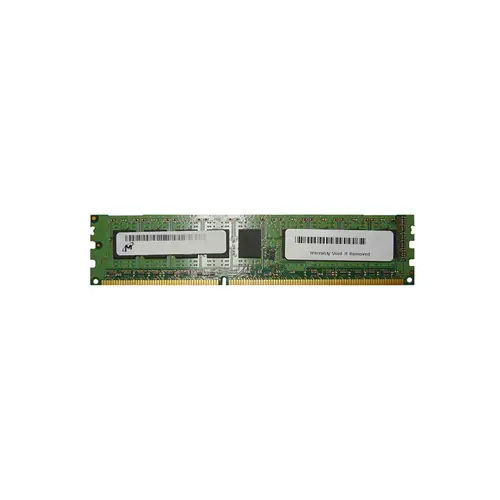
Designed as a server-grade UDIMM, the Micron MT9JSF25672AZ-1G1D1 brings an essential set of reliability and efficiency features to small-business servers, entry-level virtualization hosts, and network-attached storage appliances where data integrity cannot be compromised. Its ECC technology actively detects and corrects single-bit memory errors caused by background radiation or electrical interference—silently flipping a bit in a financial transaction log or a customer database could mean a corrupted record, but ECC prevents that unseen corruption from ever reaching your applications. The unbuffered architecture keeps signal paths direct and latency minimal, which is critical when every millisecond counts inside a lightweight virtualized firewall or a frequently queried MySQL database. With a single-rank x8 organization, this module places less electrical load on the memory bus, improving compatibility across a wider range of motherboards and allowing a server to reliably populate all DIMM slots without stability concerns. Finally, the tight CL7 CAS latency at 1066MHz ensures snappier access to the most frequently used hot data, directly translating into faster file serving, smoother remote desktop responsiveness, and a noticeably more agile multi-user experience.
Memory Type Classification: This is a server-grade DDR3 ECC Unbuffered DIMM (240-pin, 2GB, PC3-8500). Its Error Correcting Code and 1.5V operation target entry-level servers and workstations where data integrity is non-negotiable.
General Virtualization
Populate all available memory channels symmetrically with identical modules to maximize bandwidth and enable ECC protection. For light virtualized workloads, start with six modules (12GB) in a triple‑channel platform or four modules (8GB) in dual‑channel; this supports a handful of stable VMs without excessive swapping.
In-Memory Database
These 2GB modules are severely capacity‑constrained for in‑memory databases, which often demand 64GB or more. For experimental or small‑scale testing only, completely fill every DIMM slot (e.g., eight modules for 16GB) and keep ECC enabled to protect in‑flight data. Production deployments should migrate to high‑density RDIMMs.
High-Performance Computing
ECC is mandatory for HPC result integrity. Install identically specced modules across all memory channels—for a dual‑socket system, balance DIMMs evenly per processor to utilize full interleaving. A practical minimum is 12 modules (24GB) in a dual‑processor node, delivering sufficient capacity and bandwidth for MPI‑based simulations while preventing silent data corruption.
Rigorously tested ECC UDIMM for Dell PowerEdge T110 II, R210 II, HP ML110 G7, and similar servers.
Q: Can I mix this MT9JSF25672AZ-1G1D1 with other memory modules of different brands or speeds?
A: Mixing is not recommended for server environments. Mismatched modules may cause the system to disable ECC or downclock all DIMMs to the lowest common speed, compromising stability and data integrity.
Q: Is this memory compatible with my Intel Xeon E3-1200 series server or AMD equivalent platform?
A: Yes, if your server board supports unbuffered ECC DDR3 UDIMMs. It is designed for single-socket workstations and entry-level servers using Intel Xeon E3/E5 (with UDIMM support) or select AMD Opteron platforms.
Q: What is the recommended DIMM population order for optimal performance?
A: Populate identical DIMMs in matched sets per memory channel, starting with the slots farthest from the CPU. Follow the server board’s manual for symmetric channel interleaving to maintain ECC and balanced memory bandwidth.
Q: Does this module support overclocking or XMP profiles?
A: No. This is a JEDEC-standard server UDIMM operating at fixed DDR3-1066 timings. It does not contain XMP profiles, and overclocking is unsupported to ensure 24/7 mission-critical data reliability.
Q: What warranty and typical failure rate can I expect?
A: This module includes a one-year warranty. When operated within specified voltage and thermal limits, typical AFR for such enterprise-class ECC UDIMMs is very low, generally below 0.5% annually.