











 Secure payments
Standard refund policy
Trade Assurance
Secure payments
Standard refund policy
Trade Assurance
| Model | MT9JSF25672AZ-1G6K1 |
|---|---|
| Product Type | Memory Module |
| Compliance Standards | RoHS |
| Memory Capacity | 2 GB |
| Memory Technology | DDR3 |
| Product Voltage | 1.5V |
| RAM Speed | 1600MHz |
| RAM Standard | DDR3-1600/PC3-12800 |
| Error Identifying | ECC |
| Signal Type | Unbuffered |
| Column Access Strobe (CAS) | CL11 |
| Rank | Single Rank x8 |
| Quantity of Pins | 240-pin |
| RAM Genre | UDIMM |
This DDR3 UDIMM module with ECC is engineered for entry-level servers and workstations where data integrity is critical, making it ideal for small business databases, file servers, or virtualization hosts that require reliable single-processor memory. Its single-rank x8 organization and unbuffered signal type ensure low latency and stable operation at DDR3-1600, while ECC actively corrects single-bit errors to prevent silent data corruption in 24/7 environments.
1. ECC protection corrects single-bit errors on the fly, preserving transactional integrity in financial databases around the clock.
2. The memory speed of sixteen hundred megatransfers per second supplies ample bandwidth for multiple concurrent virtual machines, preventing throughput bottlenecks.
3. Single Rank x8 organization minimizes electrical loading on the memory bus, allowing a fully populated server to maintain rated speed without signal degradation.
4. Unbuffered signal path cuts access latency by a few nanoseconds, offering a snappier response for latency-sensitive caching workloads.
5. Two-gigabyte module capacity suits lightweight dedicated server roles, reducing unnecessary power draw and cost for simple appliance-like deployments.
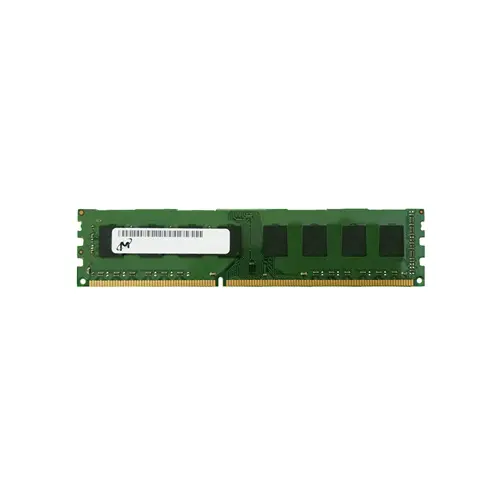
When deploying a virtualized cluster or an in-memory database, every bit of data matters. The Micron MT9JSF25672AZ-1G6K1 is an ECC unbuffered DIMM purpose‑built for entry‑level servers and workstations where integrity and responsiveness must coexist. Its Error‑Correcting Code (ECC) actively detects and corrects single‑bit memory errors—a critical safeguard during multi‑tenant hypervisor operations or financial transaction processing. Instead of a silent data corruption that could crash a virtual machine or skew a Redis query, you get reliable, self‑healing operation around the clock.
The unbuffered design eliminates the additional clock cycle delay of registered modules, delivering the low latency that latency‑sensitive databases demand. Paired with a 1600MHz clock speed and a single‑rank x8 organization, the module reduces electrical loading on the memory channel, easing the strain on the server’s memory controller. In a Docker swarm or a VMware vSAN, that translates into smoother inter‑VM communication and faster cache flushes. The standard 1.5V voltage keeps thermal profiles manageable inside dense 1U chassis, while RoHS compliance meets strict environmental mandates. For the IT administrator protecting a small business ERP or a replication node, this memory means you gain data‑center‑grade reliability without sacrificing the agile performance your services depend on.
Based on its ECC, unbuffered, 240-pin UDIMM specification, the MT9JSF25672AZ-1G6K1 is a server‑grade DDR3‑1600 module. Capacity planning must work within its 2 GB density and leverage its data integrity features.
General Virtualization
Populate every memory channel with identical 2 GB modules to maximize total capacity. A dual‑socket host with 12 slots yields 24 GB, enough for a modest number of lightweight VMs. Enable channel interleaving for balanced performance and consider memory mirroring if high availability is required.
In‑Memory Database
Fill all DIMM slots symmetrically to create the largest unified memory pool. The resulting 24 GB fits small in‑memory tables only; for larger datasets, plan a scale‑out cluster of identically configured nodes. ECC is mandatory here to guard against silent data corruption.
High‑Performance Computing (HPC)
For bandwidth‑first HPC, install one 2 GB DIMM per memory channel to sustain full 1600 MT/s and 12.8 GB/s per channel, giving 6 GB per processor on a triple‑channel platform. When capacity matters more, fully populate all slots while accepting a possible speed drop. Always use matching ECC UDIMMs to keep computational results error‑free.
Rigorously tested server UDIMM, compatible with Dell PowerEdge T110 II, T20, HP MicroServer Gen8, Lenovo TS140, Supermicro X9SCM.
Q: Can I mix this MT9JSF25672AZ-1G6K1 with other memory modules of different brands or speeds?
A: Mixing is not recommended. Unbuffered ECC modules must match spec for spec. Mismatched speeds force the memory controller to the lowest common timing, compromising stability on server platforms.
Q: Is this memory compatible with my system?
A: This 2GB DDR3-1600 ECC UDIMM is validated for entry-level servers and workstations using Intel Xeon E3 or AMD Ryzen Pro platforms with C200/C600 series chipsets. Verify motherboard ECC support before purchase.
Q: What is the recommended DIMM population order for optimal performance?
A: Populate identical modules starting from slot 0 (DIMM A1 or blue slot per most server boards). For single-rank x8 DIMMs, one module per channel yields optimal performance; balance loads across memory channels.
Q: Does this module support overclocking or XMP profiles?
A: No. Server-grade ECC UDIMMs adhere strictly to JEDEC DDR3-1600 (PC3-12800) at 1.5V without XMP. Overclocking is unsupported and would compromise error correction reliability in mission-critical environments.
Q: What warranty and typical failure rate can I expect?
A: This module carries a one-year warranty. Micron server-quality DRAM exhibits an annualized failure rate below 0.5% under normal operating conditions, backed by rigorous ECC testing for data integrity.