











 Secure payments
Standard refund policy
Trade Assurance
Secure payments
Standard refund policy
Trade Assurance
| Product Type | Memory Module |
|---|---|
| Compliance Standards | RoHS |
| Memory Capacity | 2 GB |
| Memory Technology | DDR3 |
| Product Voltage | 1.35V |
| RAM Speed | 1333MHz |
| RAM Standard | DDR3-1333/PC3-10600 |
| Error Identifying | ECC |
| Signal Type | Registered |
| Column Access Strobe (CAS) | CL9 |
| Rank | Single Rank x8 |
| Quantity of Pins | 240-pin |
| RAM Genre | RDIMM |
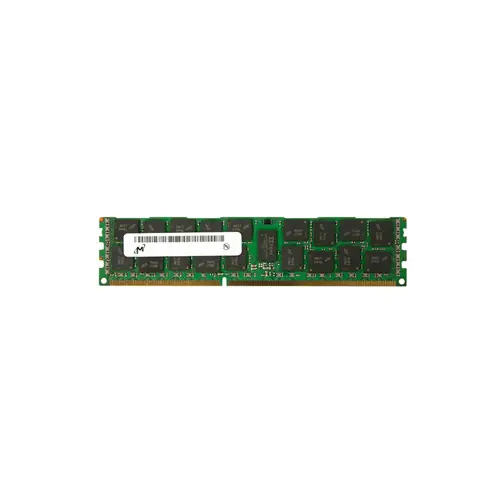
Designed for server environments requiring data integrity, this 2GB DDR3-1333 RDIMM with ECC and registered signaling ensures reliable operation in virtualization and small-scale in-memory database workloads. Its single-rank x8 organization and CL9 latency minimize electrical loading on the memory bus, improving signal stability and enabling consistent performance in dense rack configurations.
1. ECC protection transparently corrects single-bit errors, preserving data integrity in long-running virtualization and database workloads.
2. Registered buffering isolates the memory controller from electrical loads, enabling stable signal integrity when all server memory channels are fully populated.
3. The 1333 MT/s data rate supplies ample throughput for multi-threaded server processors, preventing memory bandwidth starvation during peak concurrent access.
4. Operating at 1.35 volts reduces thermal dissipation and energy draw across dense rack deployments, directly lowering data center operating costs.
5. A Single Rank x8 organization minimizes electrical loading and access latency, delivering consistent virtual machine responsiveness under heavy consolidation.
When deploying mission‑critical server infrastructure, the Micron MT9KSF25672PZ-1G4D1AD RDIMM directly addresses the realities that keep IT managers awake at night. Its ECC circuitry continuously detects and corrects single‑bit memory errors—silent data corruption that, in a virtualized cluster hosting dozens of VMs, could cascade into unexplained application crashes or filesystem inconsistencies. Paired with the Registered buffer, this module stabilizes signal integrity across multiple ranks and DIMM slots, so you can densely populate a 2U rack server without risking boot failures under heavy memory controller loads—a non‑negotiable requirement when scaling VMware ESXi or Hyper‑V hosts. The 1.35V low‑voltage DDR3 design further cuts thermal output in confined chassis, reducing cooling opex while maintaining 1333 MHz throughput at CL9 latency. For in‑memory databases like Redis or SAP HANA, that balance of speed and correctness ensures real‑time transaction processing never stalls on a corrupted cache line, safeguarding both performance and data trustworthiness.
General Virtualization
For general virtualization, populate all memory channels identically to ensure balanced NUMA access. With 2 GB registered ECC DIMMs, a dual-socket server using 12 modules per CPU (24 total) delivers 48 GB, which supports a modest number of light virtual machines. Always install identical DIMMs and configure mirroring or sparing for critical guest availability.
In-Memory Database
In-memory databases require capacity plus ECC integrity. Fill every DIMM slot with these 2 GB RDIMMs to reach the platform’s maximum—e.g., 48 GB in a 24‑slot server—suitable for small Redis or test instances. The registered ECC signalling prevents silent data errors during sustained writes. Monitor utilisation and plan to migrate to higher-capacity DIMMs as data grows.
HPC
High‑performance computing relies on memory bandwidth. Place one 2 GB RDIMM per channel across all available channels (e.g., 8 channels per socket) to enable full channel interleaving and peak throughput. A dual‑socket node with 16 modules provides 32 GB, sufficient for bandwidth‑bound kernels. The 1.35 V low‑voltage rating also reduces power and cooling demands in dense cluster deployments.
Thoroughly tested server RDIMM compatible with Dell R720, R620, HP DL380p G8, Cisco C220 M3, Lenovo x3650 M4.
Q: Can I mix this MT9KSF25672PZ-1G4D1AD with other memory modules of different brands or speeds?
A: Mixing is not recommended. For stable server operation, always use identical modules with the same part number, rank, speed, and voltage to avoid signal integrity issues and potential data corruption.
Q: Is this memory compatible with my Intel Xeon or AMD Opteron server platform?
A: It is compatible with servers supporting DDR3-1333 Registered ECC memory, such as Intel Xeon 5500/5600 series or AMD Opteron 6100 platforms. Verify your board supports 1.35V RDIMMs before purchase.
Q: What is the recommended DIMM population order for optimal performance?
A: Populate identical DIMMs per memory channel, starting with the slot farthest from the CPU. For dual-processor systems, balance memory equally across both CPU memory banks for maximum interleaving.
Q: Does this module support overclocking or XMP profiles?
A: No. As an enterprise-grade Registered ECC DIMM, it adheres strictly to JEDEC DDR3-1333 CL9 standards. Overclocking and XMP are not supported; reliability and data integrity take priority over speed.
Q: What warranty and typical failure rate can I expect?
A: This module includes a one-year warranty. Typical annualized failure rates are extremely low (under 0.5%) due to rigorous component screening and production testing for 24/7 server environments.