











 Secure payments
Standard refund policy
Trade Assurance
Secure payments
Standard refund policy
Trade Assurance
| Product Type | Memory Module |
|---|---|
| Compliance Standards | RoHS |
| Memory Capacity | 2 GB |
| Memory Technology | DDR3 |
| Product Voltage | 1.35V |
| RAM Speed | 1333MHz |
| RAM Standard | DDR3-1333/PC3-10600 |
| Error Identifying | ECC |
| Signal Type | Registered |
| Column Access Strobe (CAS) | CL9 |
| Rank | Single Rank x8 |
| Quantity of Pins | 240-pin |
| RAM Genre | RDIMM |
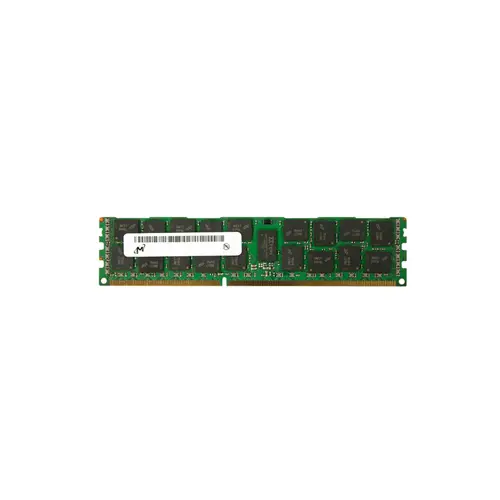
This 2GB DDR3-1333 RDIMM with ECC and 1.35V low voltage is tailored for entry-level servers and embedded systems where data integrity and power efficiency are critical, such as lightweight virtualization hosts or memory-resident caching appliances. The single-rank x8 organization combined with registered signaling ensures stable operation at reduced power draw, while ECC actively corrects single-bit errors to maintain uptime in always-on environments.
1. ECC protection silently corrects single-bit memory errors in real time, preventing data corruption during critical database transactions and long-running computational workloads.
2. Registered signal buffering stabilizes high-density memory configurations, ensuring reliable operation across all DIMM slots in 24/7 server environments.
3. Low 1.35V operation cuts memory power consumption significantly, reducing overall data center energy costs and thermal strain on server cooling systems.
4. 1333 MHz bandwidth delivers consistent throughput for virtualized workloads, keeping VM response times predictable under concurrent user sessions.
5. Single Rank x8 organization minimizes electrical loading on the memory bus, enabling stable multi-DIMM population without sacrificing signal integrity.
The Micron MT9KSF25672PZ-1G4D1DD RDIMM is engineered for server workloads where every component must ensure stability. Its ECC corrects single-bit errors, preventing silent data corruption that could crash a virtual machine or introduce inaccuracies in an in-memory database like Redis. The registered buffer amplifies command and address signals, allowing a virtualization host to populate multiple DIMMs per channel without signal degradation—crucial when scaling memory for dozens of VMs. The 1.35V low-voltage operation cuts power and cooling demands; in a rack with hundreds of modules, this directly reduces operating costs and thermal stress. Finally, its single-rank x8 configuration minimizes electrical load, delivering consistent signal integrity and latency across all slots, which is vital for memory-sensitive applications such as real-time analytics. These characteristics transform a standard DDR3 module into a reliability asset that keeps your cluster online and your data accurate.
General Virtualization
For light to moderate virtualization hosts, populate all memory channels with identical 2 GB RDIMMs to maximize interleaving and bandwidth. A typical dual‑socket server with three channels per CPU benefits from six modules (12 GB total), enough for a handful of low‑memory VMs. Avoid mixing single‑rank and dual‑rank DIMMs in the same channel to keep signal integrity and NUMA balance predictable.
In‑Memory Database
In‑memory databases demand capacity far beyond what 2 GB DIMMs can deliver; these modules are unsuitable as primary storage for datasets measured in gigabytes. If repurposing older hardware, install the maximum supported count per CPU—often 12 or 18 DIMMs—to reach 24–36 GB, but treat this only as a lab or development tier. Production deployments require high‑density RDIMMs, so plan to replace these sticks with 16 GB or 32 GB parts once the schema outgrows the initial headroom.
High‑Performance Computing (HPC)
HPC workloads are often sensitive to memory bandwidth and latency rather than total capacity. Populate one DIMM per channel for the highest clock speed with these single‑rank modules, as adding a second DIMM per channel may force the memory controller to downclock to 1066 MHz or 800 MHz. For compute‑bound jobs that fit in a small footprint, configure three or four identical 2 GB RDIMMs per socket, delivering uniform access times and stable low‑latency operation at the rated 1333 MHz.
This server DDR3 RDIMM has been rigorously tested and is compatible with Dell R720, HP DL380p G8, Lenovo RD630.
Q: Can I mix this MT9KSF25672PZ-1G4D1DD with other memory modules of different brands or speeds?
A: Mixing RDIMMs of different brands or speeds is not advised. The system will downclock all modules to the slowest common speed and may face stability issues. For certified server environments, use identical part numbers to ensure maximum reliability.
Q: Is this memory compatible with my system?
A: This ECC registered DDR3-1333 RDIMM is compatible with server platforms using Intel Xeon E5-2400/2600 v2 or AMD Opteron 6300/4300 series processors and corresponding chipset-based boards. Verify your board supports 1.35V, 240-pin RDIMMs.
Q: What is the recommended DIMM population order for optimal performance?
A: Follow your server board manual; generally, populate identical DIMMs in the first slot of each memory channel (often blue or white) for balanced interleaving. Start with the slot farthest from the CPU socket to maximize signal integrity.
Q: Does this module support overclocking or XMP profiles?
A: No. This is a JEDEC-compliant server memory module designed for stability. It does not support XMP or overclocking. It will operate at its rated 1333MHz with CL9 latency per the standard profile.
Q: What warranty and typical failure rate can I expect?
A: This module comes with a one-year warranty. As an enterprise-grade registered DIMM built with rigorous testing, typical Annualized Failure Rate (AFR) is very low, generally under 0.5%, ensuring dependable 24/7 operation.