











 Secure payments
Standard refund policy
Trade Assurance
Secure payments
Standard refund policy
Trade Assurance
| Product Type | Memory Module |
|---|---|
| Memory Capacity | 4 GB |
| Memory Technology | DDR3 |
| RAM Speed | 1600 |
| RAM Standard | DDR3-1600/PC3-12800 |
| Signal Type | Unbuffered |
| Column Access Strobe (CAS) | CL11 |
| Rank | Single Rank x8 |
| Quantity of Pins | 204-pin |
| RAM Genre | SoDIMM |
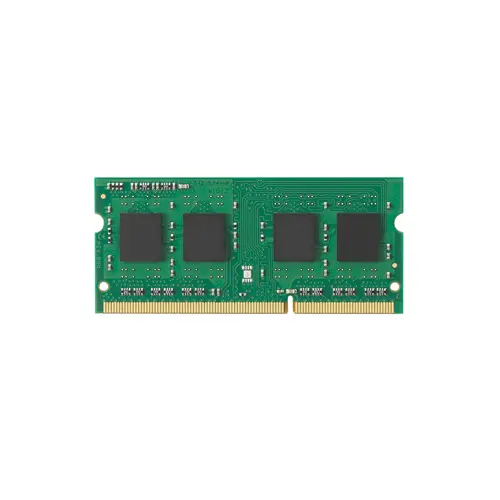
This unbuffered DDR3-1600 SO-DIMM, organized as a single-rank x8 module with CL11 latency, delivers a low-power, plug-and-play upgrade for extending the lifespan of aging notebooks and mobile workstations. Its single-rank configuration minimizes electrical loading on the memory controller, ensuring stable operation and broad compatibility across 204-pin laptop platforms without the need for BIOS tuning.
1. DDR3 memory technology ensures broad compatibility with a vast installed base of legacy notebooks, delivering a cost-effective path to revitalize aging portable systems.
2. The SoDIMM form factor guarantees a straightforward, tool-free installation in space-constrained laptop compartments, empowering even non-technical users to upgrade effortlessly.
3. A 4GB capacity expansion provides sufficient headroom for modern web browsing and office multitasking, rescuing a sluggish notebook from constant disk swapping.
4. The 1600MT/s data rate injects enough bandwidth to noticeably accelerate application launches and file operations on older mobile platforms without draining excessive power.
5. CL11 latency strikes a practical balance between response time and energy efficiency, helping the notebook maintain a brisk computing feel during battery-powered productivity sessions.
The Micron MT9KSF51272HZ-1G6E1 is a notebook-grade DDR3 SODIMM, instantly identifiable by its 204-pin form factor and unbuffered architecture. For mobile professionals and everyday users, this 4GB single-rank x8 module translates directly into meaningful real-world advantages. Inside a compact mobile workstation running Adobe Photoshop or complex financial models, that single-rank design means the memory controller drives fewer loads, reducing electrical strain and subtly preserving battery runtime—vital when you are presenting on-site or reviewing render drafts far from a power outlet. The module’s DDR3-1600 speed and CL11 latency ensure that even under multi-layered workloads, the system remains responsive without choking on swap files. For someone reviving an aging ultrabook or a slim business notebook, the standardized 204-pin SODIMM footprint guarantees drop-in certainty. You simply open the hatch, align the notch, and click it into place; there is no proprietary hardware to frustrate the upgrade. Once installed, cold boots shrink, legacy applications launch with fresh urgency, and the machine feels capable again. This is not just a spec upgrade—it is a calculated move to reclaim productivity and portability without compromising the thermal and power budget that define true mobile computing.
Based on the provided specifications — 204-pin SoDIMM, Unbuffered DDR3-1600 (PC3-12800) — this is a laptop memory module. The following capacity planning guidance applies to notebooks that support DDR3 SoDIMMs.
Laptop Upgrade
For aging systems with a single 4GB module, the simplest path is to add an identical second 4GB stick to enable dual-channel mode, doubling capacity to 8GB. If your workload demands more headroom, replace single-slot configurations entirely with a matched 8GB or 16GB kit to avoid mixing old and new ranks.
Mobile Workstation
Professional applications like CAD, 3D rendering, or large dataset analysis thrive on maximum capacity. Populate both SoDIMM slots with the largest supported modules — often 16GB or 32GB total, if the chipset allows — prioritizing capacity density over raw speed to prevent throttling during sustained rendering passes.
Ultrabook Power Saving
With a single 4GB SoDIMM already installed, retain a 1.35V low-voltage DDR3L variant if the platform supports it, as standard 1.5V DDR3 can elevate idle power draw. A solitary module operating in single-channel mode also consumes marginally less power than a dual-channel pair, which is a worthwhile trade-off for extending battery runtime in thin-and-light designs.
Compatibility verified: rigorously tested with Dell Latitude E6420, Lenovo ThinkPad T430, HP EliteBook 8470p.
Q: Can I mix this MT9KSF51272HZ-1G6E1 with other memory modules of different brands or speeds?
A: Mixing modules is not recommended. Unmatched specs can force the system to run at the slowest common speed and timings, potentially causing instability or boot failures in notebooks.
Q: Is this memory compatible with my laptop system?
A: It fits notebooks that support DDR3 SoDIMM, 1.5V standard voltage, and a 204-pin slot. Please consult your laptop's service manual for chipset and maximum supported capacity per slot.
Q: What is the recommended DIMM population order for optimal performance?
A: For dual-channel enabled laptops, populate slots symmetrically with identical modules. If using just one, refer to the system board label; usually the primary slot ensures best signal integrity.
Q: Does this module support overclocking or XMP profiles?
A: No, this module adheres to JEDEC DDR3-1600 standard latencies and does not support XMP. It's designed for stable operation at rated speed and CL11 out of the box.
Q: What warranty and typical failure rate can I expect?
A: This module includes a one-year limited warranty. Typical annualized failure rate is approximately 0.2–0.5% under normal operating conditions, ensuring reliable long-term use in compatible notebooks.