











 Secure payments
Standard refund policy
Trade Assurance
Secure payments
Standard refund policy
Trade Assurance
| Product Type | Memory Module |
|---|---|
| Compliance Standards | RoHS |
| Memory Capacity | 4 GB |
| Memory Technology | DDR3 |
| Product Voltage | 1.35V |
| RAM Speed | 1600MHz |
| RAM Standard | DDR3-1600/PC3-12800 |
| Error Identifying | ECC |
| Signal Type | Registered |
| Column Access Strobe (CAS) | CL11 |
| Rank | Single Rank x8 |
| Quantity of Pins | 240-pin |
| RAM Genre | RDIMM |
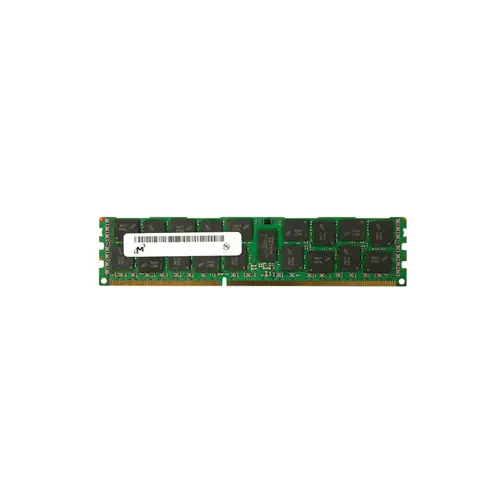
This 4GB DDR3L-1600 RDIMM is purpose-built for servers and workstations running virtualization platforms or memory-intensive databases, where data integrity and 24/7 stability are critical. Its registered signal architecture combined with ECC and a single-rank x8 organization delivers superior signal integrity and error correction across multiple DIMMs per channel, while the 1.35V low-voltage operation reduces thermal load in dense rack deployments.
1. ECC scrubbing proactively corrects single-bit memory faults, safeguarding data integrity for transactional databases and virtualized servers running around the clock.
2. Registered timing re-drives address and control signals, enabling reliable multi-DIMM configurations essential for large-scale server memory expansion.
3. High data rate sustains concurrent throughput for numerous virtual machines, preventing memory bandwidth starvation in dense cloud computing nodes.
4. Ultra-low voltage operation slashes energy consumption and cooling demands, directly lowering operational expenses in always-on enterprise data centers.
5. Single-rank x8 organization reduces electrical load on the memory bus, delivering deterministic low-latency responses crucial for real-time financial trading platforms.
When you rely on a virtualization cluster or an in-memory database like Redis, memory integrity directly defines your uptime and transaction accuracy. This Micron 4GB RDIMM (MT9KSF51272PZ-1G6E2L) brings four essential enterprise-grade characteristics that turn risks into reliability. The Error-Correcting Code (ECC) silently detects and corrects single-bit errors caused by background radiation—without it, a flipped bit inside your VMware hypervisor could corrupt a running guest or crash a financial ledger with zero warning. The Registered buffer decouples the memory’s electrical load from the CPU’s memory controller, meaning you can populate all channels and multiple DIMMs per channel. That stability is non-negotiable when you need 512GB of RAM to host dozens of virtual desktops without signal degradation. Operating at 1.35V instead of 1.5V, this low-voltage DDR3 module reduces heat and power draw across a server farm, slicing thousands of dollars from your annual cooling bill while preserving performance headroom. Finally, DDR3-1600 speed combined with a Single Rank x8 organization delivers consistent, low-latency bandwidth, preventing memory starvation when a multicore processor concurrently serves high-traffic database queries and live migrations. In your data center, these four traits translate into uninterrupted operations, lower TCO, and deterministic performance where it matters most.
General Virtualization
Populate all memory channels symmetrically to maximize bandwidth under multi-VM workloads. With these 4 GB RDIMMs, target at least 32 GB (eight modules) per socket for light to moderate consolidation; install two identical DIMMs per channel on a quad-channel platform to maintain balanced memory access and predictable performance.
In-Memory Database
An in-memory database requires the largest possible capacity with ECC protection. Fill every available DIMM slot using these low-voltage modules—a dual-socket server with 24 slots can deliver 96 GB. Consistent population across all channels ensures a unified memory pool, while the 1.35 V operation helps control power and thermal overhead in dense deployments.
High-Performance Computing (HPC)
HPC nodes depend on high memory bandwidth and reliability. Install at least one 4 GB RDIMM per channel, and ideally two for rank interleaving, which boosts throughput; an eight-channel system reaches 64 GB. The registered ECC design and 1.35 V supply promote stable, energy-efficient clusters that keep parallel processes fed.
Verified compatible with Dell R720, HP DL380p Gen8, Lenovo RD630 after rigorous testing.
Q: Can I mix this MT9KSF51272PZ-1G6E2L with other memory modules of different brands or speeds?
A: Mixing is not advised for server use. This registered ECC DIMM requires identical speed, rank, and timings. Mismatched unbuffered or non-ECC modules will likely cause POST failures and system instability.
Q: Is this memory compatible with my system?
A: It is designed for Intel Xeon E5/E5 v2 or AMD Opteron 6300/4300 platforms supporting DDR3-1600 registered ECC. Confirm your server board accepts 240-pin RDIMMs at 1.35V. Always refer to your system's qualified vendor list.
Q: What is the recommended DIMM population order for optimal performance?
A: Populate identical DIMMs per channel symmetrically across CPUs. Generally, fill the first slot (often white) in each channel to enable balanced memory interleaving. Consult your server’s platform guide for exact slot numbering.
Q: Does this module support overclocking or XMP profiles?
A: No. This is an enterprise registered ECC module strictly adhering to JEDEC DDR3-1600 CL11 standards. Overclocking and XMP are unsupported, as data integrity and stability take priority over performance tuning in server environments.
Q: What warranty and typical failure rate can I expect?
A: This module carries a 1-year warranty. Enterprise DDR3 RDIMMs typically exhibit an annualized failure rate of 0.5%–1.5% under standard operating conditions, assuming proper cooling and adherence to voltage specifications.