











 Secure payments
Standard refund policy
Trade Assurance
Secure payments
Standard refund policy
Trade Assurance
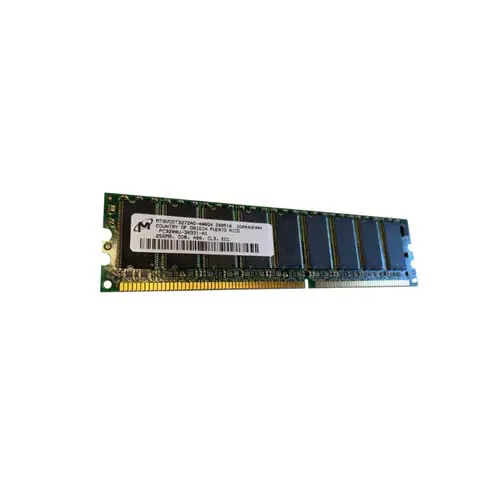
| Model | MT9VDDT3272AG-40BG4 |
|---|---|
| Product Type | Memory Module |
| Compliance Standards | RoHS |
| Memory Capacity | 256 MB |
| Memory Technology | DDR |
| Product Voltage | 2.5V |
| RAM Speed | 400MHz |
| RAM Standard | DDR-400/PC-3200 |
| Error Identifying | ECC |
| Signal Type | Unbuffered |
| Column Access Strobe (CAS) | CL3 |
| Rank | Single Rank x8 |
| Quantity of Pins | 184-pin |
| RAM Genre | UDIMM |
Designed as a legacy server-grade DDR UDIMM, this 256MB PC-3200 module is optimized for entry-level servers and workstations running memory-intensive, data-critical applications like light virtualization or local databases, where its unbuffered ECC ensures end-to-end data integrity without the latency penalties of registered alternatives. The CL3 timing and single-rank x8 organization deliver stable, low-latency access at 400MHz, making it a reliable drop-in solution for preserving uptime in aging but mission-critical platforms.
1. ECC protection silently corrects single-bit memory errors, preserving data integrity for financial transactions and long-running virtualization workloads that cannot tolerate silent corruption.
2. Unbuffered signal topology trims access latency to the absolute minimum, giving lightweight entry-server applications a deterministic response advantage in every memory cycle.
3. Single Rank x8 organization keeps electrical load on the memory controller low, raising the ceiling for slot population stability in compact server boards where uptime is paramount.
4. The base DDR frequency delivers stable, predictable bandwidth perfectly matched to steady-state services like DNS, caching, or embedded appliance control, where overspeccing brings no gain.
5. The deliberately modest capacity targets dedicated-function deployments—firewall appliances, thin hypervisor hosts, or boot drives—where reliability and compatibility matter far more than raw gigabytes.
When precision is non-negotiable, the Micron MT9VDDT3272AG-40BG4 DDR-400 module brings an uncommon safety net to desktop-grade workstations. This 256 MB UDIMM is purpose-built for professionals running memory-sensitive workloads where even a single undetected bit flip can corrupt a dataset or crash a rendering queue. Its ECC engine continuously scrubs data in flight, meaning an architect leaving a complex ray-trace render overnight or a financial analyst processing multi-gigabyte spreadsheets gets mathematical certainty instead of silent data corruption.
Equally important is the unbuffered architecture combined with a tight CL3 latency. Every access hits the DRAM directly without a register buffer delaying the transaction, which keeps transaction-to-first-byte response punishingly fast in tasks that hammer random access—think navigating dense video timelines or running real-time simulation software. Paired with a 2.5 V operating voltage, the module generates noticeably less heat than older memory standards inside cramped workstation enclosures, preserving stability during sustained turbo workloads. For a legacy platform that still needs absolute dependability, this module transforms a standard desktop into a credible fault-tolerant workhorse.
General Virtualization
A single 256 MB DDR-400 ECC UDIMM is extremely limited for modern virtualization. At most, you could pair two identical modules for 512 MB to run a lightweight hypervisor (e.g., a minimal Linux KVM host) hosting one or two tiny VMs with stripped-down operating systems. Beyond that, memory contention will immediately cripple guest performance, making this configuration suitable only for legacy appliance emulation or education.
In-Memory Database
In-memory databases demand large capacities, making 256 MB modules practically unusable. Even if you populate all available slots—assuming an old server board with four to six banks—you would barely reach 1–1.5 GB, which cannot hold meaningful datasets. This platform can only serve as a development testbed for Redis or Memcached with trivially small key-value stores, and only if you strictly limit data sizes.
High-Performance Computing (HPC)
HPC workloads require both capacity and bandwidth far beyond DDR-400. You could install paired modules for dual-channel operation to double theoretical bandwidth, but 256 MB per node is wholly inadequate. The only plausible role is a cluster of ancient nodes acting as a proof-of-concept for MPI communication patterns, where memory footprint is kept below a few hundred megabytes and computational intensity is deliberately minimized.
Rigorously tested server memory, compatible with Dell PowerEdge 1850, HP ML350 G4, IBM xSeries 226.
Q: Can I mix this MT9VDDT3272AG-40BG4 with other memory modules of different brands or speeds?
A: Mixing unbuffered ECC modules with different brands or speeds is not recommended. The system will clock down to the slowest DIMM, potentially causing stability issues on server platforms that demand strict signal integrity.
Q: Is this memory compatible with my server Intel or AMD platform?
A: This DDR-400 ECC UDIMM is targeted at legacy Intel and AMD server platforms supporting 184-pin DDR1 with ECC. Verify your motherboard requires PC-3200 ECC unbuffered memory to ensure proper operation.
Q: What is the recommended DIMM population order for optimal performance?
A: Follow your server board's population guide. Typically, install identical ECC UDIMMs in corresponding slots of each memory channel, starting with the slots farthest from the CPU to maintain signal quality.
Q: Does this module support overclocking or XMP profiles?
A: No. This is a JEDEC-compliant server memory module designed for reliable operation at DDR-400 with CL3 only. Overclocking or XMP is not supported, as data integrity in server environments is paramount.
Q: What warranty and typical failure rate can I expect?
A: This Micron module carries a one-year warranty. When operated within specifications, enterprise-grade ECC UDIMMs exhibit an annualized failure rate well below 0.5%, ensuring long-term platform stability.