











 Secure payments
Standard refund policy
Trade Assurance
Secure payments
Standard refund policy
Trade Assurance
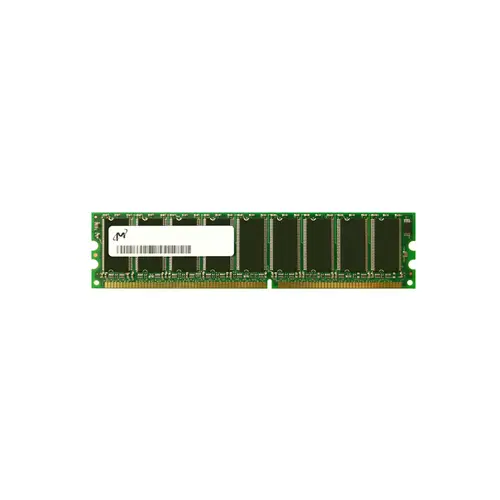
| Model | MT9VDDT6472AY-40BJ1 |
|---|---|
| Product Type | Memory Module |
| Compliance Standards | RoHS |
| Memory Capacity | 512 MB |
| Memory Technology | DDR |
| Product Voltage | 2.5V |
| RAM Speed | 400MHz |
| RAM Standard | DDR-400/PC-3200 |
| Error Identifying | ECC |
| Signal Type | Unbuffered |
| Column Access Strobe (CAS) | CL3 |
| Rank | Single Rank x8 |
| Quantity of Pins | 184-pin |
| RAM Genre | UDIMM |
Designed for legacy server platforms requiring data integrity, this DDR-400 UDIMM with ECC ensures reliable operation in memory-sensitive workloads like light virtualization and embedded systems. Its single-rank x8 organization and CL3 latency deliver stable, low-latency access, while the unbuffered signal type minimizes controller load for improved compatibility in single-socket configurations.
1. ECC protection silently corrects single-bit errors, safeguarding transactional integrity in always-on entry-level server or NAS environments where data corruption is not an option.
2. Unbuffered signal topology minimizes electrical latency between the memory controller and DRAM, improving response times for light database and web-serving workloads on cost-sensitive platforms.
3. Half-gigabyte capacity fits dedicated lightweight appliances or legacy embedded server roles, providing just enough working set space for single-purpose network functions without wasted resources.
4. 400 MHz clock speed delivers a balanced throughput ceiling for aging server chipsets, sustaining stable operation for non-virtualized background services where peak bandwidth is not the bottleneck.
5. CAS 3 latency reduces read access delays, which enhances per-command execution speed in tight synchronous workflows that benefit from every saved clock cycle.
The MT9VDDT6472AY-40BJ1 is a server-grade UDIMM built for entry-level servers and workstations where data integrity and responsiveness are non-negotiable. Its ECC error correction is the first line of defense against single-bit memory errors caused by background radiation, which is critical when running a lightweight virtualization host—one flipped bit in a hypervisor’s memory space can silently corrupt guest operating systems or bring down multiple services. Equally important, the unbuffered design and aggressive CL3 CAS latency keep the path between CPU and memory direct and low-latency. In a high-read database or in-memory cache scenario, that translates to faster query responses because the memory controller waits fewer cycles for data, reducing stall times under pressure. The 400 MHz clock rate backed by a single-rank x8 organization avoids the loading penalties of multi-rank modules, delivering consistent bandwidth for simultaneous tasks such as a file server handling concurrent CIFS/NFS streams and a lightweight email engine on the same physical box. For the system builder, this UDIMM means stable, registered-class reliability without the cost or latency of a fully buffered architecture, making small-scale server deployments safer and snappier.
The MT9VDDT6472AY-40BJ1 is a server memory module — its ECC, unbuffered UDIMM design and 184‑pin DDR‑400 standard target legacy single‑socket servers and entry‑level workstations. Capacity planning must treat the 512 MB density as the fundamental building block and rely on high module counts.
General Virtualization
Populate every available DIMM slot with these modules to reach the maximum node memory. With typical six‑ or eight‑slot boards, you can assemble 3–4 GB total, which suits only a handful of lightweight virtual machines (e.g., running tiny Linux services). Avoid overcommitting RAM; dedicate at least 512 MB per VM and disable memory‑intensive features.
In‑Memory Database
Even a fully populated configuration (8×512 MB = 4 GB) severely constrains dataset size. Use such a node exclusively for development or as a caching tier holding only hot index blocks. Partition data across multiple nodes and treat each module’s ECC as essential for data integrity. Production deployments demand far larger capacities than these modules can deliver.
HPC
Deploy modules in matched pairs to enable dual‑channel operation and maximize throughput per core. A common building block is 4×512 MB (2 GB) per compute node, which fits lightweight MPI ranks that rely on collective communication more than large memory footprints. For memory‑bound HPC jobs, cluster‑level aggregation mitigates the small per‑node capacity, but modern workloads will quickly outgrow this hardware.
Rigorously tested server memory; compatible with Dell PowerEdge 1850/2850, HP ProLiant DL380 G4, IBM xSeries 226.
Q: Can I mix this MT9VDDT6472AY-40BJ1 with other memory modules of different brands or speeds?
A: Mixing modules is strongly discouraged. Even with identical specs, subtle electrical differences may cause instability. All installed DIMMs should share the same Micron part number and revision for validated ECC integrity and reliable operation.
Q: Is this memory compatible with my server platform (Intel or AMD)?
A: This 512MB DDR-400 PC-3200 ECC Unbuffered DIMM is validated for single-processor servers and workstations using Intel 875P/E7210 or AMD Athlon 64 FX/Opteron 100 series chipsets. Verify your board supports ECC UDIMMs before purchasing.
Q: What is the recommended DIMM population order for optimal performance on a server board?
A: Install this single-rank x8 DIMM starting with the slot farthest from the CPU, usually DIMM1 or Channel A first. Refer to your specific server board manual to enable dual-channel interleaving and ECC scrubbing correctly.
Q: Does this module support overclocking or XMP profiles?
A: No. As a legacy DDR ECC server module, it adheres strictly to JEDEC DDR-400 (CL3) standard. There is no XMP support, and overclocking is not recommended as it compromises ECC functionality and data integrity.
Q: What warranty and typical failure rate can I expect for this memory?
A: This module is covered by a 1-year warranty. Actual AFR (Annualized Failure Rate) for Micron DDR ECC UDIMMs is typically below 0.3% under normal operating conditions, assuming proper ESD handling and compatible server-grade environments.