











 Secure payments
Standard refund policy
Trade Assurance
Secure payments
Standard refund policy
Trade Assurance
| Product Type | Memory Module |
|---|---|
| Compliance Standards | RoHS |
| Memory Capacity | 8 GB |
| Memory Technology | DDR4 |
| Product Voltage | 1.2V |
| RAM Speed | 2133MHz |
| RAM Standard | DDR4-2133/PC4-17000 |
| Error Identifying | ECC |
| Signal Type | Registered |
| Column Access Strobe (CAS) | CL15 |
| Rank | Single Rank x4 |
| Quantity of Pins | 288-pin |
| RAM Genre | VLP RDIMM |
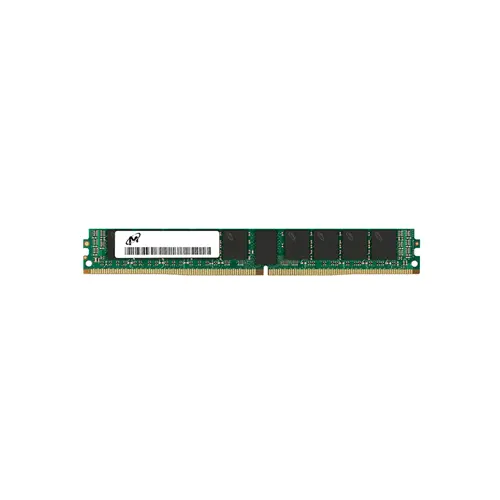
This is a server-class DDR4 VLP RDIMM featuring ECC and registered signal technology, ideally suited for dense virtualization clusters, in-memory databases, and compute-constrained 1U/2U platforms where data integrity and physical clearance are critical. Its single-rank x4 configuration with CL15 latency ensures stable signal integrity under heavy loads while the very low-profile form factor maximizes airflow and slot density in compact server chassis.
1. ECC protection guards against single-bit memory errors, safeguarding transactional data integrity in financial and database servers.
2. The registered clock driver stabilizes signal integrity, allowing higher DIMM counts per channel to maximize virtualization density.
3. Very low‑profile form factor optimizes airflow in compact 1U and blade servers, directly lowering thermal stress and failure rates.
4. x4 DRAM architecture provides narrower failure domains, strengthening ECC correction and ensuring high‑availability for mission‑critical workloads.
5. Low operating voltage cuts energy consumption and cooling demands, translating to measurable TCO savings in hyperscale data centers.
When deploying dense virtualization clusters or running in-memory databases like SAP HANA, memory integrity and signal stability are non-negotiable. The Micron MTA18ADF1G72PZ-2G1A1, a Very Low Profile Registered DDR4-2133 RDIMM, directly addresses the silent yet catastrophic threat of bit-flipping through its ECC technology—detecting and correcting single-bit errors before they corrupt a transactional record or crash an entire host. Its Registered signal buffering means you can populate all memory channels with confidence; as DIMM count rises, the onboard register re-drives commands cleanly, preventing electrical loading that leads to boot failures or data loss under heavy multi-VM contention. Meanwhile, the single-rank x4 organization optimizes bandwidth and reduces latency in sequential access patterns, accelerating query responses in Redis or Memcached instances where microseconds matter. The VLP form factor further ensures unblocked airflow in 1U rack servers and blade enclosures, protecting your investment from thermal throttling and extending hardware lifespan in always-on enterprise environments.
General Virtualization
Deploy this 8 GB VLP RDIMM in a balanced density configuration for lightweight hypervisors. Start with six to eight identical modules per dual-socket host to achieve 48–64 GB, which comfortably supports 10–15 general-purpose VMs. Dual-rank kits or larger DIMMs are typically preferred, so populate all memory channels with these single-rank modules to maintain adequate bandwidth while prioritizing cost-per-VM efficiency.
In-Memory Database
For in-memory workloads like Redis or SAP HANA, capacity is critical, making a single 8 GB module insufficient. Scale up by fully populating every channel—12 or 16 identical sticks in a dual-socket server—to reach 96–128 GB for modest caching layers. Ensure total capacity meets the working set size and pair with faster 2666 MT/s or higher kits if latency budgets tighten, but the 2133 MHz CL15 ECC registered profile delivers the data integrity required for persistent stores.
High-Performance Computing
HPC nodes demand maximum memory bandwidth, so use these modules in balanced, fully populated configurations—typically eight or sixteen per node—to enable all memory channels. Configure identical sticks across sockets for symmetric multiprocessing, aiming for 64–128 GB per node for MPI-based simulations. The registered ECC and very low-profile design help maintain signal integrity in dense 1U/2U enclosures, while single-rank characteristics can benefit command rate timing in compute-bound workloads.
Rigorously tested and compatible with servers including Dell PowerEdge R750, HPE ProLiant DL380 Gen10, and Lenovo ThinkSystem SR650.
Q: Can I mix this MTA18ADF1G72PZ-2G1A1 with other memory modules of different brands or speeds?
A: Mixing is not recommended. Registered DIMMs demand matched ranks, timings, and speeds for reliable operation. Use identical part numbers to avoid POST failures or subtle data integrity issues in server platforms.
Q: Is this memory compatible with my system?
A: It suits servers using Intel Xeon E5-2600 v3/v4 or select AMD EPYC platforms with DDR4 ECC Registered support. Verify your motherboard QVL list and ensure VLP form factor fits 1U/2U chassis constraints.
Q: What is the recommended DIMM population order for optimal performance?
A: Follow your system board’s memory population guide. Typically, populate identical DIMMs in the first slot of each memory channel across all populated processors to balance interleaving and maximize throughput.
Q: Does this module support overclocking or XMP profiles?
A: No. This is a JEDEC-compliant server memory module running at standard DDR4-2133 CL15. It does not support overclocking or XMP profiles, ensuring maximum stability and data integrity in enterprise environments.
Q: What warranty and typical failure rate can I expect?
A: It includes a 1-year warranty. As an enterprise-grade RDIMM with minimal infant mortality, typical annualized failure rates are well below 0.5% under standard operating conditions.