











 Secure payments
Standard refund policy
Trade Assurance
Secure payments
Standard refund policy
Trade Assurance
| Product Type | Memory Module |
|---|---|
| Memory Capacity | 8 GB |
| Memory Technology | DDR4 |
| Product Voltage | 1.2V |
| RAM Speed | 2666MHz |
| RAM Standard | DDR4-2666/PC4-21300 |
| Error Identifying | ECC |
| Signal Type | Registered |
| Column Access Strobe (CAS) | CL19 |
| Rank | Dual Rank x8 |
| Quantity of Pins | 288-pin |
| RAM Genre | RDIMM |
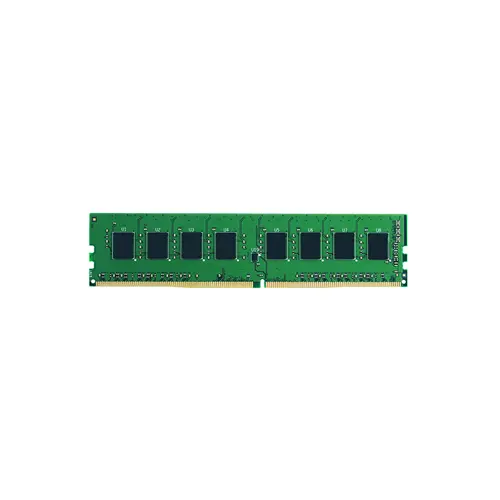
This RDIMM is a server-class DDR4-2666 module with ECC and registered signaling, designed to ensure data integrity and stable operation in multi-slot configurations. Its dual-rank x8 organization maximizes memory bandwidth efficiency, making it ideal for virtualized environments and in-memory databases where fault tolerance and consistent performance are critical.
1. ECC error correction silently detects and rectifies single-bit memory faults, preserving transactional data integrity in virtualized workloads and mission-critical databases.
2. The registered signal type buffers command and address lines, stabilizing signal integrity across dense memory configurations essential for large-scale virtualization hosts.
3. Dual-rank organization interleaves internal banks to fully saturate the memory channel, directly accelerating in-memory analytics and the responsiveness of consolidated VMs.
4. A 2666 megatransfers per second data rate delivers the sustained bandwidth needed to keep multiple server threads fed without bottlenecking under concurrent enterprise loads.
5. Operating at just 1.2 volts minimizes per-DIMM thermal and power draw, a crucial efficiency gain in dense rack and blade server environments where every watt matters.
This server-grade RDIMM, MPN MTA18ASF1G72PDZ-2G6E1RI, is purpose-built to eliminate the pain points that keep IT administrators awake at night. Its four defining traits directly tackle your real-world challenges. First, ECC error correction neutralizes single-bit errors triggered by background radiation. In a virtualization farm running dozens of virtual machines, an unchecked bit flip could silently corrupt a financial transaction or force a hypervisor crash; ECC converts that liability into peace of mind. Second, registered signal buffering ensures clean command and address signals even when all DIMM slots are populated, a must for memory-hungry database nodes where scaling to high capacities often introduces instability. Third, the dual-rank x8 design uses rank interleaving to deliver higher sustained bandwidth, dramatically improving response times in read-intensive caching tiers like Redis. Fourth, the 1.2V DDR4-2666 operation balances solid throughput with reduced power draw, directly lowering cooling demands in dense rack deployments. For your virtualized clusters and in-memory databases, these characteristics ensure exceptional uptime and consistently low latency.
General Virtualization
With 8 GB RDIMMs, a balanced virtualized host benefits from installing modules in multiples of eight (e.g., 8×8 GB for 64 GB) to fully populate a dual-socket server’s memory channels. Registered ECC ensures data integrity for mixed VM workloads, while 2666 MT/s keeps latency acceptable for light-to-medium density. Start with six or eight identical DIMMs per socket for optimal interleaving and spare capacity to absorb occasional VM overcommit.
In-Memory Database
In-memory databases demand high capacity and reliability, making these 8 GB ECC RDIMMs suitable for clustered scale-out nodes rather than massive single instances. Configure at least 12 modules per server (96 GB) to hold sizable working sets fully in RAM, maintaining dual-rank parallelism for maximum throughput. Always budget for an additional hot-spare rank and populate all channels to avoid bandwidth bottlenecks under heavy read/write pressure.
High-Performance Computing
HPC clusters thrive on maximum memory bandwidth, so populate every channel per CPU with one dual-rank 8 GB RDIMM to reach the sweet spot of capacity and channel utilization. A typical dual-socket compute node benefits from 12 modules (96 GB) delivering consistent 2666 MHz transfer rates for tightly coupled simulations. For memory-bound codes, avoid mixing ranks asymmetrically and lock the rated CL19 latency to sustain deterministic performance across large parallel runs.
Rigorously tested, compatible with servers like Dell PowerEdge R740, HPE ProLiant DL380 Gen10, and Lenovo ThinkSystem SR650.
Q: Can I mix this MTA18ASF1G72PDZ-2G6E1RI with other memory modules of different brands or speeds?
A: Mixing RDIMMs is not recommended. Different brands, speeds, or ranks may cause POST failures or silent data corruption. For stability, install identical modules validated for your server platform.
Q: Is this memory compatible with my system?
A: It is compatible with servers supporting DDR4 Registered ECC DIMMs, such as Intel Xeon Scalable or AMD EPYC platforms. Verify your motherboard qualifies 8GB dual-rank x8 RDIMMs at PC4-21300.
Q: What is the recommended DIMM population order for optimal performance?
A: Follow your server board’s guide. Typically, populate the farthest DIMM slot per channel first, then balance across channels to enable memory interleaving and maximize bandwidth.
Q: Does this module support overclocking or XMP profiles?
A: No. This is a JEDEC-compliant server RDIMM running at DDR4-2666 CL19. It does not support XMP, overclocking, or user-adjustable timing profiles.
Q: What warranty and typical failure rate can I expect?
A: It comes with a one-year warranty. High-quality RDIMMs typically show an annualized failure rate below 0.5%, ensuring reliable 24/7 operation in validated server environments.