











 Secure payments
Standard refund policy
Trade Assurance
Secure payments
Standard refund policy
Trade Assurance
| Product Type | Memory Module |
|---|---|
| Memory Capacity | 8 GB |
| Memory Technology | DDR4 |
| Product Voltage | 1.2V |
| RAM Standard | DDR4-2133/PC4-17000 |
| Error Identifying | ECC |
| Signal Type | Registered |
| Column Access Strobe (CAS) | CL15 |
| Rank | Single Rank x4 |
| Quantity of Pins | 288-pin |
| RAM Genre | NVDIMM |
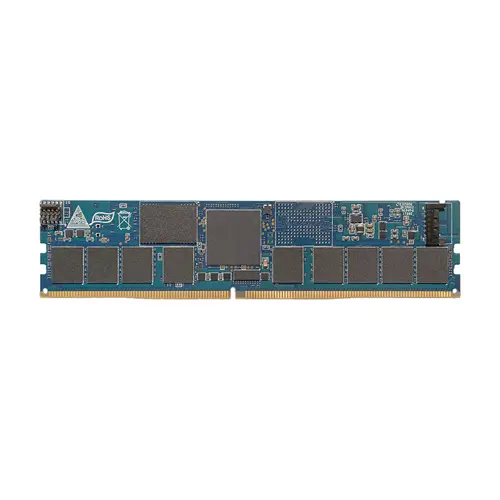
This 8GB DDR4-2133 NVDIMM module, with its registered ECC architecture and single-rank x4 organization, is engineered for mission-critical server platforms running memory-intensive workloads like virtualization and in-memory databases where data integrity is non-negotiable. Its non-volatile design preserves data during power loss, while the CL15 latency and registered signaling ensure stable, low-latency operation in dense multi-DIMM configurations.
1. NVDIMM technology safeguards critical in-flight data during unexpected power loss, enabling servers to resume transactions instantly without cascading storage I/O delays.
2. ECC protection continuously corrects single-bit errors, preventing silent data corruption across long-running virtualized databases and memory-centric workloads.
3. Registered DIMM architecture buffers command and address signals, allowing dense memory populations that maximize the number of stable virtual machines per physical host.
4. Eight-gigabyte capacity per module serves as an ideal persistent write buffer or journal cache in hyper-converged appliances, accelerating access to hot metadata.
5. DDR4-2133 PC4-17000 bandwidth supplies 17 GB/s per channel, ensuring smooth concurrency for simultaneous OLTP queries without saturating the memory controller.
When evaluating the Micron MTA18ASF1G72PF1Z-2G1, an 8GB DDR4-2133 NVDIMM with ECC and registered signal, it is unmistakably engineered for enterprise server environments where conventional memory falls short. Its ECC brings non-negotiable data integrity, silently correcting single-bit errors caused by cosmic radiation or electrical noise. In a dense virtualization cluster hosting dozens of virtual machines, an undetected bit flip can corrupt hypervisor operations and cascade into unplanned downtime; ECC ensures every instruction and data element remains accurate, preserving business continuity.
The registered design buffers command and address signals, stabilizing the memory channel when fully populated with multiple modules. This is critical for in-memory databases like SAP HANA or Redis, where the memory controller must drive large arrays reliably under incessant read/write loads. Here, the single-rank x4 configuration and CL15 latency achieve a balance between rank interleaving bandwidth and deterministic response times, preventing bottlenecks during real-time analytics. Crucially, the NVDIMM architecture merges DRAM speed with persistent NAND backup. During a power anomaly, the module autonomously saves volatile data to its onboard flash, then restores it upon reboot. For financial trading systems or journaling databases that demand sub-second recovery, this eliminates the costly trade-off between performance and crash consistency, turning a potential catastrophe into a seamless resume.
The given module is a server-grade DDR4-2133 ECC Registered NVDIMM, designed for persistent memory acceleration in enterprise platforms. The following capacity planning guidelines address key workload scenarios.
General Virtualization
Pair this 8 GB NVDIMM with standard RDIMMs to create a persistent write cache that reduces hypervisor swap overhead. Install one NVDIMM per memory channel alongside a 32 GB RDIMM; a dual-socket server with 16 channels would use 16 such modules. This mixed configuration boosts VM density while maintaining consistent low-latency I/O.
In-Memory Database
Persistent NVDIMMs are ideal for storing redo logs or hot index tables. Populate at least one 8 GB NVDIMM per occupied channel, aiming for 8–16 modules to build a 64–128 GB persistent tier. Complement this with large-capacity DRAM and configure the NVDIMMs in app-direct mode to enable microsecond durability and near-instant recovery.
High-Performance Computing
In HPC clusters, NVDIMMs enable fast application checkpointing without saturating parallel file systems. Install one 8 GB NVDIMM and one identical-capacity RDIMM in each channel; a dual-socket node with 16 channels requires 16 modules, delivering 128 GB of persistent storage. This layout provides uniform memory latency and dramatically reduces checkpoint stall time.
This rigorously tested server memory is compatible with Dell PowerEdge R740, HPE ProLiant DL380 Gen10, Lenovo ThinkSystem SR650, and more.
Q: Can I mix this MTA18ASF1G72PF1Z-2G1 with other memory modules of different brands or speeds?
A: Mixing Registered ECC modules of different brands or speeds is not recommended. It can cause POST failures or stability issues. Always use identical Micron-certified part numbers for guaranteed signal integrity and server reliability.
Q: Is this memory compatible with my system?
A: This 8GB DDR4-2133 RDIMM targets Intel Xeon E5-2600 v3/v4 and similar server platforms requiring 1.2V ECC Registered memory. Please verify your server board's qualified vendor list and NVDIMM support if you intend to use the persistent memory feature.
Q: What is the recommended DIMM population order for optimal performance?
A: Populate identical DIMMs starting from the farthest slot per channel, following your motherboard's balanced memory configuration. For single-rank x4 RDIMMs, install in sets to match memory channels and maintain symmetric interleaving for peak throughput.
Q: Does this module support overclocking or XMP profiles?
A: No. As a server-grade Registered ECC NVDIMM, it does not support overclocking or XMP profiles. It operates strictly at JEDEC standard DDR4-2133 to ensure data integrity and 24/7 stability under mission-critical workloads.
Q: What warranty and typical failure rate can I expect?
A: This module comes with a 1-year warranty. Micron server memory typically exhibits an annualized failure rate below 0.5% under normal operating conditions. Adequate system cooling further enhances long-term reliability.