











 Secure payments
Standard refund policy
Trade Assurance
Secure payments
Standard refund policy
Trade Assurance
| Product Type | Memory Module |
|---|---|
| Memory Capacity | 16 GB |
| Memory Technology | DDR4 |
| Product Voltage | 1.2V |
| RAM Speed | 2400MHz |
| RAM Standard | DDR4-2400/PC4-19200 |
| Error Identifying | ECC |
| Signal Type | Registered |
| Column Access Strobe (CAS) | CL17 |
| Rank | Dual Rank x8 |
| Quantity of Pins | 288-pin |
| RAM Genre | RDIMM |
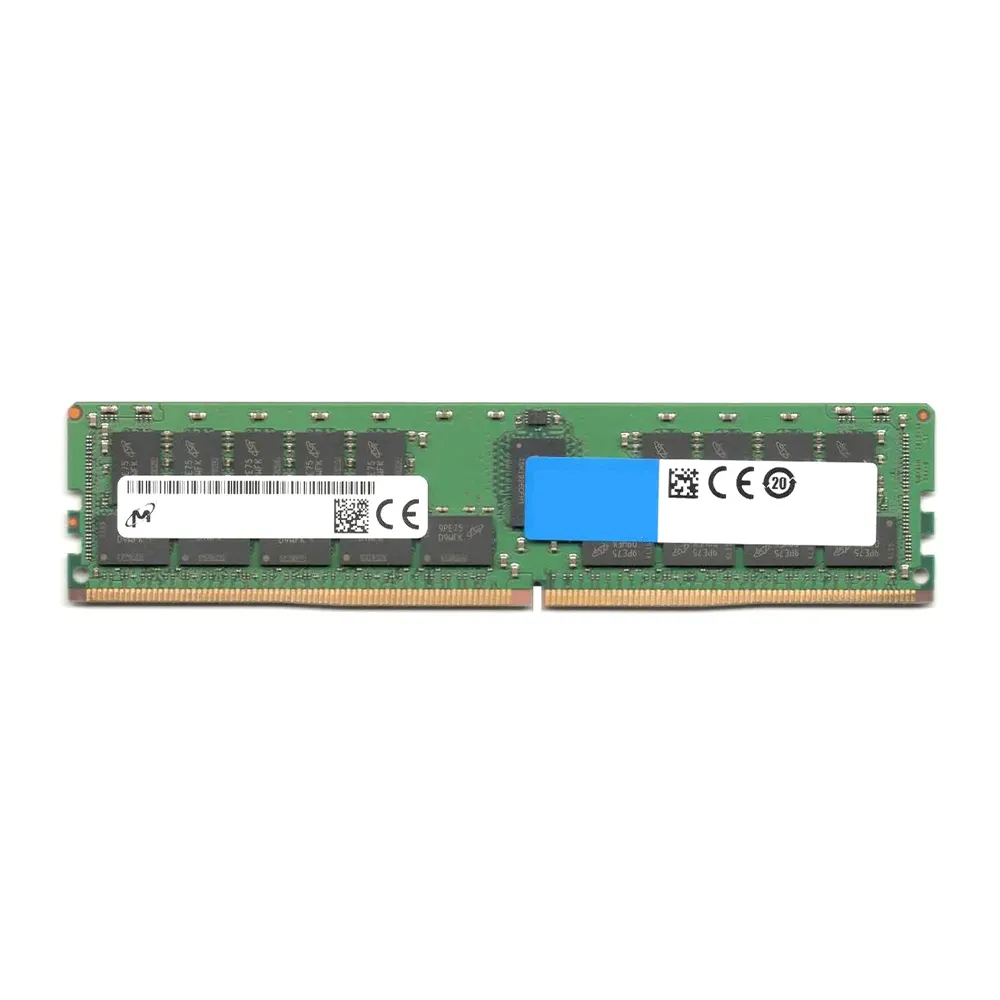
This Micron 16GB DDR4-2400 Registered DIMM is engineered for server platforms requiring high data integrity and stable operation under heavy loads, with ECC and registered signal buffering ensuring error correction and reliable signal integrity for virtualization or in-memory database workloads. The dual-rank x8 organization enhances memory bandwidth efficiency and capacity flexibility, while the CL17 latency at 1.2V balances performance with energy efficiency in dense data center deployments.
1. Registered DIMM architecture buffers command and address signals, preserving signal integrity across fully populated server memory channels and ensuring non-stop stability for virtualization hosts.
2. ECC memory actively corrects single-bit errors in real time, shielding critical workloads like in-memory databases and financial ledgers from silent data corruption.
3. Registered signaling allows the platform to scale to massive total capacity without sacrificing clock reliability, a must for dense multi-socket enterprise servers.
4. Dual rank x8 organization interleaves access across internal banks, raising sustained bandwidth and lowering transaction latency when dozens of VMs contend for memory.
5. A sixteen-gigabyte per module density lets IT architects pack sufficient DRAM into space-constrained 1U or 2U nodes, boosting container density per rack unit without wasting DIMM slots.
The MTA18ASF2G72PDZ-2G3B1RG is immediately identifiable as a server-grade RDIMM by its ECC, Registered signal type, and 288-pin form factor. In mission-critical environments, these four design choices directly prevent costly failures. First, ECC corrects single-bit memory errors caused by cosmic radiation or electrical noise, which is non-negotiable when a flipped bit in an in-memory database like Redis or SAP HANA can silently corrupt financial transactions or customer records. Second, the Registered buffer stabilizes signal integrity by reducing electrical loading on the memory controller, enabling a virtualization host to populate all 24 DIMM slots across multiple channels without sacrificing 2400MHz speed. Third, the dual-rank x8 architecture interleaves memory accesses across two internal ranks per module, delivering measurably higher bandwidth under the heavy parallel read/write workloads of a hypervisor juggling dozens of virtual machines. Finally, the 1.2V DDR4 voltage directly lowers power draw and thermal output across a full rack of servers, reducing cooling OPEX while maintaining CL17 responsiveness for latency-sensitive applications like high-frequency trading platforms.
General Virtualization
For a typical hypervisor hosting multiple VMs, populate the server with balanced RDIMMs across all memory channels to maximize bandwidth. Deploy six or eight identical 16 GB DDR4-2400 ECC Registered modules to achieve 96 GB or 128 GB total, ensuring adequate headroom for moderate consolidation ratios while maintaining memory interleaving performance. Avoid mixing ranks or speeds to prevent the memory controller from down-clocking and to preserve the ECC error protection essential for guest uptime.
In-Memory Database
In-memory database workloads such as SAP HANA or Redis demand the largest possible memory footprint and low latency. Fill all available DIMM slots with these 16 GB dual-rank x8 RDIMMs to reach the platform’s maximum capacity, often 512 GB or more on two-socket systems, and favor a 1 DIMM per channel (1DPC) population first to sustain 2400 MHz speed before scaling to 2DPC if capacity is paramount. The registered ECC design guarantees data integrity during sustained high-throughput cache operations.
High-Performance Computing
HPC clusters benefit from memory bandwidth as much as from core count. Install one DIMM per populated channel—typically eight or sixteen modules per node—to keep the 2400 MHz clock and dual-rank x8 data path fully engaged, delivering peak GB/s to the CPU. When job profiles lean toward capacity-bound simulation or checkpointing, add a second matching 16 GB RDIMM to each channel but budget for a slight frequency drop; ECC Registered signaling remains critical for silent data corruption protection over multi-day runs.
Rigorously tested server memory, compatible with Dell PowerEdge R740, HPE ProLiant DL380 Gen10, Lenovo ThinkSystem SR650, and Supermicro SYS-6029P-TR4.
Q: Can I mix this MTA18ASF2G72PDZ-2G3B1RG with other memory modules of different brands or speeds?
A: Mixing memory is not recommended in servers. Mismatched speeds or brands may cause instability, forcing the system to default to the lowest speed. For reliable operation, use identical modules.
Q: Is this memory compatible with my system?
A: This DDR4-2400 registered ECC DIMM is compatible with Intel Xeon E5-2600 v4, Scalable, and select AMD EPYC platforms using DDR4. Verify your motherboard's qualified vendor list.
Q: What is the recommended DIMM population order for optimal performance?
A: For dual-socket servers, populate identical DIMMs per channel, starting with the farthest slot from the CPU. Follow the motherboard’s specific population guide for balanced memory channels and maximum bandwidth.
Q: Does this module support overclocking or XMP profiles?
A: No, server-grade RDIMMs prioritize stability over overclocking. This module operates at JEDEC standard DDR4-2400 with no XMP profile. Overclocking is not supported and may void warranty.
Q: What warranty and typical failure rate can I expect?
A: This Micron module includes a 1-year warranty. Enterprise-class RDIMMs have a very low annualized failure rate (AFR), typically under 0.3%, ensuring reliable 24/7 operation in data centers.