











 Secure payments
Standard refund policy
Trade Assurance
Secure payments
Standard refund policy
Trade Assurance
| Product Type | Memory Module |
|---|---|
| Memory Capacity | 16 GB |
| Memory Technology | DDR4 |
| Product Voltage | 1.2V |
| RAM Speed | 2400MHz |
| RAM Standard | DDR4-2400/PC4-19200 |
| Error Identifying | ECC |
| Signal Type | Registered |
| Column Access Strobe (CAS) | CL17 |
| Rank | Dual Rank x8 |
| Quantity of Pins | 288-pin |
| RAM Genre | RDIMM |
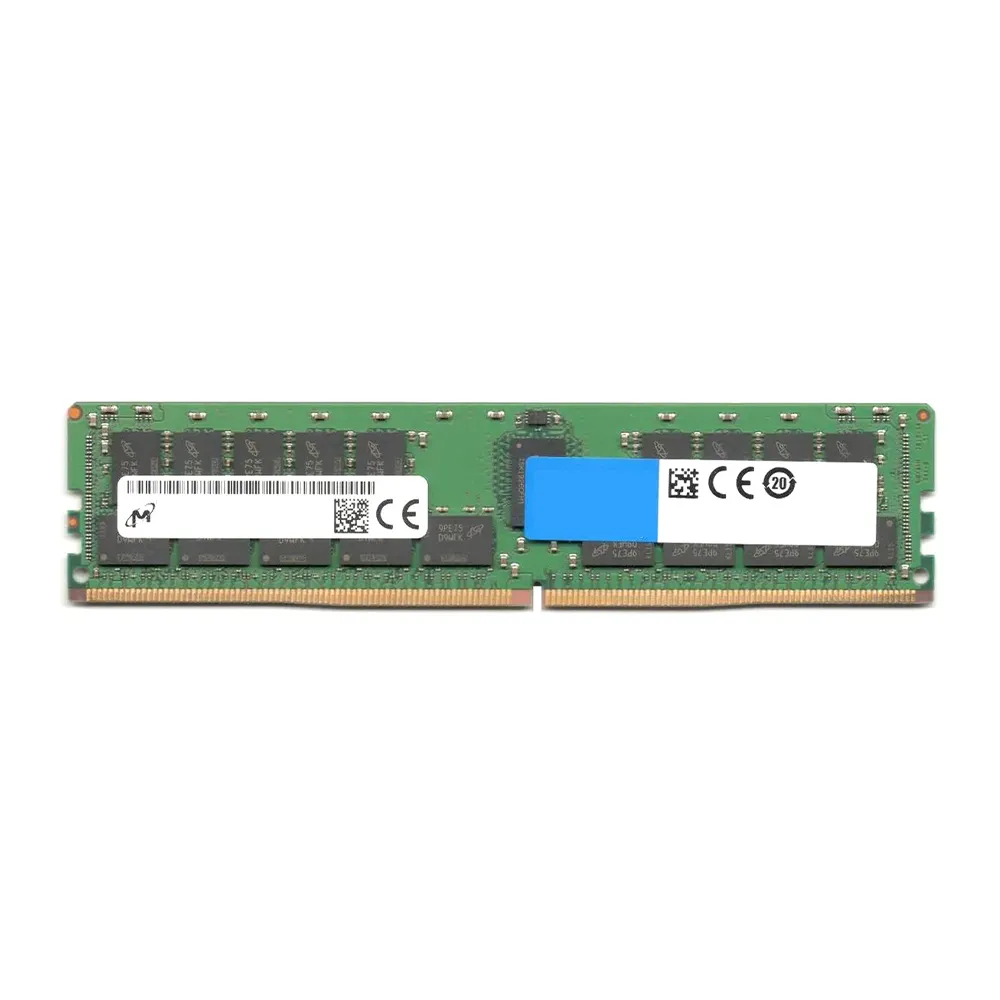
This DDR4-2400 Registered DIMM with ECC is engineered for server platforms, making it ideal for demanding workloads such as virtualization and in-memory databases where data integrity is critical. The dual-rank x8 organization and registered signal topology ensure stable operation under heavy memory loads, while the 1.2V operating voltage and CL17 latency provide a balance of energy efficiency and reliable performance.
1. ECC error correction safeguards transactional data integrity, preventing silent memory corruption in mission-critical database and financial workloads.
2. Registered signal buffering enables high-density memory configurations, allowing virtualized servers to host more VMs without compromising electrical stability.
3. Sixteen-gigabyte capacity per module strikes an optimal balance between cost and density, supporting meaningful consolidation ratios in mid-range virtualization hosts.
4. Dual Rank x8 organization interleaves memory accesses across rank boundaries, sustaining throughput under heavily threaded enterprise application processing.
5. The DDR4-2400 speed grade delivers ample memory bandwidth for multi-core server CPUs, ensuring smooth data flow during concurrent analytics and backup operations.
The Micron MTA18ASF2G72PDZ-2G3D1QK is a 16GB DDR4-2400 Registered ECC DIMM purpose-built for mission‑critical server platforms where every uncorrected error directly translates to revenue loss. In a dense virtualized cluster, background radiation occasionally flips memory bits without warning. The integrated ECC instantly detects and corrects these single-bit upsets, preserving transactional integrity for your in-memory database like SAP HANA or financial ERP—preventing silent data corruption that could cascade through dozens of VMs and bring your entire operation to a halt. As you scale to a fully populated 2-socket server, the Registered buffer re-drives command and address signals, dramatically lowering the electrical load on the memory controller. This eliminates the intermittent boot failures and blue screens that plague unbuffered designs in high-density configurations, guaranteeing stable uptime when you cannot afford a single minute of downtime. The dual-rank x8 architecture interleaves operations across internal banks, effectively doubling the bank-level parallelism. For latency-sensitive applications such as Redis or large-scale Apache Spark analytics, this translates to noticeably higher sustained bandwidth under heavy query concurrency—your decision dashboards update faster without transaction stalls. Operating at just 1.2V, it further minimizes thermal waste, allowing you to pack more DIMMs per rack within tight power budgets without sacrificing reliability. What that means for you is a memory investment that directly strengthens the trustworthiness, scalability, and speed of your entire enterprise infrastructure.
General Virtualization
For general virtualization hosts, deploy identical 16 GB RDIMMs across all memory channels to guarantee balanced NUMA performance and maximum throughput. Start with four modules (64 GB) per socket for modest VM consolidation, and scale to eight modules (128 GB) or more as multi‑tenant density grows. The ECC and registered design ensure data integrity and stable operation under continuous mixed‑workload pressure.
In-Memory Database
In‑memory databases demand large, contiguous capacity at low latency. Populate every channel of a dual‑socket server with these 16 GB dual‑rank x8 RDIMMs—typically 12 to 24 modules—to deliver 192–384 GB of protected memory, keeping entire datasets in RAM. Dual‑rank construction heightens bank‑level parallelism for higher transactions per second, while registered buffering stabilises signal integrity even at maximum configurations.
High-Performance Computing (HPC)
For HPC, install six or eight identical 16 GB RDIMMs per socket (one DIMM per channel) to achieve peak memory bandwidth and avoid rank throttling. In memory‑bound simulations, scale each node to 128 GB (8 × 16 GB), leveraging dual‑rank modules to maximise bank‑group utilisation. ECC protection eliminates silent data corruption, which is critical for long‑running parallel jobs where result accuracy cannot be compromised.
Validated server-grade DDR4 RDIMM, rigorously tested. Compatible with Dell PowerEdge R740, HPE ProLiant DL380 Gen10, Lenovo ThinkSystem SR650, and more.
Q: Can I mix this MTA18ASF2G72PDZ-2G3D1QK with other memory modules of different brands or speeds?
A: Mixing is not recommended for server environments. Registered ECC modules require identical specifications. Installing mismatched brands, speeds, or ranks risks system instability, POST failures, and uncorrectable memory errors.
Q: Is this memory compatible with my system?
A: It is compatible with servers supporting DDR4-2400 ECC Registered RDIMMs, such as Intel Xeon E5-2600 v3/v4 or AMD EPYC platforms. Verify your motherboard’s QVL or technical guide to confirm 288-pin RDIMM support.
Q: What is the recommended DIMM population order for optimal performance?
A: Follow your server manual for balanced channel interleaving. Typically, populate identical DIMMs in the first slot of each memory channel (e.g., A1, B1) first, then continue to A2, B2 to maximize throughput and NUMA efficiency.
Q: Does this module support overclocking or XMP profiles?
A: No. This is a JEDEC-standard DDR4-2400 registered ECC server module built for 24/7 stability. It does not support XMP or overclocking, as data integrity and error correction take priority over speculative speed increases.
Q: What warranty and typical failure rate can I expect?
A: This Micron module includes a 1-year warranty. Enterprise-class ECC RDIMMs exhibit extremely low failure rates under normal operating conditions. For mission-critical systems, we recommend keeping a cold spare to ensure rapid recovery.