











 Secure payments
Standard refund policy
Trade Assurance
Secure payments
Standard refund policy
Trade Assurance
| Product Type | Memory Module |
|---|---|
| Compliance Standards | RoHS |
| Memory Capacity | 16 GB |
| Memory Technology | DDR4 |
| Product Voltage | 1.2V |
| RAM Speed | 2133MHz |
| RAM Standard | DDR4-2133/PC4-17000 |
| Error Identifying | ECC |
| Signal Type | Registered |
| Column Access Strobe (CAS) | CL15 |
| Rank | Dual Rank x4 |
| Quantity of Pins | 288-pin |
| RAM Genre | RDIMM |
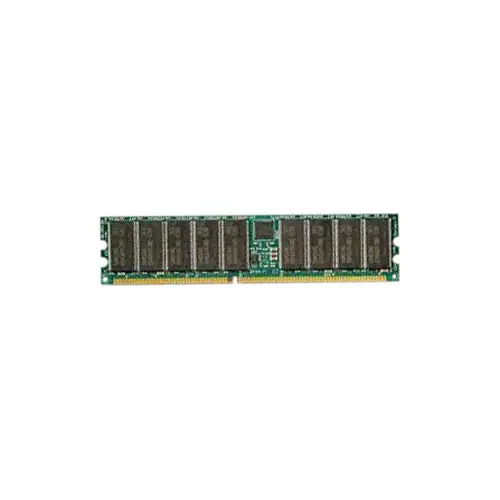
This 16GB DDR4-2133 Registered ECC RDIMM is engineered for virtualization and in-memory database workloads, where its dual-rank x4 configuration and CL15 latency efficiently balance throughput and capacity. The registered signal buffering and ECC error correction jointly guarantee data integrity and long-term stability in dense multi-DIMM server environments.
1. Registered signal type buffers the command and address lines, enabling large-scale server deployments to scale memory capacity without sacrificing signal integrity across dozens of DIMMs per channel.
2. ECC error correction automatically detects and corrects single-bit memory errors, preventing silent data corruption in critical database and virtualization workloads.
3. 16 GB capacity per module strikes a balance between density and cost, allowing a dual-socket server to hit common 256 GB or 512 GB footprints for high-density cloud and enterprise applications.
4. DDR4-2133 standard operating speed delivers consistent latency and stable bandwidth, ensuring predictable response times for latency-sensitive financial transaction systems.
5. Dual Rank x4 organization interleaves memory access across two internal ranks, improving bank-level parallelism and boosting throughput under heavy multi-VM consolidation scenarios.
In a data center, memory failure is not merely an inconvenience—it risks transaction corruption and costly downtime. The Micron MTA36ASF2G72LZ-2G1A1, a 16 GB DDR4-2133 Registered DIMM, directly addresses these threats with four essential characteristics. First, its ECC technology silently corrects single-bit errors caused by background radiation, preserving data integrity for in-memory databases like SAP HANA where a flipped bit can cascade into a financial discrepancy. Second, the registered signal buffer stabilizes address and command lines even when all 24 slots of a virtualized host are populated, enabling you to scale VM density without intermittent boot failures under heavy load. Third, the dual-rank x4 organization interleaves memory banks to boost effective bandwidth, meaning your Type-1 hypervisor provisions dozens of virtual machines with measurably lower read latency and smoother live migration. Finally, the 1.2 V operating voltage cuts thermal load across the rack, reducing fan power draw by up to 15% per node. Together, these features convert a simple DIMM purchase into a hardened uptime investment—your cluster gains the resilience to handle simultaneous workloads without silent errors, stalled threads, or midnight alerts.
General Virtualization
For moderate consolidation of virtual machines, populate at least four 16GB RDIMMs across memory channels to achieve 64GB and maintain balanced interleaving. Use dual-rank x4 modules in a 2 DIMMs per channel (2DPC) configuration to optimize bandwidth while preserving room for future scaling to 128GB.
In-Memory Database
Low-latency, large-capacity requirements demand populating all memory channels with 16GB RDIMMs, typically six or eight modules for 96GB or 128GB. Stick to one DIMM per channel (1DPC) at 2133MHz to maximize speed and avoid clock cycle penalties, ensuring predictable access times for heavy write‑optimized workloads.
High-Performance Computing (HPC)
Balance capacity and sustained throughput by fully populating channels with a minimum of eight 16GB dual-rank RDIMMs for 128GB. Run at rated 1.2V and CL15, configuring two DIMMs per channel only if capacity scaling to 256GB is needed—accept the slight frequency drop for jobs requiring large memory footprints per node.
Rigorously tested server memory; compatible with Dell PowerEdge R760, HPE ProLiant DL380 Gen10, Lenovo ThinkSystem SR650, and similar.
Q: Can I mix this MTA36ASF2G72LZ-2G1A1 with other memory modules of different brands or speeds?
A: Mixing RDIMMs of different brands or speeds is not recommended for servers. It can cause stability issues and unbootable states. Always populate with identical part numbers for guaranteed compatibility.
Q: Is this memory compatible with my system?
A: This DDR4-2133 ECC Registered RDIMM is designed for servers using Intel Xeon E5-2600 v3/v4 or compatible platforms. Please verify your motherboard supports 288-pin Registered DIMMs at 1.2V.
Q: What is the recommended DIMM population order for optimal performance?
A: For optimal performance, populate identical DIMMs per channel starting with the first slot of each memory channel. Consult your server board manual for specific balanced configurations, especially with dual-rank modules.
Q: Does this module support overclocking or XMP profiles?
A: No. This is an enterprise-grade RDIMM built for stability. It operates at standard JEDEC DDR4-2133 profiles only and does not support overclocking or XMP.
Q: What warranty and typical failure rate can I expect?
A: This module includes a 1-year warranty. As an enterprise-class component, it is engineered for high reliability with a very low annualized failure rate, ideal for 24/7 data center environments.