











 Secure payments
Standard refund policy
Trade Assurance
Secure payments
Standard refund policy
Trade Assurance
| Product Type | Memory Module |
|---|---|
| Memory Capacity | 16 GB |
| Memory Technology | DDR4 |
| Product Voltage | 1.2V |
| RAM Speed | 2133MHz |
| RAM Standard | DDR4-2133/PC4-17000 |
| Error Identifying | ECC |
| Signal Type | Registered |
| Column Access Strobe (CAS) | CL15 |
| Rank | Dual Rank |
| Quantity of Pins | 288-pin |
| RAM Genre | RDIMM |
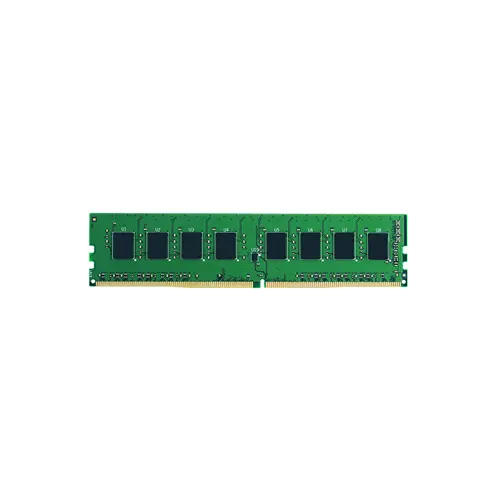
Designed for mission-critical enterprise servers, this 16GB DDR4-2133 RDIMM with ECC and registered signaling ensures data integrity in virtualized environments and in-memory database workloads. Its dual-rank configuration enhances memory bandwidth efficiency under heavy multi-DIMM loads, while the CL15 latency and 1.2V operation deliver reliable, power-efficient performance for sustained 24/7 operation.
1. ECC protection silently corrects single-bit errors at runtime, ensuring transactional integrity and virtually eliminating silent data corruption in always-on database servers.
2. Registered signal buffering stabilizes command and address lines across high-density memory populations, allowing multi-socket servers to scale to terabytes of RAM without signal degradation.
3. Dual-rank organization leverages interleaving to keep memory channels saturated, delivering higher effective bandwidth for virtualized workloads under heavy consolidation.
4. DDR4’s native low-voltage operation slashes per-DIMM power draw, directly reducing cooling overhead and energy costs in dense rack and blade deployments.
5. A 16 GB capacity per module enables building sizeable memory footprints with fewer slots, optimizing virtual machine density on mid-range hypervisor hosts without early scaling limits.
As a server-class Registered DIMM, this Micron module directly addresses the uncompromising demands of enterprise data centers. Its ECC technology continuously scans for and corrects single-bit errors induced by background radiation, a critical defense when processing financial transactions or hosting an in-memory database like SAP HANA where even a single flipped bit can corrupt a record. The registered buffer then cleans and re-drives command signals, enabling you to populate all available memory channels with 16 GB modules across a virtualized cluster without the signal degradation that leads to cryptic system crashes under heavy VM density. Furthermore, the dual-rank architecture interleaves internal banks to sustain peak bandwidth, reducing latency when dozens of virtual machines pound the memory controller simultaneously. Finally, the 1.2V low-voltage design drastically cuts thermal output per DIMM; across a rack of servers this compounds into substantial electricity savings and lower cooling overhead, directly improving your operational bottom line while maintaining absolute data integrity around the clock.
General Virtualization
For general virtualization hosts, deploying balanced memory capacity is key. A dual-socket server populated with eight to twelve of these 16GB Registered DIMMs (128–192 GB total) allows you to run a comfortable density of moderate VMs without overcommitting memory. Distribute modules evenly across all memory channels to maintain bandwidth, and leave headroom for failover and maintenance while avoiding excessive paging.
In-Memory Database
In-memory databases thrive on low latency and high reliability, making this ECC RDIMM an excellent fit. Plan for dense configurations—often 16 or more modules per server—to hold entire datasets in RAM (256 GB and above). Populate all channels equally and prioritize rank interleaving: these dual-rank DIMMs improve performance by allowing parallel access, but avoid mixing with quad-rank modules to prevent speed downgrades.
High-Performance Computing (HPC)
HPC workloads demand maximum memory bandwidth and predictable latency. Populate every memory channel with one of these dual‑rank DIMMs to saturate the memory bus (e.g., 16 DIMMs in an eight‑channel system for 256 GB). Strict population order per the server’s manual is critical; misplacement can drop to single‑channel mode and starve compute cores. For bandwidth‑sensitive simulations, favor a larger number of 16GB modules over fewer high‑capacity DIMMs to keep all channels active.
Validated server memory, compatible with Dell PowerEdge R760, R750, HPE ProLiant DL380 Gen10, Lenovo ThinkSystem SR650.
Q: Can I mix this MTA36ASF2G72PZ with other memory modules of different brands or speeds?
A: Mixing different brands or speeds is not recommended for RDIMMs. It can cause timing conflicts and instability. Use identical part numbers to guarantee reliable operation in server environments.
Q: Is this memory compatible with my system?
A: This DDR4-2133 Registered ECC RDIMM is compatible with servers supporting DDR4 Registered DIMMs, such as Intel Xeon E5-2600 v3/v4 or Scalable platforms, and AMD EPYC. Verify with your motherboard's QVL.
Q: What is the recommended DIMM population order for optimal performance?
A: Follow your server's manual. Generally, populate identical slots across all memory channels first (e.g., white slots) to balance interleaving. For dual rank DIMMs, this maximizes bandwidth and ensures optimal performance.
Q: Does this module support overclocking or XMP profiles?
A: No. This is a JEDEC-compliant DDR4-2133 ECC RDIMM designed for stability at 2133 MT/s. It does not support overclocking or XMP profiles, as server memory prioritizes data integrity and reliability.
Q: What warranty and typical failure rate can I expect?
A: This module comes with a 1-year warranty. You can expect a typical annualized failure rate (AFR) below 0.5%, attributable to stringent testing and enterprise-grade quality control, ensuring reliable operation.