











 Secure payments
Standard refund policy
Trade Assurance
Secure payments
Standard refund policy
Trade Assurance
| Product Type | Memory Module |
|---|---|
| Memory Capacity | 64 GB |
| Memory Technology | DDR4 |
| Product Voltage | 1.2V |
| RAM Speed | 2933MHz |
| RAM Standard | DDR4-2933/PC4-23400 |
| Error Identifying | ECC |
| Signal Type | Registered |
| Column Access Strobe (CAS) | CL21 |
| Rank | Quad Rank x4 |
| Quantity of Pins | 288-pin |
| RAM Genre | RDIMM |
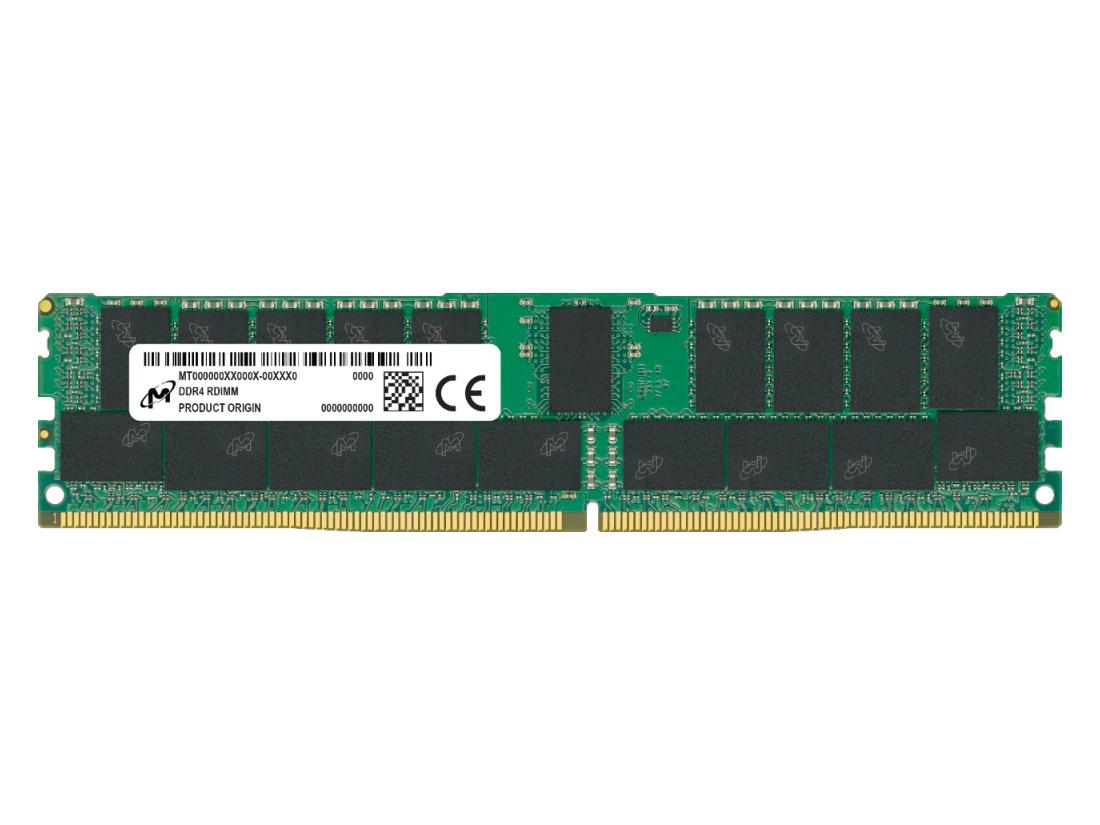
This 64GB DDR4-2933 Registered ECC RDIMM employs a quad-rank x4 organization to deliver high capacity per channel while maintaining signal integrity, making it ideally suited for memory-intensive server workloads such as virtualization and in-memory databases. The combination of ECC error correction and registered buffering ensures end-to-end data integrity and stable operation in multi-DIMM platforms where reliability is critical.
1. ECC protection detects and corrects single-bit errors on the fly, safeguarding transactional data integrity in mission-critical virtualization and database servers.
2. Registered signal type buffers command and address lines, enabling massive memory populations without compromising signal integrity at scale.
3. A dense 64 GB capacity per module maximizes VM density and in-memory database performance, reducing the need for costly server sprawl.
4. Quad Rank x4 organization keeps memory channels deeply saturated, delivering consistent throughput under heavy multi-tenant consolidation workloads.
5. Operating at 2933 MHz, the module supplies the elevated memory bandwidth demanded by real-time analytics and high-frequency trading applications.
When deploying a high-density virtualization cluster, you are not just running one workload—you are hosting dozens of virtual machines on a single node. A silent memory error in such an environment is catastrophic. The ECC engine on this Micron 64GB DDR4-2933 RDIMM detects and corrects single-bit flips in real time, preserving data integrity and preventing application crashes or subtle data corruption that could propagate across your entire estate. That alone is insurance for your uptime SLA.
In a demanding in-memory database like SAP HANA or a real-time analytics engine, capacity and signal stability become inseparable. The module’s Registered architecture buffers command and address signals, allowing the server to populate all channels with 64GB quad-rank DIMMs without degrading signal integrity or forcing a downclock. You get a dense, reliable memory footprint that keeps massive datasets entirely in RAM, slashing query latency. The quad-rank x4 organization further boosts bandwidth through internal bank interleaving, giving your virtualized database hosts the sustained throughput needed under peak transaction loads. This memory turns raw scalability into practical, worry-free performance where every nanosecond matters.
Based on the specifications—DDR4-2933, ECC, Registered, Quad Rank x4, 288-pin RDIMM—this is definitively server memory. The following capacity planning guide addresses three common server workloads using this 64 GB module.
General Virtualization
Populate memory channels symmetrically to maximize available bandwidth for multiple VMs. A balanced configuration of four 64 GB modules (256 GB total) per socket provides ample headroom for moderate consolidation, while leaving slots free for future scaling. Stick to one DIMM per channel initially to sustain 2933 MT/s and only add a second DIMM per channel if capacity demands outweigh minor speed trade-offs.
In-Memory Database
Maximize total capacity and prioritize rank interleaving by fully populating all channels with two DIMMs per channel. For example, eight modules (512 GB) across an eight-channel platform ensure the database working set resides entirely in RAM, with the quad-rank design boosting parallel access. Monitor memory speed; at two DIMMs per channel the bus may downclock, so confirm the performance impact against transaction latency requirements.
High Performance Computing
Bandwidth is paramount—fill every available memory channel with a single 64 GB RDIMM to sustain the highest clock speed. On a dual-socket system with eight channels per CPU, sixteen modules deliver 1 TB of balanced, high-bandwidth capacity. Avoid using more than one DIMM per channel to prevent frequency drops, and ensure all modules are identical to maintain uniform access patterns across nodes.
Rigorously tested; compatible with Dell PowerEdge R760, HPE ProLiant DL380 Gen10, Lenovo ThinkSystem SR650.
Q: Can I mix this MTA36ASF8G72LZ-2G9B1 with other memory modules of different brands or speeds?
A: Mixing is strongly discouraged for registered server memory. Mismatched ranks or speeds force the memory controller to downclock all DIMMs, compromising stability and ECC functionality. Uniformity is critical.
Q: Is this memory compatible with my server?
A: This DDR4-2933 RDIMM is designed for Intel Xeon Scalable (2nd Gen and later) and AMD EPYC 7002/7003 platforms. Please verify your motherboard's QVL for 64GB quad-rank x4 support at this speed.
Q: What is the recommended DIMM population order for optimal performance?
A: Refer to your server's manual. Typically, populate identical quad-rank DIMMs starting with the first slot of each memory channel (often blue slots) to maintain balanced interleaving and full throughput.
Q: Does this module support overclocking or XMP profiles?
A: No. As an industry-standard, JEDEC-compliant registered ECC module, it operates strictly at its specified 2933 MT/s with CL21 timings. Overclocking and XMP are unavailable to ensure data integrity.
Q: What warranty and typical failure rate can I expect?
A: This module includes a one-year warranty. Enterprise DDR4 RDIMMs have an extremely low annualized failure rate, typically below 0.2% in controlled data center environments with proper cooling.