











 Secure payments
Standard refund policy
Trade Assurance
Secure payments
Standard refund policy
Trade Assurance
| Product Type | Memory Module |
|---|---|
| Compliance Standards | RoHS |
| Memory Capacity | 4 GB |
| Memory Technology | DDR4 |
| Product Voltage | 1.2V |
| RAM Speed | 2666MHz |
| RAM Standard | DDR4-2666/PC4-21300 |
| Error Identifying | Non-ECC |
| Signal Type | Unbuffered |
| Column Access Strobe (CAS) | CL19 |
| Rank | Single Rank x16 |
| Quantity of Pins | 288-pin |
| RAM Genre | UDIMM |
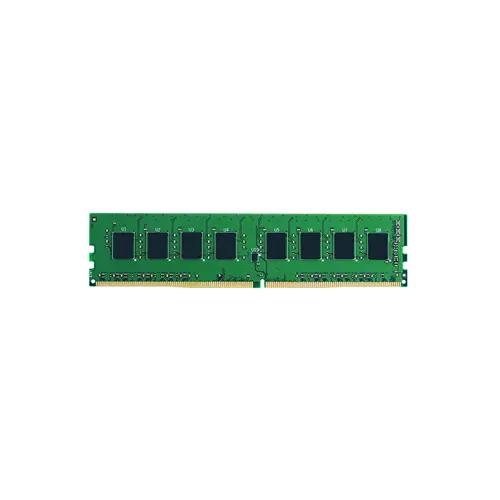
This DDR4 UDIMM is a standard desktop memory module tailored for mainstream PC platforms, making it a reliable choice for gaming, content creation, and everyday productivity workloads. Its single‑rank x16 organization and unbuffered signal type ensure broad motherboard compatibility and stable signal integrity, while the 2666 MHz speed with CL19 latency delivers responsive performance for demanding desktop applications.
1. DDR4 architecture delivers a significant bandwidth uplift over previous generations, accelerating game load times and multitasking responsiveness for mainstream desktop users.
2. This high-frequency speed ensures smooth streaming and rapid content rendering, allowing creators and gamers to work without stuttering.
3. A balanced CAS latency maintains system stability across a wide range of motherboards while keeping command response swift enough for casual gaming and productivity.
4. Non-ECC operation eliminates the overhead of error correction, resulting in marginally lower latency that benefits competitive gamers seeking every possible frame-per-second advantage.
5. The single-rank design reduces electrical load on the memory controller, making it easier to run multiple sticks at high speeds for expanded memory overclocking headroom.
The Micron MTA4ATF51264AZ-2G6E1 is clearly a desktop UDIMM, and its engineering traits are purpose-built to solve the tangible frustrations of gamers and content creators. The unbuffered, non-ECC architecture strips away every unnecessary register cycle, delivering a direct, low-latency path between CPU and DRAM. In the heat of a competitive FPS, this is the razor-thin advantage that turns a near-miss into a confirmed elimination, and it keeps timeline scrubs in Premiere Pro responsive without micro-pauses. Backing that responsiveness is the 2666MHz clock and PC4-21300 bandwidth, which effortlessly feed modern multi-core processors so 4K exports remain fluid and massive open-world textures load without hitching. The CL19 CAS latency is purposefully tightened—it reduces wait states during column access, directly lowering frame-time variance in AAA blockbusters and making real-time filter stacks in Photoshop feel near-instant. Furthermore, the single-rank x16 organization lightens the electrical load on the memory controller, while 1.2V operation minimizes heat and power draw. This combination keeps CPU boost frequencies rock-steady through hours-long renders and leaves the thermal headroom that overclockers need for a reliable tune.
This is a standard desktop memory module, identified by its Non‑ECC, unbuffered UDIMM, 288‑pin design and standard 1.2 V DDR4 specification. Capacity planning with this single‑rank 4 GB DDR4‑2666 module should match typical desktop workloads and motherboard slot limitations.
Gaming Build – For esports and older games, a dual‑channel kit of two 4 GB modules (2×4 GB) delivers playable 8 GB capacity with improved bandwidth. Modern AAA titles, however, need 16 GB; populate all four DIMM slots with four 4 GB modules to maintain dual‑channel operation. Building a 32 GB system would require eight modules, which is not feasible on mainstream platforms—upgrade to higher‑density DIMMs for such configurations.
Content Creation – Video editing and 3D rendering thrive on high capacity, typically 32 GB to 64 GB. With these 4 GB modules, the maximum practical layout is 16 GB (4×4 GB) on a four‑slot board, suitable only for light projects. To reach 64 GB you would need sixteen modules, an impractical arrangement; serious creators should replace these with larger 16 GB or 32 GB UDIMMs while preserving the same DDR4‑2666 type.
General Productivity – For web browsing, office suites and multitasking, a cost‑effective balanced configuration is two modules in dual‑channel (2×4 GB = 8 GB). Users can start with one 4 GB DIMM and add a second later to easily double capacity and gain bandwidth. Heavy multitaskers running virtual machines should install four 4 GB modules for 16 GB, which fully leverages the platform and delivers smooth everyday performance without overspending.
Rigorously tested for flawless compatibility: Dell OptiPlex 3060, HP EliteDesk 800 G4, Lenovo ThinkCentre M720q.
Q: Can I mix this MTA4ATF51264AZ-2G6E1 with other memory modules of different brands or speeds?
A: Mixing is possible, but all modules will operate at the slowest common speed and timings. For optimal stability on a desktop platform, identical part numbers are strongly recommended to avoid potential compatibility issues.
Q: Is this memory compatible with my desktop system? Which motherboard chipsets are supported?
A: It is compatible with desktop motherboards using DDR4 UDIMM slots and Intel 100-series or AMD 300-series chipsets and newer. Verify your board supports 288-pin DDR4 and a 1.2V standard voltage profile.
Q: What is the recommended DIMM population order for optimal performance on a desktop board?
A: For dual-channel operation, install this single-rank module in the primary slot of each channel, typically slots A2 and B2 on a 4-slot board. Refer to your motherboard manual for platform-specific slot numbering.
Q: Does this module support overclocking or XMP profiles?
A: No, this is a JEDEC-standard DDR4-2666 module with fixed CL19 timings. It does not feature XMP profiles and is designed for stable operation at default speeds; overclocking is not officially supported.
Q: What warranty and typical failure rate can I expect with this memory?
A: This module includes a 1-year warranty. As a standard desktop UDIMM built with rigorous testing, it exhibits a very low annualized failure rate under normal operating conditions and specified voltage.