











 Secure payments
Standard refund policy
Trade Assurance
Secure payments
Standard refund policy
Trade Assurance
| Product Type | Memory Module |
|---|---|
| Memory Capacity | 64 GB |
| Memory Technology | DDR4 |
| Product Voltage | 1.2V |
| RAM Speed | 2666MHz |
| RAM Standard | DDR4-2666/PC4-21300 |
| Error Identifying | ECC |
| Signal Type | Registered |
| Column Access Strobe (CAS) | CL19 |
| Rank | Quad Rank x4 |
| Quantity of Pins | 288-pin |
| RAM Genre | RDIMM |
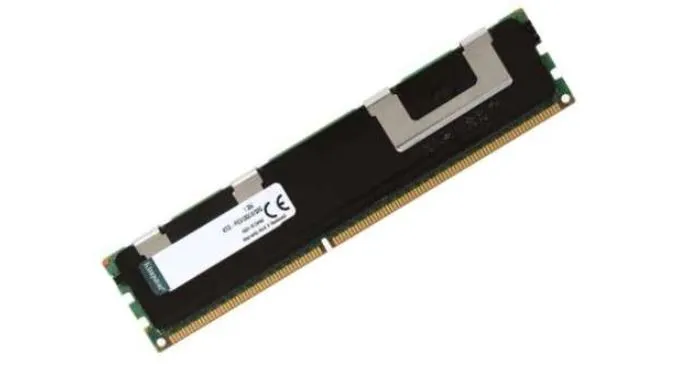
This DDR4-2666 Registered DIMM with ECC is engineered for enterprise servers and memory-intensive workloads such as virtualization, in-memory databases, and mission-critical applications demanding uncompromising data integrity. Its quad-rank x4 organization maximizes capacity density per channel while the registered signal type and ECC ensure stable operation and single-bit error correction across large memory populations, all at a low 1.2V operating voltage.
1. 64 GB capacity per module allows dense server configurations to host hundreds of virtual machines or large in-memory databases without resorting to costly multi-node expansion.
2. ECC error detection and correction eliminates silent data corruption, safeguarding transactional integrity in financial services and life-sciences compute clusters.
3. Registered buffering decouples electrical loading from the memory bus, preserving signal integrity when all channels are fully populated in high-density rack servers.
4. Quad Rank x4 organization interleaves more DRAM pages per channel, delivering higher sustained bandwidth for real-time analytics and memory-constrained containerized workloads.
5. 2666 MHz DDR4 throughput efficiently feeds multi-core server CPUs, maintaining predictable low latency under bursty client requests in virtual desktop infrastructure deployments.
In the data center, where every calculation carries business consequences, the MTA72ASS8G72PSZ-2S6E1 RDIMM is engineered to eliminate the compromises that put your workloads at risk. Its ECC technology is not just a specification; it silently detects and corrects single-bit memory errors caused by background radiation before they silently corrupt a financial transaction or a patient record in a virtualized cluster, turning unpredictable data corruption into a non-event. The registered signal buffer addresses a critical physical reality: when you populate a server board with multiple 64GB modules to support a dense VMware farm, the electrical load on the memory bus becomes overwhelming. This buffer stabilizes command signals, allowing the host to manage massive memory pools without command integrity loss, so you can confidently scale up virtual machines. The Quad Rank x4 organization delivers the deep, sustained bandwidth that in-memory databases like SAP HANA demand during peak query storms—it keeps data streaming when cache hit rates fluctuate. In a hyper-converged infrastructure running dozens of containers, this 64GB capacity means fewer DIMMs per server, reducing power draw and thermal stress while preserving critical memory expansion headroom. This module transforms raw specifications into assured uptime and transactional consistency, making it the silent foundation beneath your most vital applications.
This server-grade DDR4-2666 Registered ECC module (64 GB, quad-rank) is purpose-built for platforms requiring high capacity, data integrity, and multi-channel memory architectures. Below are capacity planning recommendations for three common enterprise workloads.
General Virtualization
Start with a balanced configuration of four identical 64 GB RDIMMs (256 GB total) distributed evenly across memory channels—typically one DIMM per channel in a dual-socket system. This preserves full memory bandwidth for moderate VM density while keeping expansion slots free. Scale incrementally by adding matched sets to double capacity without sacrificing populated-channel symmetry.
In-Memory Database
Maximize capacity per server by fully populating all channels with these 64 GB modules; for example, eight modules yield 512 GB of fault-tolerant memory ideal for large in-memory datasets. Operate at the platform’s maximum supported speed (often requiring a slight frequency reduction when populating 2 DIMMs per channel with quad-rank DIMMs) and validate against the database vendor’s latency guidelines. Redundancy through ECC is non-negotiable here to protect transactional data.
High-Performance Computing (HPC)
Prioritize sustained bandwidth over raw capacity. Populate one 64 GB DIMM per channel across all channels (e.g., 8 DIMMs for 512 GB) to maintain the highest clock speed without rank-induced downclocking. For memory-bandwidth-bound simulations, this clean single-DIMM-per-channel layout delivers the most predictable performance. Supplement with additional identical kits if per-node capacity must grow, always keeping the population symmetric to avoid NUMA imbalances.
Rigorously tested server memory compatible with Dell PowerEdge R740, HPE ProLiant DL380 Gen10, Lenovo ThinkSystem SR650.
Q: Can I mix this MTA72ASS8G72PSZ-2S6E1 with other memory modules of different brands or speeds?
A: Mixing brands or speeds on a server platform is not recommended, as it can cause signal integrity issues and system instability. For reliable operation, use identical RDIMMs with the same Micron part number.
Q: Is this memory compatible with my system?
A: This 64GB DDR4-2666 ECC Registered DIMM is compatible with server platforms supporting 288-pin RDIMM, such as Intel Xeon Scalable Gen 1/2 and AMD EPYC 7001/7002 series. Verify your board’s qualified vendor list.
Q: What is the recommended DIMM population order for optimal performance?
A: Populate identical DIMMs per memory channel, typically starting with the slots furthest from the CPU. Always follow your server board’s population guide for balanced channel interleaving and maximum throughput.
Q: Does this module support overclocking or XMP profiles?
A: No. As a JEDEC-compliant server RDIMM, this module does not support overclocking or XMP profiles. It runs at a fixed 2666MHz to ensure data integrity and 24/7 stability in enterprise environments.
Q: What warranty and typical failure rate can I expect?
A: This module carries a one-year warranty. The typical annualized failure rate (AFR) for Micron RDIMMs is well below 0.5%, reflecting high quality and rigorous post-production testing.