











 Secure payments
Standard refund policy
Trade Assurance
Secure payments
Standard refund policy
Trade Assurance
| Product Type | Memory Module |
|---|---|
| Memory Capacity | 8 GB |
| Memory Technology | DDR4 |
| Product Voltage | 1.2V |
| RAM Speed | 2400MHz |
| RAM Standard | DDR4-2400/PC4-19200 |
| Error Identifying | ECC |
| Signal Type | Unbuffered |
| Column Access Strobe (CAS) | CL17 |
| Rank | Single Rank x8 |
| Quantity of Pins | 288-pin |
| RAM Genre | UDIMM |
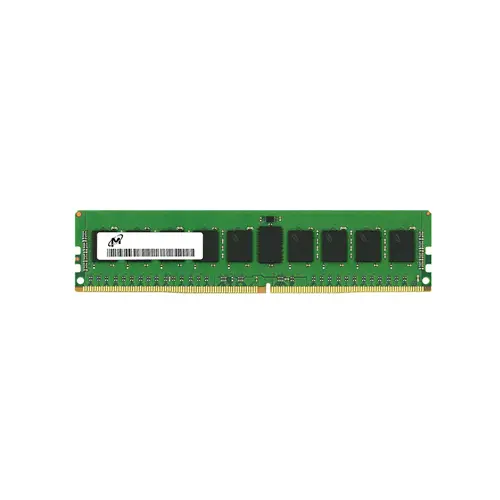
This unbuffered ECC UDIMM is ideally suited for entry-level servers and small-scale workstations where data integrity is paramount, enabling reliable operation in memory-sensitive workloads such as light virtualization, file services, or NAS applications through its single-bit error correction. The single-rank x8 configuration and 288-pin DDR4 design at 1.2V deliver stable, low-latency CL17 performance while maintaining broad compatibility with platforms that require ECC without the overhead of registered memory.
1. ECC protection ensures end-to-end data integrity, eliminating silent memory errors that could corrupt financial transactions or database records in always-on microserver environments.
2. Unbuffered architecture delivers lower access latency compared to registered DIMMs, giving latency-sensitive edge-server applications a measurable response-time advantage.
3. Eight-gigabyte capacity per module strikes a cost-efficient balance for entry-level virtualization hosts, allowing enough headroom for multiple light containers without overspending on unused resources.
4. 2400 MT/s data rate supplies ample memory bandwidth for concurrent web-server threads and real-time analytics engines running on small office server platforms.
5. Single Rank x8 organization guarantees full-speed operation when all memory channels are populated, maximizing throughput stability in compact server builds that rely on native memory-controller capabilities.
When you select the Micron MTA9ASF1G72AZ-2G3B1 for your server infrastructure, you are making a decisive commitment to runtime integrity and consistent performance in memory-sensitive workloads. This is an 8GB DDR4-2400 UDIMM with true ECC, a critical combination for single-socket servers, entry workstations, and small virtualization hosts where buffered RDIMMs are not supported but data accuracy is non-negotiable.
In a virtualized cluster running multiple lightweight VMs, a single-bit error in guest memory can silently corrupt file systems or application state. The onboard ECC detects and corrects these bit flips in real time, directly preventing unexplained service restarts and data drift that erode user trust over weeks of uptime. Unbuffered signaling keeps the electrical path short and latency low, which matters when a Type-1 hypervisor schedules frequent context switches.
For an in-memory database or Redis cluster, the number of rank and access latency shape throughput under load. This single-rank x8 module offers clean, predictable electrical loading, allowing the memory controller to drive 2400MHz at CL17 with tighter command spacing than a dual-rank alternative. The result: faster key lookups and lower tail latency during concurrent client floods. Every watt also counts in a dense deployment, and the fixed 1.2V operating voltage helps contain thermal envelope growth without sacrificing signal reliability over the full 288-pin socket interface.
General Virtualization
For lightweight VM hosts, populate at least four of these 8 GB ECC UDIMMs to achieve 32 GB total, enabling comfortable density for a handful of VMs. Stick to identical single‑rank x8 modules and symmetrical DIMM population per memory channel to preserve memory bandwidth and error correction. Avoid mixing with non‑ECC modules, as the platform would drop to non‑ECC operation.
In-Memory Database
In‑memory datasets demand capacity and reliability over raw speed. Deploy six to eight modules per socket (48–64 GB) to hold working sets entirely in RAM, leveraging ECC to protect data integrity. Given the 2400 MHz speed, prioritize socket balance—fill all channels with matched UDIMMs to avoid bandwidth bottlenecks on large in‑memory joins.
High-Performance Computing (HPC)
HPC favors bandwidth‑sensitive workloads; install four or eight DIMMs in a balanced configuration across all memory channels. The single‑rank x8 design supports consistent latency, but 2400 MHz may cap throughput. If the node supports higher speeds, consider faster ECC UDIMMs; otherwise, maximize channel count with 8 GB sticks to feed compute cores efficiently without oversubscribing the memory bus.
Server-grade compatibility: rigorously tested for Dell PowerEdge R240, HPE ProLiant DL20 Gen10, and Lenovo ThinkSystem SR250.
Q: Can I mix this MTA9ASF1G72AZ-2G3B1 with other memory modules of different brands or speeds?
A: Mixing ECC UDIMMs with non-ECC or different speeds is not recommended. The system will clock all modules to the slowest speed, and mixing may disable ECC functionality, risking data integrity.
Q: Is this memory compatible with my server platform (Intel or AMD)?
A: This DDR4-2400 ECC UDIMM is designed for Intel Xeon E3-1200 v5/v6 or AMD Ryzen PRO platforms that support unbuffered ECC memory. Verify your motherboard’s QVL for 1.2V, 8 GB ECC UDIMM support.
Q: What is the recommended DIMM population order for optimal performance?
A: For single-processor configurations, populate the farthest slot from the CPU in each memory channel first (e.g., A1, B1). Always refer to your server board manual to maintain balanced channels and full ECC support.
Q: Does this module support overclocking or XMP profiles?
A: No. This ECC UDIMM follows strict JEDEC DDR4-2400 standards. Servers and workstations prioritize data reliability over overclocking, so XMP profiles and voltage adjustments are not supported.
Q: What warranty and typical failure rate can I expect?
A: This module includes a one-year warranty. As a Micron server-grade product, it delivers a very low annualized failure rate (AFR) under 0.5% in typical operating conditions, ensuring high reliability.