











 Secure payments
Standard refund policy
Trade Assurance
Secure payments
Standard refund policy
Trade Assurance
| Product Type | Memory Module |
|---|---|
| Memory Capacity | 8 GB |
| Memory Technology | DDR4 |
| Product Voltage | 1.2V |
| RAM Speed | 2400MHz |
| RAM Standard | DDR4-2400/PC4-19200 |
| Error Identifying | ECC |
| Signal Type | Registered |
| Column Access Strobe (CAS) | CL17 |
| Rank | Single Rank x8 |
| Quantity of Pins | 288-pin |
| RAM Genre | RDIMM |
Designed for server platforms, this DDR4-2400 Registered DIMM with ECC is ideal for memory-intensive workloads such as virtualization and in-memory databases where data integrity is critical. Its single-rank x8 configuration and registered signal type ensure stable operation at 2400 MHz with a CAS latency of 17, minimizing electrical loading on the memory bus while maintaining reliable error correction in multi-DIMM configurations.
1. Registered DIMM architecture buffers command and address signals, enabling fully populated server channels without compromising signal integrity, which directly supports high-density virtualization deployments.
2. ECC protection silently corrects single-bit errors in real time, preserving data integrity for transactional databases and financial computing where even silent corruption is unacceptable.
3. DDR4’s standby voltage as low as 1.2V scales down energy consumption per DIMM, meaning cooler rack-level thermals and lower power bills in always-on data centers.
4. The 2400MHz clock delivers a peak transfer rate of 19.2 GB/s per channel, keeping up with the throughput demands of in-memory analytics and heavily consolidated VMs.
5. A CAS latency of 17 strikes an efficient balance behind the register, offering the responsive access times needed for latency-sensitive workloads like high-frequency trading.
Designed for mission-critical servers, this 8GB DDR4-2400 RDIMM combines ECC, registered signals, a single-rank x8 layout, and 1.2V operation to solve real-world data center challenges. In a virtualization cluster, ECC is non-negotiable—it silently corrects single-bit errors, preventing data corruption across VMs and averting costly hypervisor failures. The registered buffer decouples the memory controller from heavy loads, letting you fully populate all channels without signal integrity issues; this is vital when scaling an in-memory database like Redis or SAP HANA, where every gigabyte matters and the database demands stable, high-capacity memory pools. The single-rank architecture minimizes bus contention, ensuring consistent 2400MT/s throughput and CL17 latency even in multi-DIMM setups, which directly translates to faster query execution and smoother VM operations. Finally, the 1.2V voltage meets the modern data center’s mandate for energy efficiency, cutting power draw per module and reducing thermal output—so dense deployments stay cool and cost-effective.
Server Memory Capacity Planning
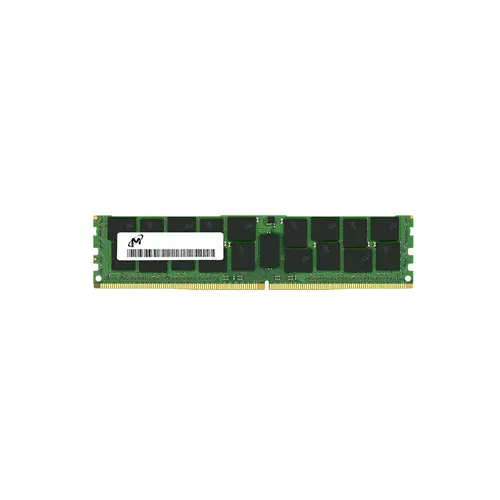
This Micron 8GB DDR4-2400 registered ECC RDIMM (PC4-19200, single-rank x8) is purpose-built for server platforms. Below are recommended configurations for three common data-center workloads.
General Virtualization
Density per host is driven by VM count and memory overcommit ratios. For moderate consolidation (e.g., 20–30 light VMs), populate six to eight such 8GB RDIMMs per populated memory channel to reach 48–64 GB, keeping a balanced configuration across all CPU memory controllers. Always install identical DIMMs in matched sets to maintain uniform ECC and NUMA performance.
In-Memory Database
In-memory workloads demand both capacity and low latency. Use the largest validated population your server board permits, typically 12 or 16 modules per socket for 96–128 GB total, leveraging all channels. Operating at the rated 2400MT/s and CL17 ensures deterministic access times, while registered ECC safeguards data integrity at scale.
High Performance Computing
HPC benefits from high memory bandwidth per core. Optimize by fully populating all available memory channels—for a dual-socket system running 8 channels each, install one 8GB RDIMM per channel (16 modules total, 128 GB). This channel-balanced layout maximizes sustained throughput for MPI and threaded simulations, with ECC protecting against silent data corruption during long runtimes.
Rigorously tested, compatible with servers like Dell PowerEdge R760, HPE ProLiant DL380 Gen10, Lenovo ThinkSystem SR650.
Q: Can I mix this MTA9ASF1G72PZ-2G3A1II with other memory modules of different brands or speeds?
A: Mixing this Kingston RDIMM with modules of different brands or speeds is not recommended, as it may cause signal integrity issues, degrade ECC functionality, and lead to server instability. Uniform population ensures validated reliability.
Q: Is this memory compatible with my Intel or AMD server platform?
A: This DDR4-2400 ECC registered DIMM is compatible with server boards using Intel Xeon E5-2600 v3/v4 or AMD EPYC 7001 series processors that support Registered DDR4 memory at 1.2V. Verify your motherboard's qualified vendor list.
Q: What is the recommended DIMM population order for optimal performance?
A: Install identical DIMMs in identical slots across memory channels, filling blue slots first per your server board manual. Typically, populate one DIMM per channel initially to balance interleaving and maximize throughput.
Q: Does this module support overclocking or XMP profiles?
A: No. This is a JEDEC-compliant server RDIMM running at standard DDR4-2400 speed with CL17. It does not support overclocking or XMP, as stability and data integrity are critical in enterprise environments.
Q: What warranty and typical failure rate can I expect?
A: This module includes a one-year limited warranty. As an enterprise-grade RDIMM, it delivers very low annualized failure rates under normal operating conditions, ensuring dependable 24/7 server operation.