











 Secure payments
Standard refund policy
Trade Assurance
Secure payments
Standard refund policy
Trade Assurance
| Product Type | Memory Module |
|---|---|
| Memory Capacity | 8 GB |
| Memory Technology | DDR4 |
| Product Voltage | 1.2 V |
| RAM Speed | 3200 MHz |
| RAM Standard | DDR4-3200/PC4-25600 |
| Error Identifying | ECC |
| Signal Type | Registered |
| Column Access Strobe (CAS) | CL22 |
| Rank | Single Rank x8 |
| Quantity of Pins | 288-pin |
| RAM Genre | RDIMM |
This DDR4-3200 registered ECC module, built with single-rank x8 organization and CL22 timings, delivers the signal stability and data integrity essential for small-to-midsize server platforms running virtualization, in-memory databases, or other latency-sensitive enterprise workloads. Its 1.2 V operating voltage and 8 GB capacity offer a power-efficient, reliable foundation for systems that demand consistent uptime and error correction under continuous load.
1. ECC error correction actively prevents single-bit data corruption, ensuring unwavering transaction accuracy for financial databases and virtualized enterprise applications that cannot tolerate silent errors.
2. Registered signal buffering amplifies command and address lines to sustain rock-solid stability across fully loaded memory channels in dense, multi-socket server nodes.
3. The DDR4-3200 speed grade supplies generous bandwidth per channel, empowering hypervisors to pack more virtual machines onto a single host without memory-induced latency spikes.
4. A CAS latency of 22 cycles provides deterministic access timing, which sharpens query responsiveness in in-memory databases and reduces jitter in latency-critical cloud services.
5. Single Rank x8 organization eliminates cross-rank contention, allowing the memory controller to lock at peak transfer rates in one-DIMM-per-channel configurations for predictable VM performance under heavy consolidation.
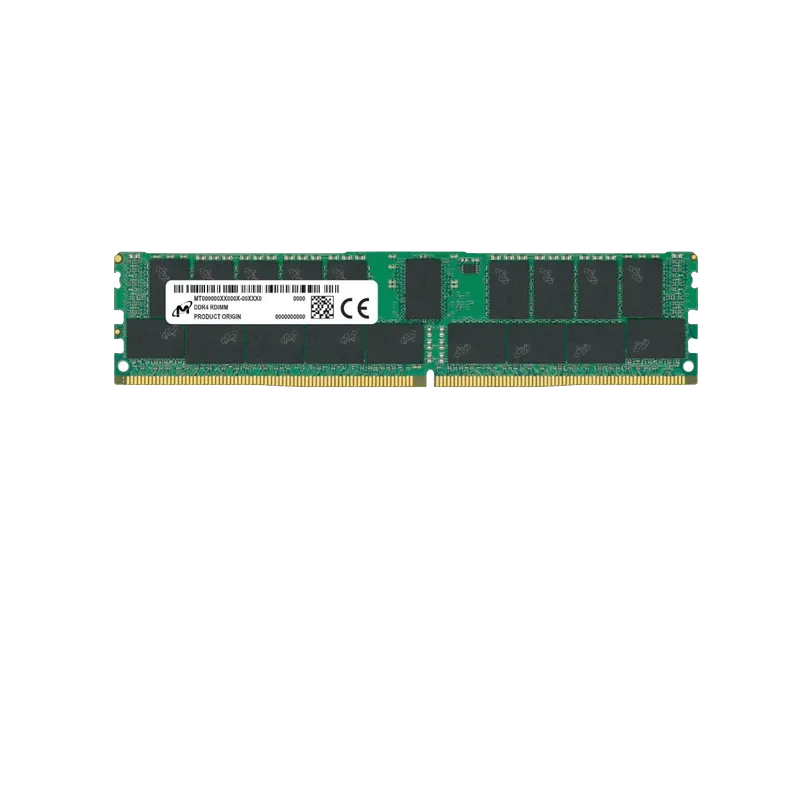
The Micron MTA9ASF1G72PZ-3G2 is an 8GB DDR4-3200 registered DIMM engineered for relentless server workloads. In a virtualized cluster running dozens of VMs, its hardware ECC is your silent guardian—it corrects single-bit flips caused by cosmic radiation before they corrupt hypervisor memory or silently alter a financial transaction inside your in-memory database. The registered buffer actively redrives command and address signals, which becomes critical when you populate all memory channels to maximize capacity; without it, signal integrity degrades and forces speed reductions. This means you can fill every slot and still run stable at 3200 MT/s, supporting more virtual machines per server. The single-rank x8 organization further reduces bus loading, helping sustain full speed under heavy access patterns, while the 1.2 V operating voltage cuts power draw and cooling overhead in dense racks. For a real-time Redis or SAP HANA instance, the combination of high bandwidth, verified data integrity, and scalable capacity translates directly into consistent low-latency queries and uncompromising uptime.
General Virtualization
Populate memory channels evenly with these 8GB registered ECC modules to balance capacity and bandwidth. An eight-module configuration provides 64GB of reliable DDR4-3200 memory, ideal for hosting a moderate number of virtual machines without bottlenecks. For denser consolidation, scale to 16 modules (128GB) while maintaining consistent ECC protection and full speed.
In-Memory Database
Maximize per-node capacity by filling every available DIMM slot; a dual-socket server with 24 of these 8GB RDIMMs reaches 192GB. The registered ECC design ensures data integrity critical for in-memory datasets, and the 1.2V operation helps control thermals in dense configurations. Plan to expand capacity horizontally with additional nodes as your database grows beyond single-server limits.
HPC
Optimize memory bandwidth by installing one single‑rank DIMM per channel—for example, eight modules for 64GB on an 8‑channel platform. This preserves the full 3200MT/s speed and low CL22 latency, minimizing bottlenecks for compute‑intensive simulations. Size the per‑node memory to your working set, and scale out across nodes when simulations outgrow a single system.
Validated server memory. Compatible with Dell PowerEdge R750, HPE DL380 Gen10+, Lenovo SR650 V2, and more.
Q: Can I mix this MTA9ASF1G72PZ-3G2 with other memory modules of different brands or speeds?
A: Mixing RDIMMs with different brands or speeds is not recommended. It may cause instability or prevent the system from booting. For guaranteed reliability, use identical modules from the same manufacturer and part number.
Q: Is this memory compatible with my system?
A: This is a DDR4-3200 registered ECC module designed for servers supporting Intel Xeon Scalable or AMD EPYC platforms. Verify that your server board explicitly supports 8GB 1Rx8 PC4-25600 RDIMMs at 1.2V.
Q: What is the recommended DIMM population order for optimal performance?
A: Refer to your server motherboard manual for the precise population sequence. Typically, populate identical RDIMMs in balanced channels per CPU, starting with the furthest slots from the processor, to maintain optimal memory interleaving and total throughput.
Q: Does this module support overclocking or XMP profiles?
A: No. This is a server-grade registered ECC module operating strictly at JEDEC standard DDR4-3200 with CL22 timings. It does not support XMP or overclocking, as data integrity and stability are paramount in server environments.
Q: What warranty and typical failure rate can I expect?
A: This Micron module includes a 1-year warranty. Enterprise-class RDIMMs like this have an extremely low annualized failure rate, typically under 0.5%, ensuring high reliability in 24/7 server operations.